

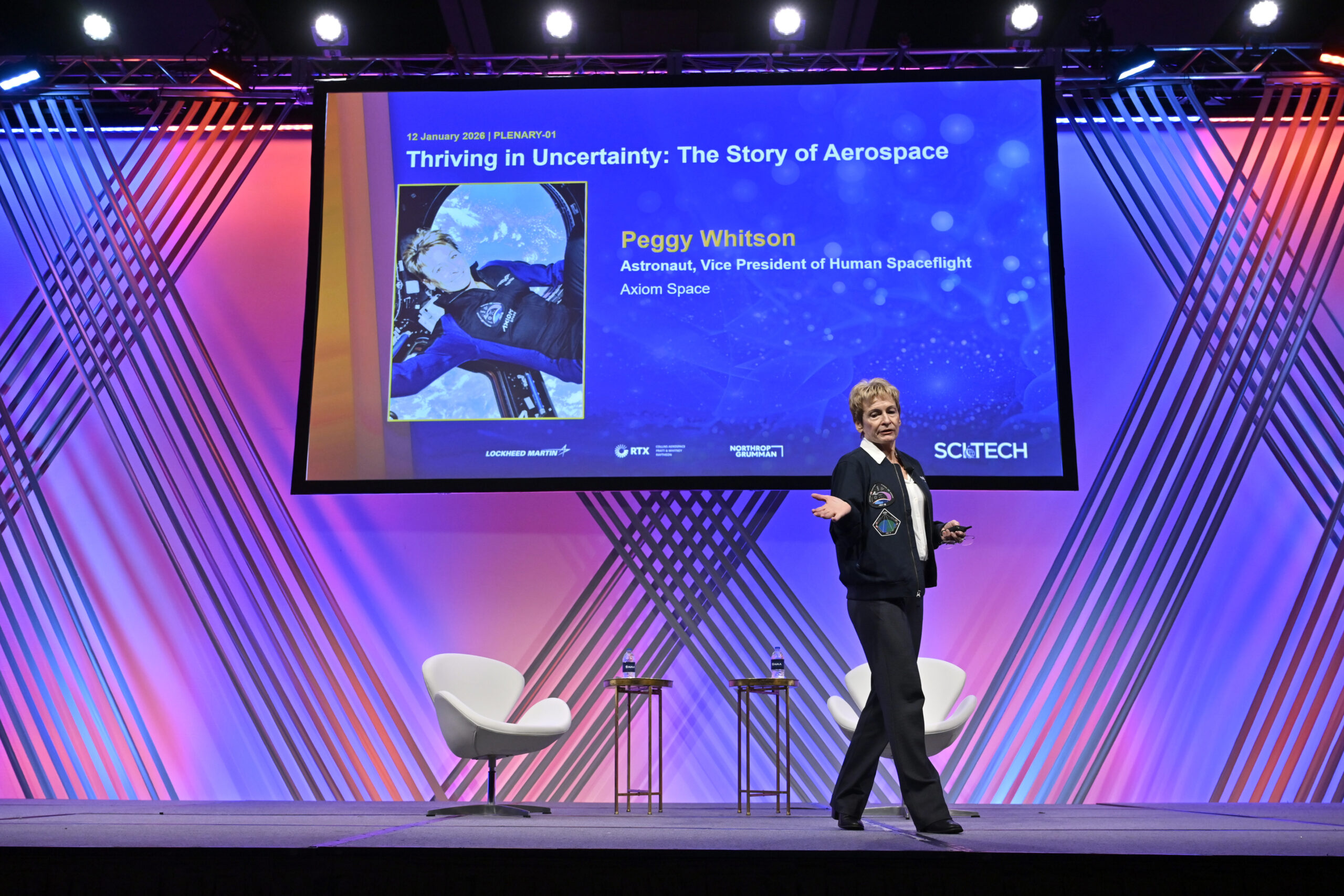
ORLANDO — Astronaut and Axiom Space’s Director of Human Spaceflight Peggy Whitson opened AIAA SciTech Forum 2026 in Orlando with an inspirational message about the future of space as the International Space Station (ISS), in orbit for 25 years, transitions to commercially run stations by 2030.
“I’m excited by all the people interested in aerospace because we’re going to need a lot of people in a very short time period to come up to speed to get the job done,” Whitson said.
Whitson, America’s most experienced astronaut with 695 days in space, acknowledged the important legacy of the ISS, noting that “while things aren’t always great on Earth, we managed to work through… and keep that partnership together for 25 years.”
“Our vision now with Axiom Space, we want to transcend Earth and build a new space station, taking advantage of the lessons we’ve learned on the ISS and transfer some of those lessons to Axiom Space and make it better in lots of different ways.”
With the next phase of low Earth orbit (LEO) development under commercial leadership, Whitson anticipates rapid industrialization of space, where humanity will bring space breakthroughs back to Earth.
Whitson admitted part of what drew her to Axiom Space was the idea of transitioning all the research conducted over the last 25 years on the ISS “to something on Earth that we’ll get the benefit of.”
Axiom Space’s Outlook
Axiom Space is leading the new commercial push, completing four missions and conducting a total of 160 investigations. “It’s miraculous that we did four missions in four years, and we learned a lot in a short time frame because we had to,” shared Whitson, noting that Axiom Space had to develop their own procedures and processes for making a mission fly – “everything from developing our own mission control to developing the timelines for flying these missions in space.”
She commanded two of the missions – Ax-2, which featured the first two government-sponsored astronauts, including the first woman astronaut from Saudi Arabia, and Ax-4, which returned to Earth this summer with a crew that included astronauts from India, Poland, and Hungary. They were the first astronauts from their respective countries to go to the ISS. “It was great to bring three guys together from three different countries and make a cohesive team,” she said.
A key highlight for Whitson, a self-described “science geek,” was the biomedical experiments. One investigation on Ax-4 tested a new cancer-fighting drug using tissue from actual breast cancer patients.
The final two missions, Ax-5 and Ax-6, will be announced in the next few weeks.
Whitson gave a sneak peek of the Axiom Space station roadmap. The first modules, the Payload Power Thermal module, will attach to the ISS and be used in part to transfer decades of flight hardware and science and technology – a critical solution that ensures the continuity of research conducted international partners to be able to continue.
The HAB-1 will serve as the first crew quarters. Both modules will attach to each other in 2028. HAB-2, once deployed, will support an eight-person permanent crew presence. The final module focused on research and manufacturing, will include an Earth observation facility, which Whitson described as the current ISS cupula “on steroids.” The cupola will fit an astronaut’s entire body inside with room to float, giving the sensation of doing a spacewalk.
The company also is working with new industry partners on the Axiom Space spacesuit, which is designed to function in the extreme cold of moon craters. The new suit’s backpack weighs less and has more redundancies. According to Whitson, Prada is bringing knowledge of textiles to new suit designs, while Nokia is providing the 4G LTE communications for the suit. Oakley is collaborating on the visors and Gu is creating a new hands-free nutrition delivery system inside the suits.
As Axiom Space prepares for the next phase – their own commercial space station – Whitson emphasized the significance of a continuous U.S. presence in orbit, with Axiom Space positioned to help the U.S. continue that presence.
Advice to Next-Gen Innovators
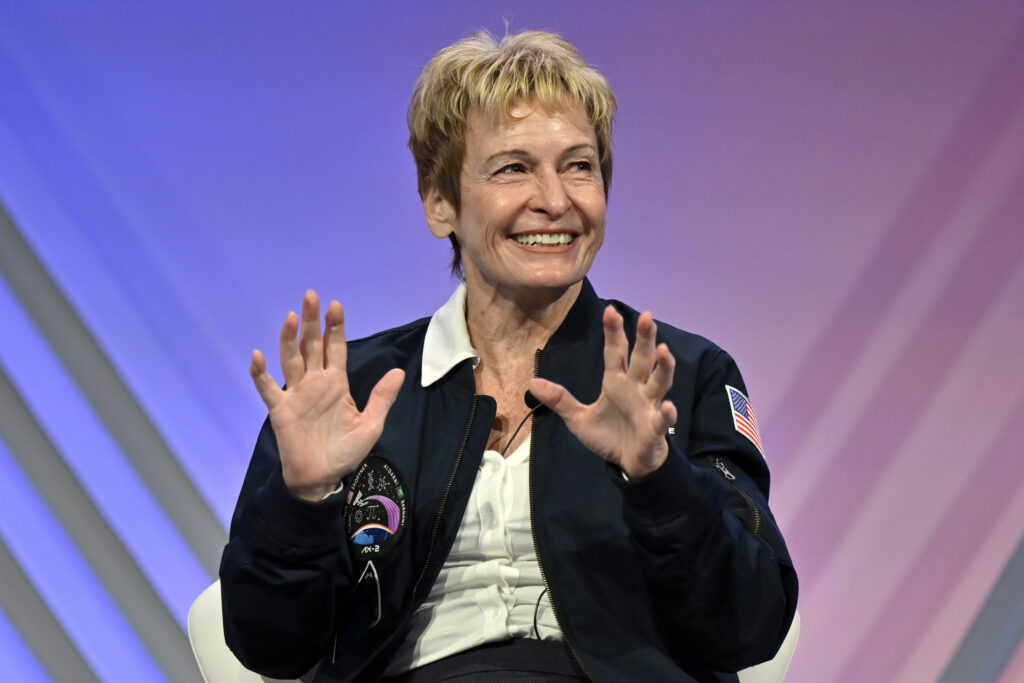
Her most compelling message was directed to the students in the audience: to not give up. Whitson, who was nine years old when the Apollo astronauts landed on the moon, dreamed of going to space but didn’t know how. Whitson was a senior in high school when NASA selected the first female astronauts, a milestone that prompted her dream “to become a goal.” After finishing her Ph.D., she joined NASA, but it took 10 years before she was selected for the astronaut corps.
“You are the only one who knows what you want and what drives you, so you have to listen to your heart,” she said.
“I was rejected multiple times and now I have more time in space than any U.S. astronaut,” she noted, emphasizing, “I can look back and say those 10 years were the most valuable because during those 10 years I was doing collaborations with the small science program, I was working in small teams… All that experience led me to be selected as the first female commander of the U.S. military and the first female and first non-military chief of the Astronaut Office at NASA.”
She concluded, “You have to take advantage of where you are and what you’re learning. Don’t be afraid of failure. Push yourself beyond what you think you’re capable of. You are capable of so much more than you give yourself credit for, so push yourself to learn new things and really expand your limits.”
Inspiring the Audience
Whitson’s message resonated with AIAA SciTech’s younger audience. “It was reassuring to hear that people who are very successful have overcome struggles,” said Braden Buckler, an aerospace engineering student in his fifth year of a five-year program at the University of Cincinnati, referring to Whitson’s decade-long struggle to be selected into the astronaut program.
Buckler also could relate to Whitson’s roots growing up on an Iowa farm. “Being from a small town in northwestern Ohio surrounded by farmland, I could relate,” he said.
“I found her message to students to be resilient and work through failure very inspirational,” agreed Charles Norton, deputy chief technologist for NASA Jet Propulsion Laboratory. “We’re in a time now where there are challenges within the aerospace industry and I think she had a very positive message on how to be relevant and still advance your interests and goals by continuing to push forward until your opportunity comes.”