

Mobility Is the Mission, Reliability Is the North Star, Verissimo Says
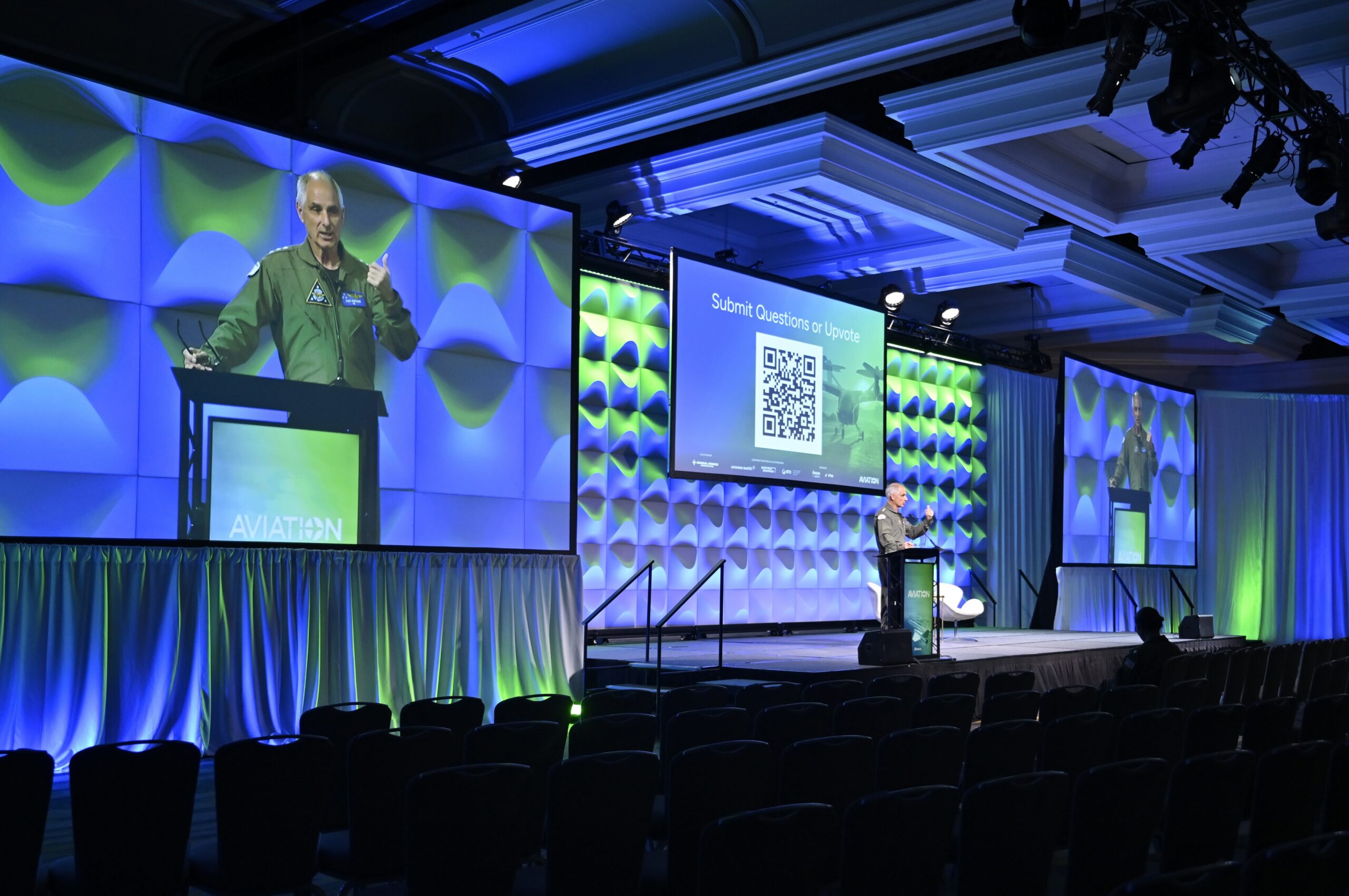
SAN DIEGO — When U.S. Navy Vice Admiral Doug (V8) Verissimo stepped onto the AIAA AVIATION Forum’s plenary stage on 10 June, he wore his operational flight suit rather than a more formal Navy uniform.
“This uniform is where our warfighters exercise the equipment, the technology, the advancements,” he told the room of aerospace engineers, research scientists, and executives from industry, academia and the services. “It’s the part of the job that keeps me up at night, that these systems and capabilities function as advertised,” he said, immediately centering everyone’s focus on the naval aviators, Marines, and sailors currently in theater.
In an age of long‑range missiles and contested logistics, the Navy’s strength is in mobile sea‑based forces that can move mass and effects where they’re needed, when they’re needed.
“Our differentiated value to our nation in the maritime domain is our mobility,” he declared.
In the shadow of ongoing attacks on shipping and uncrewed systems in the Red Sea and surrounding waters, Verissimo’s central message was that naval airpower is still indispensable – and it must be more reliable, more maintainable, and safer if it is to deter and prevail in today’s conflicts.
“My main North Star in my two and a half to three years of this job is going to [be] to have an enduring capability to keep six aircraft carriers, six carrier air wings, and 80% of our force of our expeditionary force combat surge ready,” he said.
Readiness, in his view, starts with platforms that break less often and are designed from the outset for safe, maintainable operations – not just exquisite performance. “Our design teams are very strong. Designing so that we have fewer maintenance and fewer operator mishaps is where I’m asking the designers and the engineers to think through for that capable force,” he explained.
He called on industry to help build the next generation of aircraft and systems with reliability as a primary design metric – and to engineer out the maintenance and operator errors that erode readiness.
Getting there will mean getting repair closer to the tactical edge, Verissimo emphasized, with sailors fixing more on their own, sooner and closer to the fight.
Verissimo cast AI not as a replacement for humans, but as a force multiplier of tactical problem‑solving at the edge, calling it an “amazing knee in the curve that we are taking advantage of every day in naval air forces.” He explained that there are teams who are teaching U.S. Navy personnel how to use the latest tools to solve complex problems and emphasized that humans must still validate and verify that the system’s outcomes are what commanders intend.
He pushed back on narratives about the “demise” of carrier aviation, pointing to recent operations in the Arabian Gulf and adjacent theaters as proof that air-breathing assets and sea-based aviation remain among the first tools presidents reach for to project power, protect commerce, and manage escalation.
Looking ahead, Verissimo explicitly called for tighter collaboration across operators, engineers, and industry:
- He cited historical innovations like wing-fold systems and swing-wing fighters as examples of operator–engineer co-creation that changed the art of the possible.
- He urged today’s S&T community to study past, “pre-computer” solutions and make sure AI models aren’t blind to those lessons.
- He emphasized that breakthroughs in corrosion control, non-destructive inspection, training simulators, and AI-enabled logistics are only valuable if they translate into fewer mishaps and higher readiness for sailors actually flying and fixing aircraft in today’s conflict zones.
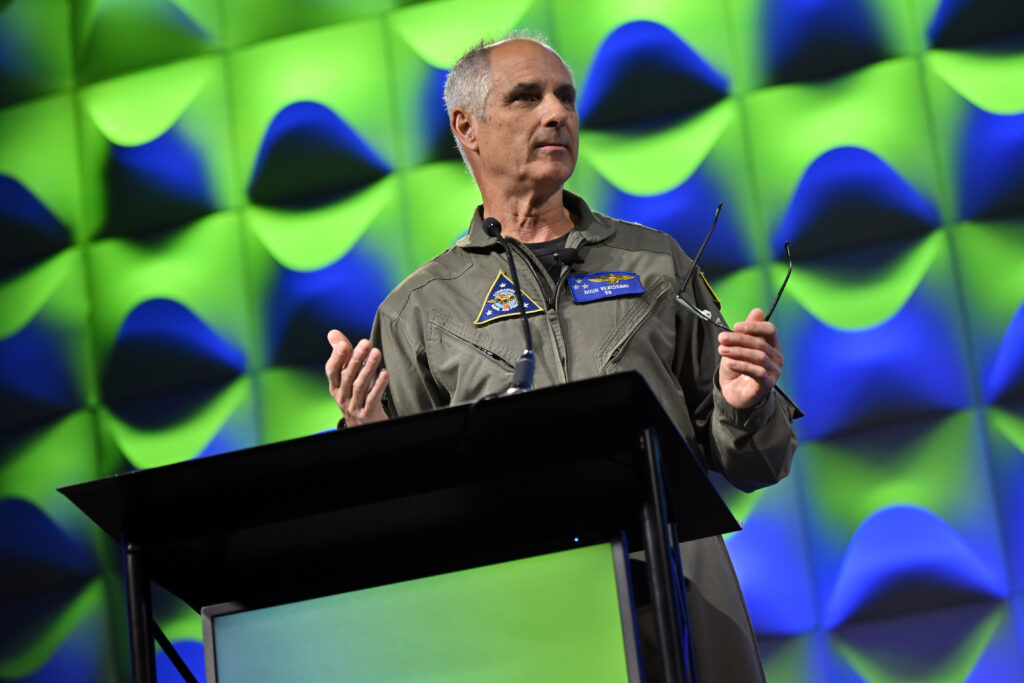
During the Q&A, the vice admiral fielded several questions. When asked to name his favorite airplane, the former member of the Navy’s celebrated Blue Angels flight demonstration squadron said, “When I received my wings of gold and my commission, there was one airplane I wanted to fly, and I’ve flown it for about 4,300 hours — it’s the F‑18. It is my race car; it is my Ferrari.”
When asked what’s most important in training the next generation and how their pipeline was different than his, Verissimo recalled how he attended three separate training aircraft and ground schools, while today there are fewer aircraft but training takes longer.
His mandate is to take young officers and provide them with the skills they need before they ever touch live-combat scenarios. As the Air Boss, he oversees the Chief of Naval Air Training, who “build[s] brand new aviators from street to fleet,” and he stressed that modern training now blends live flying with engineering accurate virtual and constructive environments.
Concluding his remarks, Verissimo looked back on his naval career that began at age 22. “I spent my entire adult life in love with a profession that has grown and expanded beyond my imagination,” he said. “I was an Apollo kid. I was a Top Gun teen…and there are eight-year-olds right now falling in love with Artemis and falling in love with Top Gun Maverick.”
He called for more collaboration with the S&T community, noting, “We need to do better at coming together in rooms…to solve those real-world problems, and find those specific use cases that keep us ahead of the pack.”
Several audience members responded positively to his message. Clay Mowry, CEO of AIAA cited the vice admiral’s emphasis on reliability and warfighter readiness and the need to drive down the cost of maintenance and repair while still being able to project force. “For a community that designs and builds military aircraft, he delivered a very clear message: build in reliability, maintainability, and AI capabilities, keep safety front and center, and empower people at the edge to do more of their own work.”
Rob Haywood, a business development manager with W. L. Gore & Associates, a materials science and advanced manufacturer, was impressed by the vice admiral’s candid discussion of the challenges sailors face while repairing equipment at sea and how industry could better support forward-deployed operators. “I thought it was an intriguing challenge to the industry to step up, maybe give up some of the legacy control, and really empower the soldier,” he said.