

Isaacman Expects More Rocket Launches, More Commercial Collaboration, and No Distractions from America’s Moon Mission
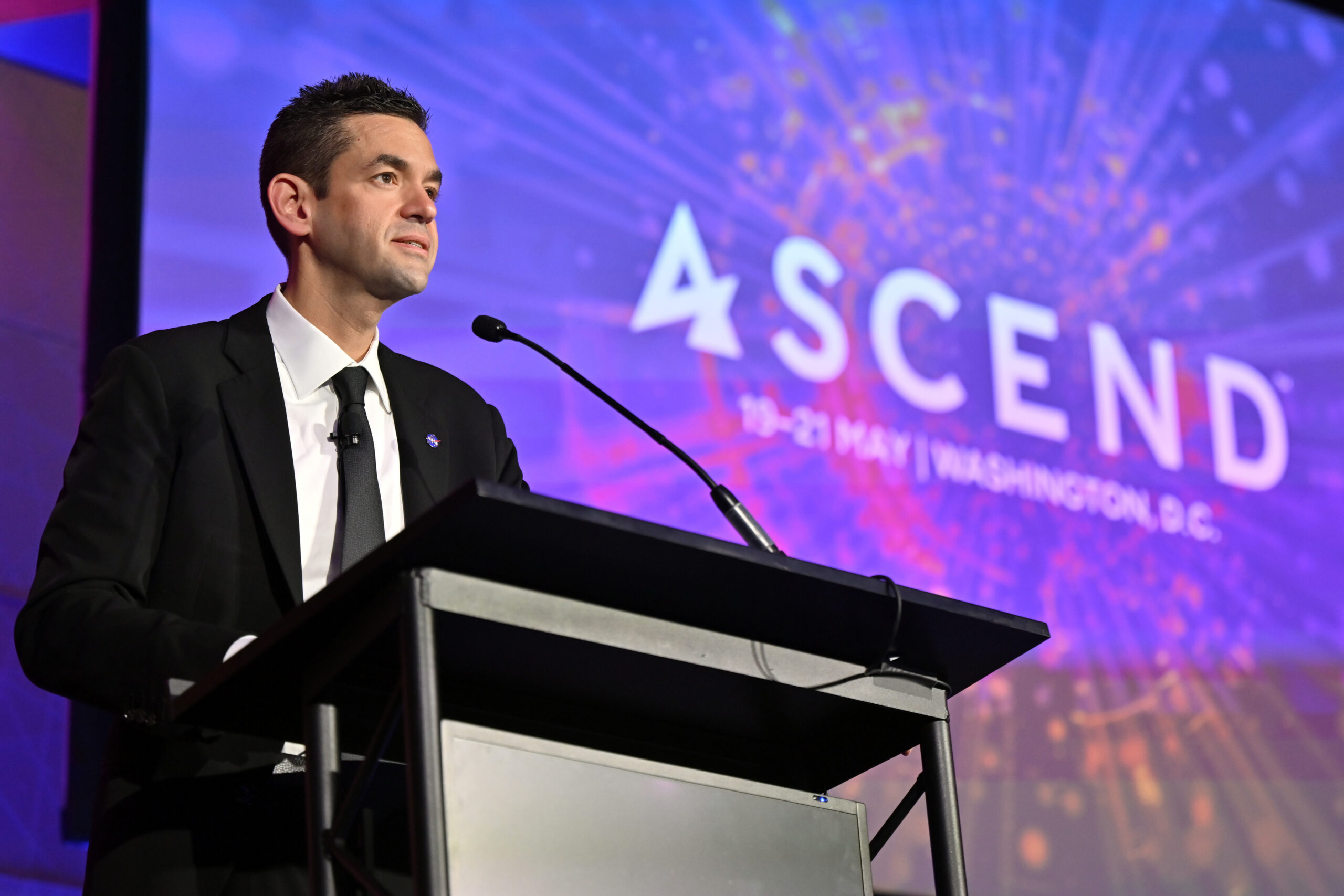
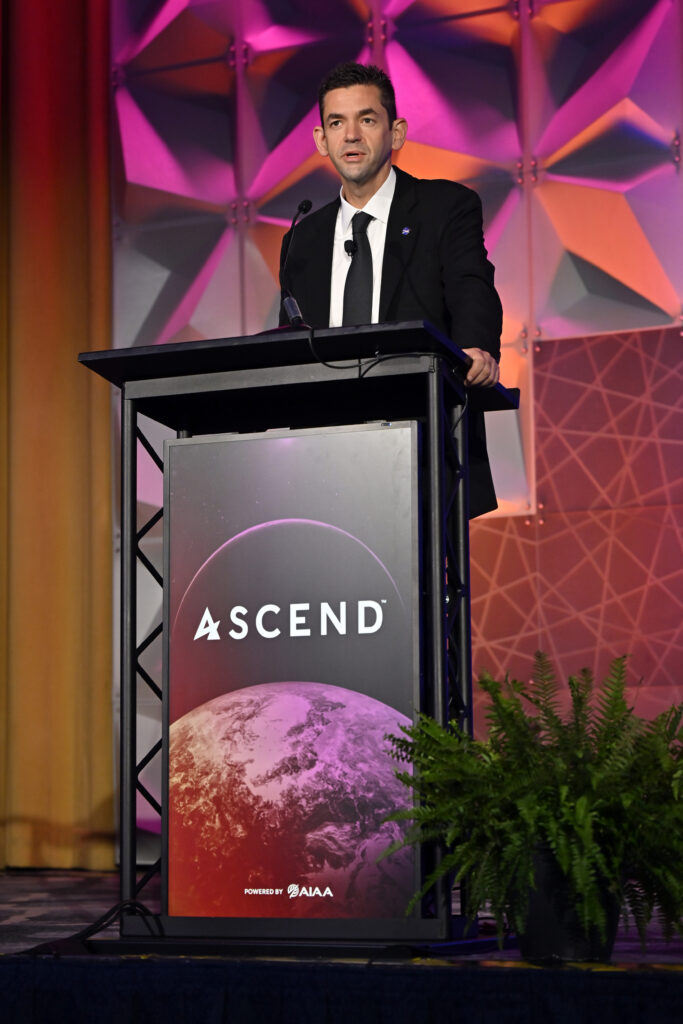
Jared Isaacman took the stage at ASCEND 2026’s opening plenary with a singular message: NASA is a fundamentally different agency – one that will act with urgency to return to the moon, build a permanent base there, and realize the economic potential of operating on the lunar surface.
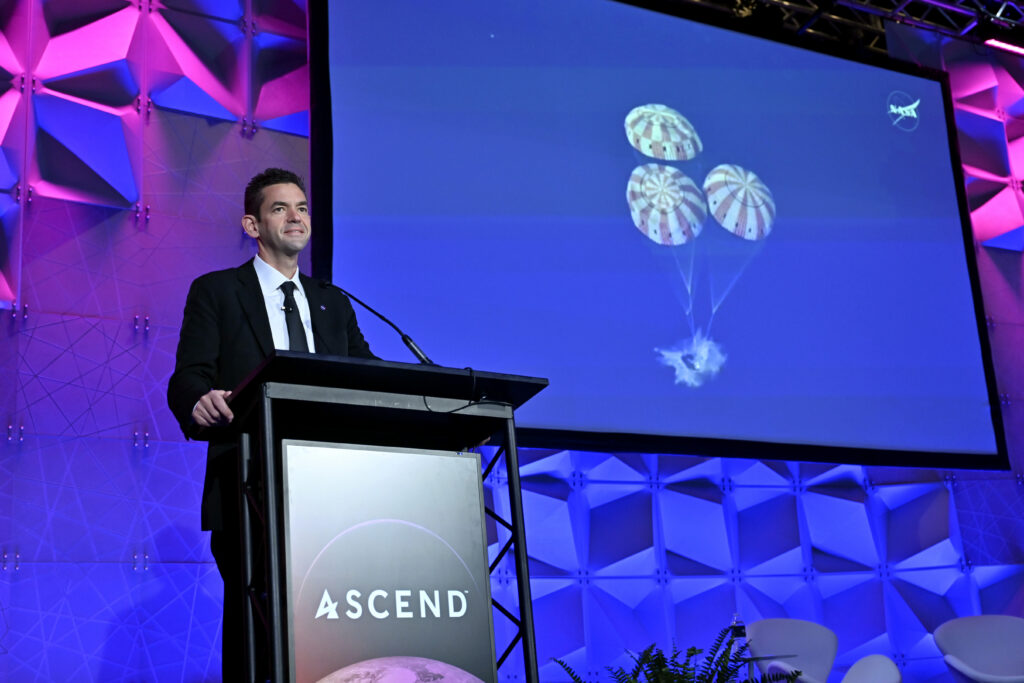
“We’re off to a good start,” he noted, referencing last month’s Artemis II mission, which captured the world’s attention when the crew journeyed farther from Earth than any humans in history, rounding the moon and returning safely.
Isaacman framed this moment as a new space race against a highly capable adversary – one where success and failure will be measured in months, not years.
“Together we have the opportunity to lead in the greatest adventure in the history of human civilization, and the best part is the journey has only just begun,” he said.
Isaacman last spoke at ASCEND in 2021, after piloting the Inspiration4 mission – the first all-civilian crew in space. Now back on stage as NASA Administrator, the 42-year-old made clear he intends to rebuild the agency from the ground up.
He called on industry to reconnect to the momentum of America’s Apollo era, when NASA embraced iterative design – progressing through Mercury, Gemini, and Apollo – rather than, as he put it, “going straight to ‘Apollo 11.'”
He pulled no punches in his assessment of NASA’s loss of focus in the intervening decades. Absent global competition, the agency grew distracted trying to please everyone, and programs “became too big to fail” and “too costly to really succeed.”
NASA, he emphasized, no longer has the luxury of launching the world’s most complex rocket system every three years. “Nor will we accept hardware that is obsolete by the time it’s delivered, or dozens of nuclear power and propulsion programs that have never flown.”
He observed that waiting years between the Artemis I, II, and III missions “wouldn’t have been a recipe for success in the 1960s; it won’t be today.”
He credited President Trump’s national space policy for allowing “us to start focusing our resources on the true needle-moving objectives” – namely, returning to the moon and building an enduring base.
To get there, Isaacman said NASA needs many landers, rovers, and fast learning cycles. That will require major investments in nuclear power and propulsion, and shedding side projects that don’t align with national policy. He called for adding a new Artemis III mission in 2027 as a deliberate Apollo-9-style systems test, where teams learn as they go.
Starting in early 2027, NASA expects nearly monthly lunar landings, plans to accept failures as part of the learning process, and intends to become a more active partner to industry.
“NASA is not just a procurement organization; we are going to embed subject-matter expertise across the supply chain to drive outcomes. We can’t take a passive role in this.” That hands-on philosophy, he said, was at the heart of his Ignition event – putting plans into action.
One area he intends to address is the agency’s overreliance on outsourced talent, which has led to the “atrophy” of core competencies that should remain in-house. Isaacman has reimagined NASA’s workforce – currently around 14,500 agency staff and more than 40,000 contractors – so that many functions now handled externally will return inside the agency. Contractors and consultants will be reserved for highly specialized tasks, not routine aerospace engineering.
The agency is also expanding rotational assignments, offering one- and two-year terms in industry with the option to transition full time. Civil servants, in turn, will have opportunities to work in the private sector. “That’s how we really bring in … that knowledge from around industry, recognizing that we’re not the only game in town,” Isaacman said.
Attracting the next generation is another priority. NASA has launched a new internship program, and the success of Artemis II has already sparked renewed interest – NASA space camp enrollments have doubled compared with 2025.
Isaacman also pointed to several other signs of momentum. The Nancy Grace Roman Space Telescope came in ahead of schedule and under budget, with a launch window as soon as this summer. “And what an exploration asset – 1,000 times the scan rate of Hubble.”
He also highlighted NASA’s Dragonfly mission, which will send a nuclear-powered octocopter to Saturn’s moon Titan, with launch scheduled for July 2028. “You’re actually going to have three nuclear payloads launching in late 2028,” he added.
On the international front, more than half of the Artemis Accord partners attended the Ignition event and asked how they could help – a sign, Isaacman suggested, that America is not building this future alone.
With partners engaged and momentum building, Isaacman closed by reiterating what’s at stake: American leadership in space against a capable rival.
“The status quo is not going to work…Don’t delay even a day a problem that we can solve. This is a very different NASA. We’re happy to shred policies and processes that … impede progress. Communicate with us on how we can be a better partner. Don’t delay. There’s no time to waste.”
Watch the video: Views on Unlocking the Space Economy from NASA Administrator at ASCEND 2026
Isaacman’s message about speed and execution resonated strongly with Corey Smith, nuclear engineering lead for Analytical Mechanics Associates, an engineering services company that works with NASA. “Everything’s been a decade away for a long time at this point, so the fact that we’re getting a little push in the right direction is very positive,” said Smith. “Our biggest issue is that technology takes too long to develop and it goes through multiple administrations and then it gets canceled because it starts costing too much money. The fact that we’re trying to get it done properly and to get something off the ground, turn it on and make sure it works properly is exciting.”
Nora Bailey, an astronomer with Neutralino Space Ventures, a satellite solutions engineering firm, was more circumspect, noting, “It’s a bit rich to say that America is investing in science when we’re pretty actively divesting in science.”
Contrasting Isaacman’s comments about U.S. space leadership with the Trump administration’s policies of “not letting people in the country, Bailey noted, “We’re expecting a brain drain at the moment.”
• Related viewing: Clay Mowry Opens ASCEND 2026