

AIAA honors ISRO for Chandrayaan-3 breakthrough as India charts course to Crewed Moon Landing
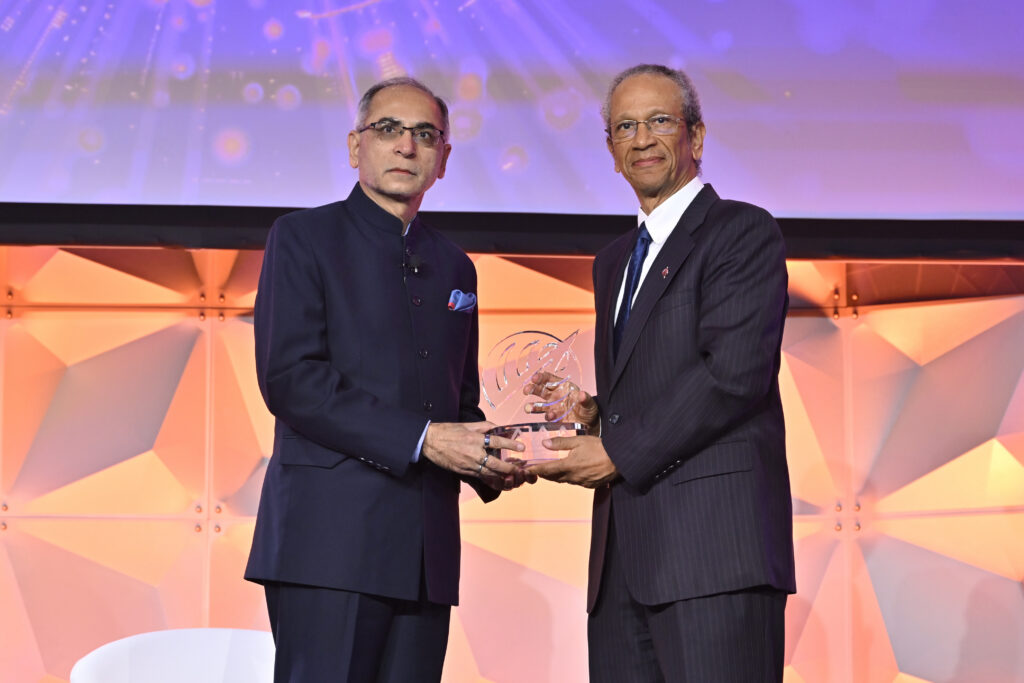
WASHINGTON, D.C. – On the final day of ASCEND, AIAA saluted India’s space agency, the Indian Space Research Organisation (ISRO), with its highest honor, the Goddard Astronautics Award, for the agency’s groundbreaking lunar mission, Chandrayaan-3, and its achievements developing world-class satellites, launch vehicle technologies and space exploration.
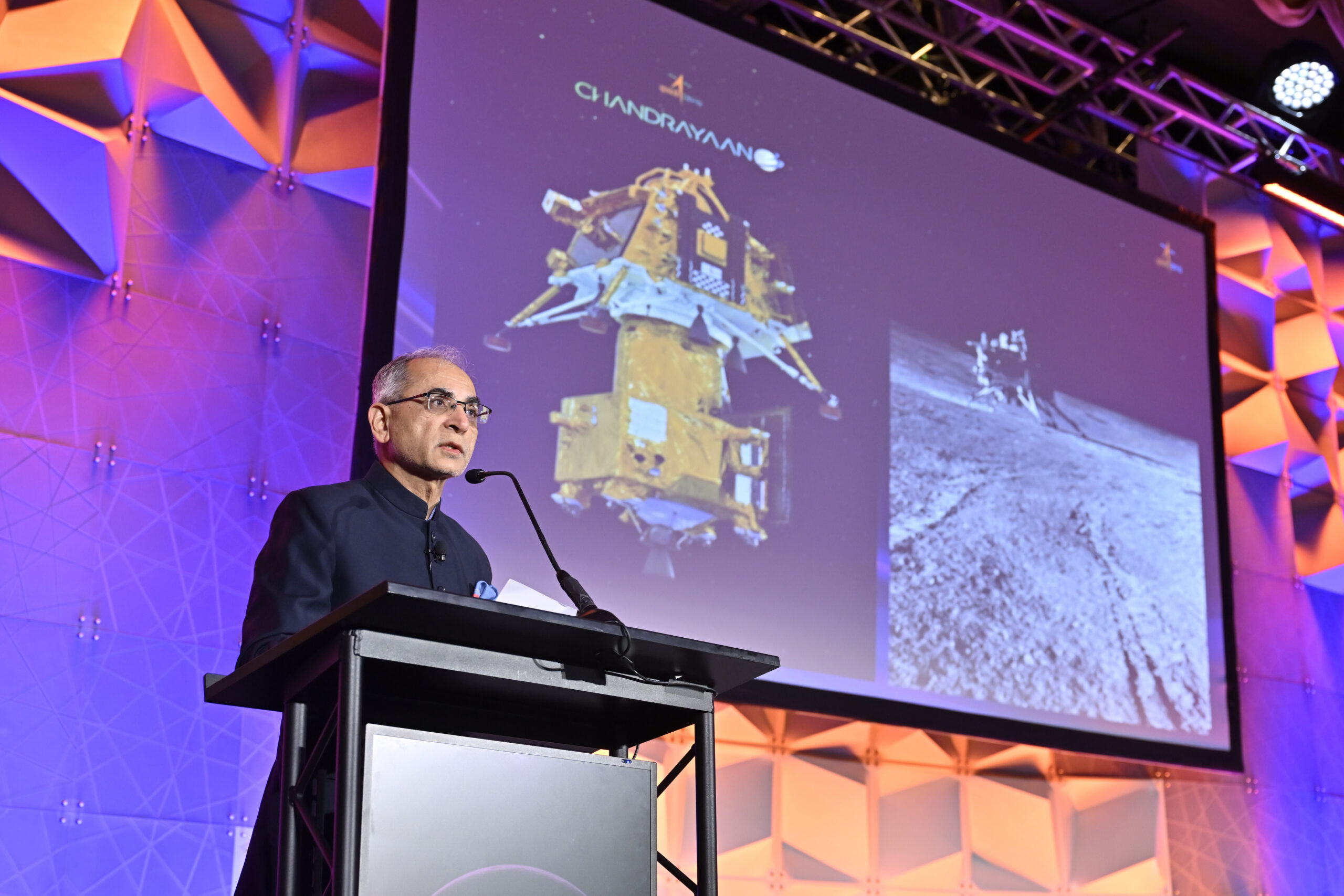
Chandrayaan-3 made history in August 2023 by becoming the first spacecraft ever to successfully soft-land near the unexplored lunar south pole. With that feat, India became the fourth country in the world to land on the moon.
“On behalf of the Indian Space Research Organisation, I extend my heartfelt gratitude to the American Institute of Aeronautics and Astronautics and the jury for this award,” said His Excellency Vinay Kwatra, India’s Ambassador to the United States, after accepting the award.
Addressing the ASCEND audience, the Ambassador highlighted Indian Prime Minister Narendra Modi’s remark that “it mirrors the aspirations and capabilities of the 1.4 billion Indians” as they pursue future horizons.
“For us in India, space is about exploration and discovery, but it’s also about using space to empower people and contribute to the economic growth. The fact that the mission planning, execution, and precision landing could be achieved in under a US $100 million budget speaks to the abilities, drive, and purpose of the Indian scientific community.”
The space domain, he noted, continues to be one of India’s key anchor priorities, reflected in the Prime Minister’s “Space Vision 2047.” It’s also a cornerstone of U.S.-India partnership.
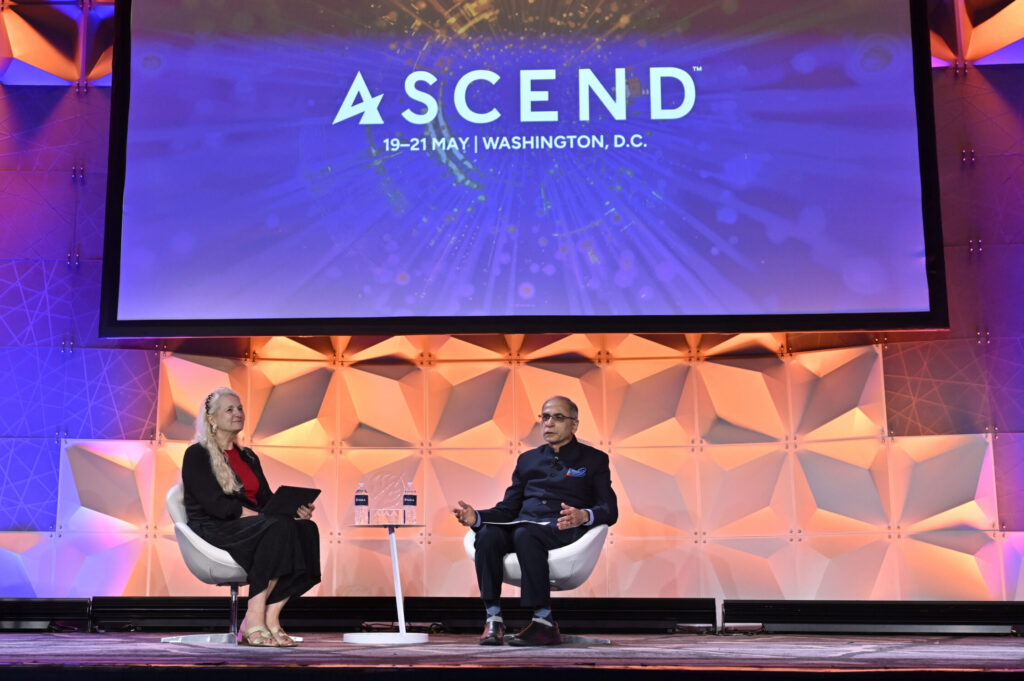
During a fireside chat with the Committee on Space Research’s (COSPAR) Prof. Pascale Ehrenfreund, Ambassador Kwatra said India’s space vision calls for targeting the first human spaceflight in the next year, deploying the first module of the Bharatiya Antariksh Station (BAS) around 2028, achieving full space station capability by 2035. India plans to carry out a crewed landing on the moon by 2040.
A key underlying goal, he added, was supply chain self-reliance, with ISRO leading technology development with support from “a rapidly growing private sector, comprised of roughly 400 startups.” The goal for India is to have a robust, domestically anchored space economy.
During their conversation, the Ambassador touched on other key milestones, including last December’s launch of BlueBird-6, the heaviest satellite on record to deploy from Indian soil. He also celebrated the launch of NASA-ISRO Synthetic Aperture Radar (NISAR) mission last July. NISAR was the subject of this year’s Pickering Lecture at ASCEND, featuring early findings of this Earth-observation mission, which is the result of more than a decade of collaboration between NASA and ISRO. The Pickering Lecture is named for former NASA Jet Propulsion Laboratory Director William H. Pickering, honoring his initiation and leadership of America’s robotic scientific space program, from Explorer I in 1958 through the development of the Viking Mars orbiters and the Voyager outer planet and interstellar missions.
Related viewing: Pickering Lecture given by Paul Rosen, NASA Jet Propulsion Laboratory
In addition, ISRO is building on the success of Chandrayaan-3 with two follow-on missions. Chandrayaan‑4, targeted for launch around 2027, will attempt a south polar landing, collect lunar samples, and demonstrate more complex capabilities such as orbital docking, high‑capacity landing, and re‑entry – all key technologies on the path to putting Indian astronauts on the moon by 2040. The Chandrayaan‑5 mission, pursued in partnership with JAXA, ESA, and NASA, will focus on exploring water ice at the lunar poles, marking another crucial step as India transitions from robotic lunar exploration to crewed missions in the coming decades.
The conversation concluded on a powerful note with the Ambassador emphasizing the importance of space sustainability, noting that ISRO and India are committed to achieve “zero-debris missions by 2030.” That commitment was put into action when ISRO returned the Chandrayaan-3 propulsion module to Earth orbit after its primary mission was complete, instead of leaving it in lunar orbit adding to the debris.
India also has established Project NETRA (the NEtwork for space object TRacking and Analysis) to actively track space objects and debris and monitor collision risks.
“Sustainability is…a living philosophy, which gets embedded into each of our programs… Sustainability for us is really not an afterthought. It is perhaps one among the starting points when we engineer or design a mission,” he concluded.
Following the talk, Chetan Angadi, a senior manager at Leidos in Houston, was impressed by the degree of excitement for space evident in India: “It’s amazing to see how things are changing. ISRO flew synthetic aperture radar on a NASA satellite, and from a geopolitical standpoint a lot had to come together to make that happen. It really shows how globalization is driving the growth of the space industry in the U.S. and India – and how both nations, working in parallel on future moon missions and a U.S. moon base, can ultimately achieve permanent residency on the moon.”