

At AIAA Regional Student Conferences students present their research in a formal technical meeting atmosphere, as well as exchanging ideas and discussing programs with students from other schools in the region. 2026 marks the first time that every student conference featured a dedicated track for high school students to present their work. Between the six 2026 Regional Student Conferences held in the United States, a total of 42 papers were presented by high school students.
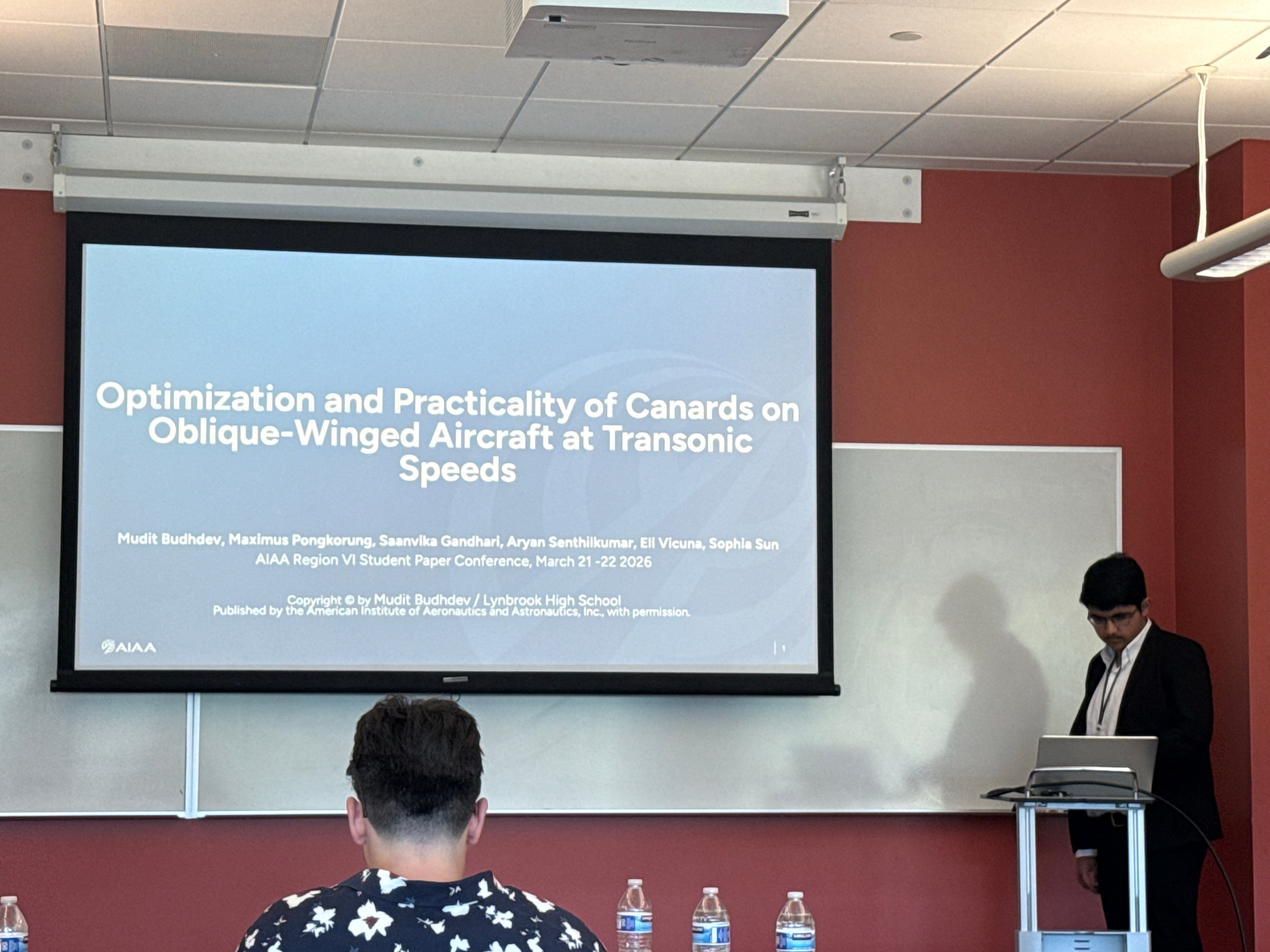
Mudit Budhdev, a high school junior from California, presented work on behalf of his team at the Region VI Student Conference at Cal Poly – San Luis Obispo in March. Mudit’s interest in aviation kicked off when he was in the 8th grade. “I used to be really into playing flight simulator games online. I think I logged about 2,000 hours in one of those games.”
Interested in building his own video game, Mudit explored “learning how to do the 3D modeling and coding,” and realized he “learned so much about aircraft from that.” This research led him to his current passion for aircraft and aerodynamics, and he started reading everything he could about the subject.
One pivotal book for Mudit was Skunk Works: A Personal Memoir of My Years of Lockheed by Ben Rich. “It’s a really good book. Exhilarating.” Mudit recalled, “After that I read a lot of aerodynamics textbooks and then I self-taught myself a bunch of computational fluid dynamics (CFD) because I just find it super cool. And then, I heard about AIAA and joined as a high school member, and now here we are.”
Mudit’s research group is a mix of high school seniors, juniors, and some sophomores. They met through the AIAA High School Subcommittee: the group of highly active High School Student Members who collaborate on a variety of hands-on activities and initiatives. At first, Mudit’s group would meet every Sunday, connecting on the AIAA high school Discord server. As the conference got closer, they started meeting more frequently to reach their goals – a challenge as many of them live in different time zones across the globe.
Mudit described their topic, “A couple years ago, NASA wanted to see how to optimize aircraft for supersonic flight. They came up with the idea of, instead of making the wing perpendicular to the fuselage, instead they angled it. That’s known as an oblique wing aircraft.” This design was made a reality with the creation of the NASA AD-1.
Mudit read all the papers about the aircraft he could find. This research led him to the understanding that the design had an inherent instability; the aircraft consistently wants to roll.
The high school team’s paper, “Optimization and Practicality of Canards on Oblique-Winged Aircraft at Transonic Speeds,” describes a possible solution, a forward-mounted small wing that generates additional lift, called a canard. “What we were looking at,” said Mudit, “Was the impact of placing a canard at the deflection angle, and we measured the oblique wing angle and then measured how, hypothetically, a canard could fix the inherent aerodynamic instability within the oblique wing aircraft. What’s great about the oblique wing is they actually get rid of the sonic boom that you hear in supersonic fight. And it’s much more fuel efficient. Because these oblique wing designs are so fuel efficient, it could hypothetically help solve many challenges we now face with supersonic flight.”
This isn’t Mudit’s first CFD project. He has worked on RC planes and participated on his school’s rocketry team, both of which involved CFD, but he noted this is by far the biggest such project he has undertaken.
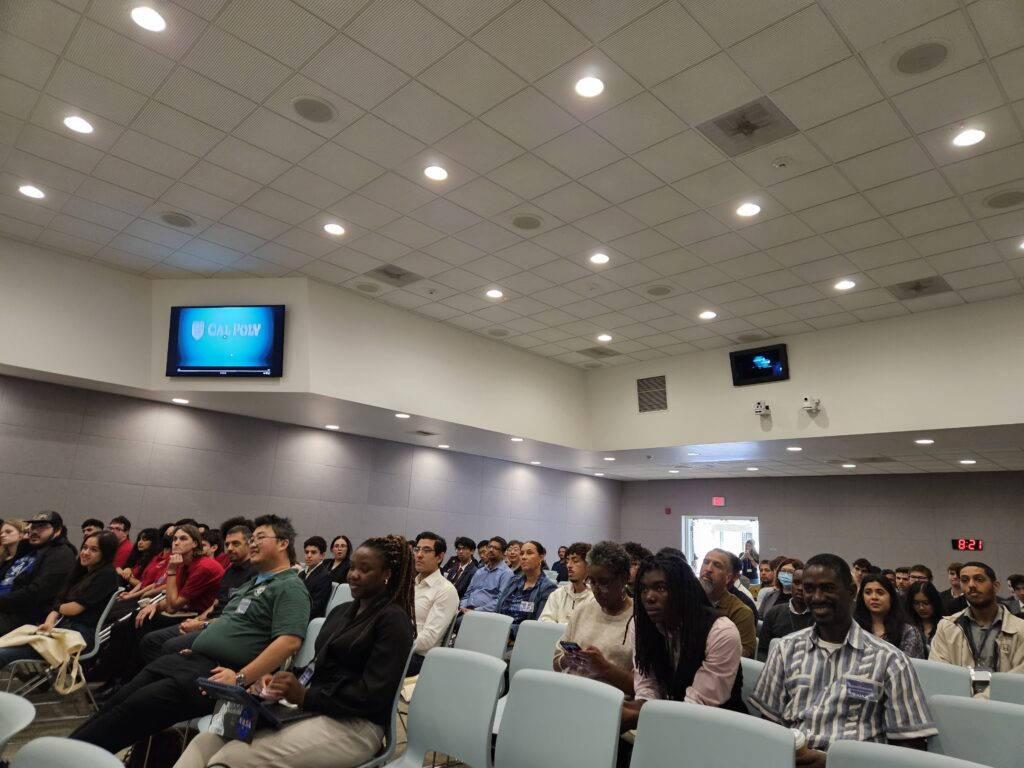
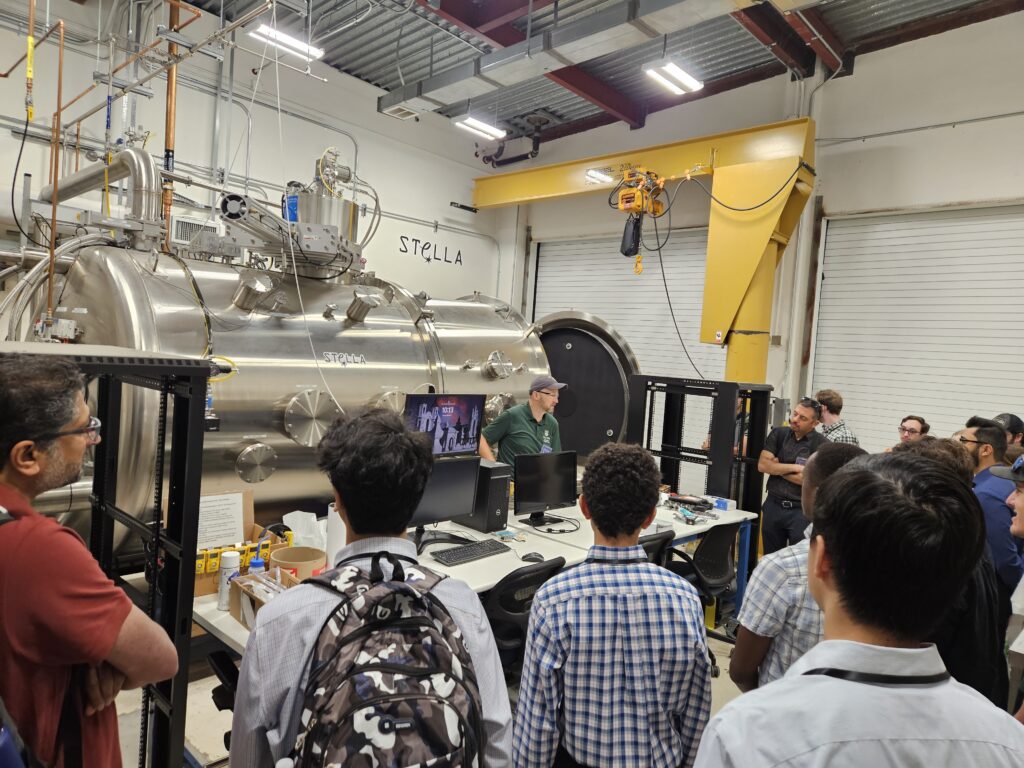
Presenting at the AIAA Region VI Student Conference was a new experience for Mudit. “It was very fun. It was cool to see other people who are also so interested in planes and aircraft and aerospace in general. I don’t think I’ve ever been in a place before that had so many people who are so knowledgeable and excited about aerospace all in one place.” He appreciated the opportunity to talk in depth with students and professionals of all ages about planes, aircraft, and CFD. “I enjoyed speaking about the research our team did. It was fun having people ask me thoughtful questions about it. And it was great to get feedback from the judges so I can improve next time.”
Mudit also learned from the undergrad and graduate technical presentations, as well as keynote sessions from the CEO of Mojave Air and Space Port and the Chief Mission Architect for Science and Robotic Exploration at Northrop Grumman.
Finding this network of people energized and interested in the same fields has been transformative. Beyond the people he met in person at the conference, Mudit is appreciative of the high school subcommittee group. “They’re a community of young people that I can work with and I can talk to about planes.”
His experience with both the research team and conference presentation have strengthened Mudit’s commitment to the field. When he goes to college in a few years, he plans to major in aerospace engineering or aeronautical engineering. “I want to do more research in aerodynamics. The regional student conference was a very fun experience. So, I’m excited to continue doing this.”
Abstract submissions for the 2027 Region I–VI Student Conferences
will open in September. Learn more.