

Work has Increased Storm Warning Times, Attracted the Attention of Hollywood
ORLANDO — As a child growing up in Oklahoma, Brian Argrow had two passions: meteorology and aerospace engineering. He never imagined one day he would combine both interests — deploying tornado-chasing drones that showed how tornadoes form, key to increasing warning times.
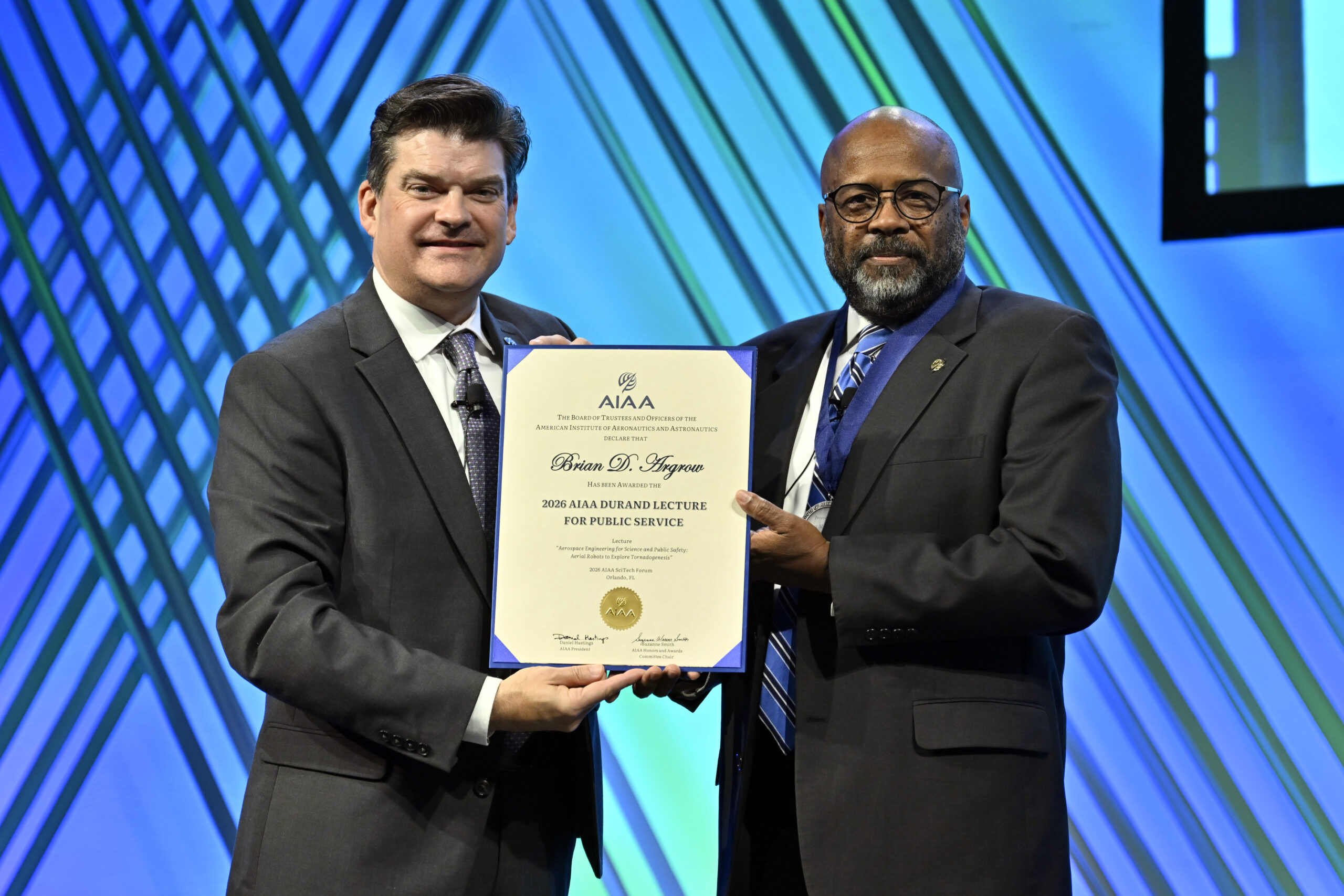
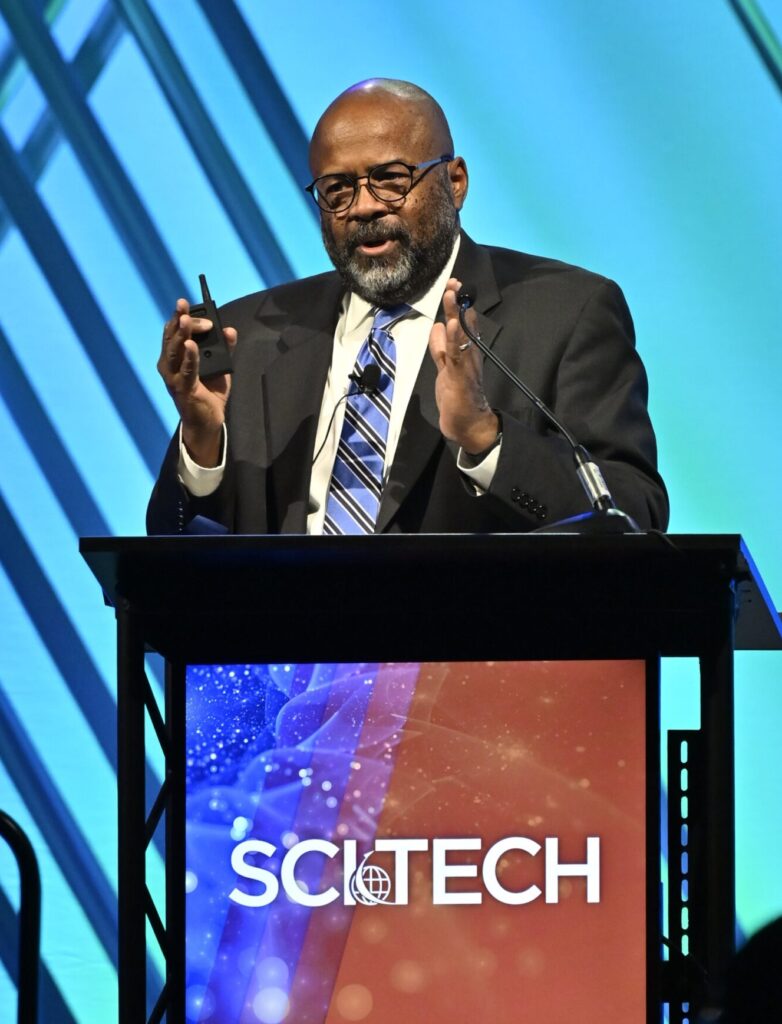
On Monday, Argrow, Distinguished Professor of Aerospace Engineering at the University of Colorado Boulder, delivered the 2026 Durand Lecture for Public Service at AIAA SciTech Forum 2026, given in recognition for contributions that have led directly to understanding of a science or technology for the betterment of society.
Since the 1960s, people have wanted to build drones for weather research, but it took longer for such studies to achieve scale, recalled Argrow, who was motivated to understand how and why tornadoes form.
“These are questions that meteorologists have been trying to address,” said Argrow, noting that engineers help with the observational requirements and must depend on instruments because humans can’t go into the storms.
Having founded the Research and Engineering Center for Unmanned Vehicles at CU Boulder in 2003, he was contacted by the Air Force after the U.S. invaded Iraq to help field small drones for real-time communications by Special Forces. In 2019, Argrow and his team simultaneously tackled two multi-year research projects with funding from the National Science Foundation and the U.S. Air Force.
Understanding How Tornadoes Are Born
One of the projects, TORUS (Targeted Observations Using Radar and UAS of Super Cells), focused on tornadogenesis – the process by which tornadoes form. Argrow and his faculty colleague Eric Frew collaborated closely with Adam Houston, a meteorologist and professor of Atmospheric Sciences at the University of Nebraska-Lincoln.
The project required a storm-chasing drone called RAAVEN (Robust Autonomous Aerial Vehicle-Endurant Nimble). The vehicle can withstand the turbulent environments of supercells – massive rotating thunderstorms that generate tornadoes and damaging hail.
Tornadoes form when wind shear creates horizontal rotation; the storm’s strong updraft tilts and ingests that rotation, producing a spinning updraft. Inflow and precipitation introduce or amplifiy low-level vorticity, a measure of how much air is spinning. The updraft stretches that air, which tightens into a tornado. Downdrafts, or cold outflows, can either help concentrate or abort tornadogenesis, Argrow explained.
“The tornado actually forms from the ground up; it’s really not from the cloud down. It’s pulling vorticity from the ground and concentrating it into the storm,” he said, adding that a P-3 Orion aircraft, or hurricane hunter, named Ms. Piggy supported their mission, with the aircraft orbiting the storm while the drones flew underneath.
Navigating Regulatory Environment
For multiple tornadogenesis projects, the team had to deploy drones in U.S. air space over large distances. “A major hurdle was regulations,” Argrow recalled.
To make the measurements of the storms, he had to secure FAA approval for the drone pilots (both engineering staff and students) to operate in U.S. airspace. Ultimately, the team received multiple Certificates of Authorization (COAs) that allowed them to deploy their drones over 11 states, from South Central Texas to the Canadian border —an area of 500,000 square miles. Once the projects were in the field, those pilots were in charge, he added.
Using high-fidelity RAAVEN data, Argrow’s group has contributed to improving forecasting models aimed at significantly increasing tornado warning times – an advance that translates directly to lives saved.
The researchers also have worked closely with the National Severe Storms Laboratory and its “Warn on Forecast” project that hopes to increase the average warning time for tornado alerts from 15 minutes to an hour.
All this work garnered interest from Hollywood, which featured a replica of the RAAVEN drone in the 2024 movie, Twisters.
Studying Hail
In spring 2025, Argrow’s team completed their latest field campaign that included studying hail. For this mission, rather than coming in from the front side of the storm like his team did for its tornadogenesis work, they came in from the back side of the storm to document the hail that the storm had left. Scientists are looking to connect what radar indicates as being hail and what actually makes it to the ground.
While not as life threatening as a tornado, hail often causes significantly more damage, especially to agricultural crops, noted Andrew Mord, an aerospace engineering Ph.D. student at UC Boulder, who was in the audience. Mord also has worked on the hail observation project since 2024.
“The coolest thing for me was the field work,” said Mord, who admitted the work could be stressful, even if the team was in the middle of nowhere. “You have to balance getting data, flying the drone – keeping track of a lot of things. A lot of hail storms can turn into tornadoes. You always have to have tornadoes on your mind.
He recalled one memorable moment last summer when a funnel cloud dissipated in front of their eyes over the span of a minute, “Then a minute later, it starts…pummeling us in hail. We got into our vehicle and floored it a mile south.”
Another audience member, Paul Nielsen, described the lecture as “a really interesting non-traditional application of drone technology.”
“When we think of drones, we think of surveillance, not flying into tornadoes,” said Nielsen, past president of AIAA and current director and CEO of the Software Engineering Institute, a Carnegie Mellon program funded by the U.S. Department of Defense. “To think that these little drones could survive was surprising to me, yet they’re really contributing to the science of how tornadoes are formed to help predict when they’re going to be a threat to people, so they get some warning,” he added.
Bryan Kowalczyk, co-director of the Applied Autonomy Lab at the University of Cincinnati, noted, “I’ve worked in parallel research with a lot of first responders. Seeing how researchers overcame challenges was amazing. It took a lot of time and wasn’t a single project, it was a lot of effort from a very large group of very vested and passionate researchers.”