

AIAA proudly returned as a sponsoring partner of the International Rocket Engineering Competition (IREC), hosted by the Experimental Sounding Rocket Association (ESRA), for the second consecutive year. Held at Spaceport Midland in West Texas in mid-June, IREC brought together more than 2,000 university students from 144 teams to design, build, and launch rockets in the desert heat. As the world’s largest collegiate rocket engineering competition, IREC gives students a place to test their innovation, build practical skills they can carry into the workforce, and work together toward a shared goal.
AIAA CEO Clay Mowry welcomed the crowd to IREC by recalling the first reusable rocket launch he witnessed, which also took place in West Texas. He invited students to join the AIAA community and connect to a global network of aerospace professionals and enthusiasts. Mowry also highlighted the MoU that AIAA and ESRA signed last year, expanding the partnership beyond the competition and creating new opportunities collaboration.
Challenging weather closed the launch pad for most of 18 June and all of 19 June. ESRA quickly shifted the awards presentation to a virtual event on 2 July, allowing teams to use the additional time for launches on 20 June. From sunrise to sunset, teams made 67 rocket launch attempts, demonstrating remarkable teamwork and perseverance.
AIAA is also expanding its support for IREC participants by publishing team papers in AIAA’s Aerospace Research Center (ARC) digital library. These papers will join a collection of more than 200,000 aerospace papers, the largest technical library of its kind in the world.
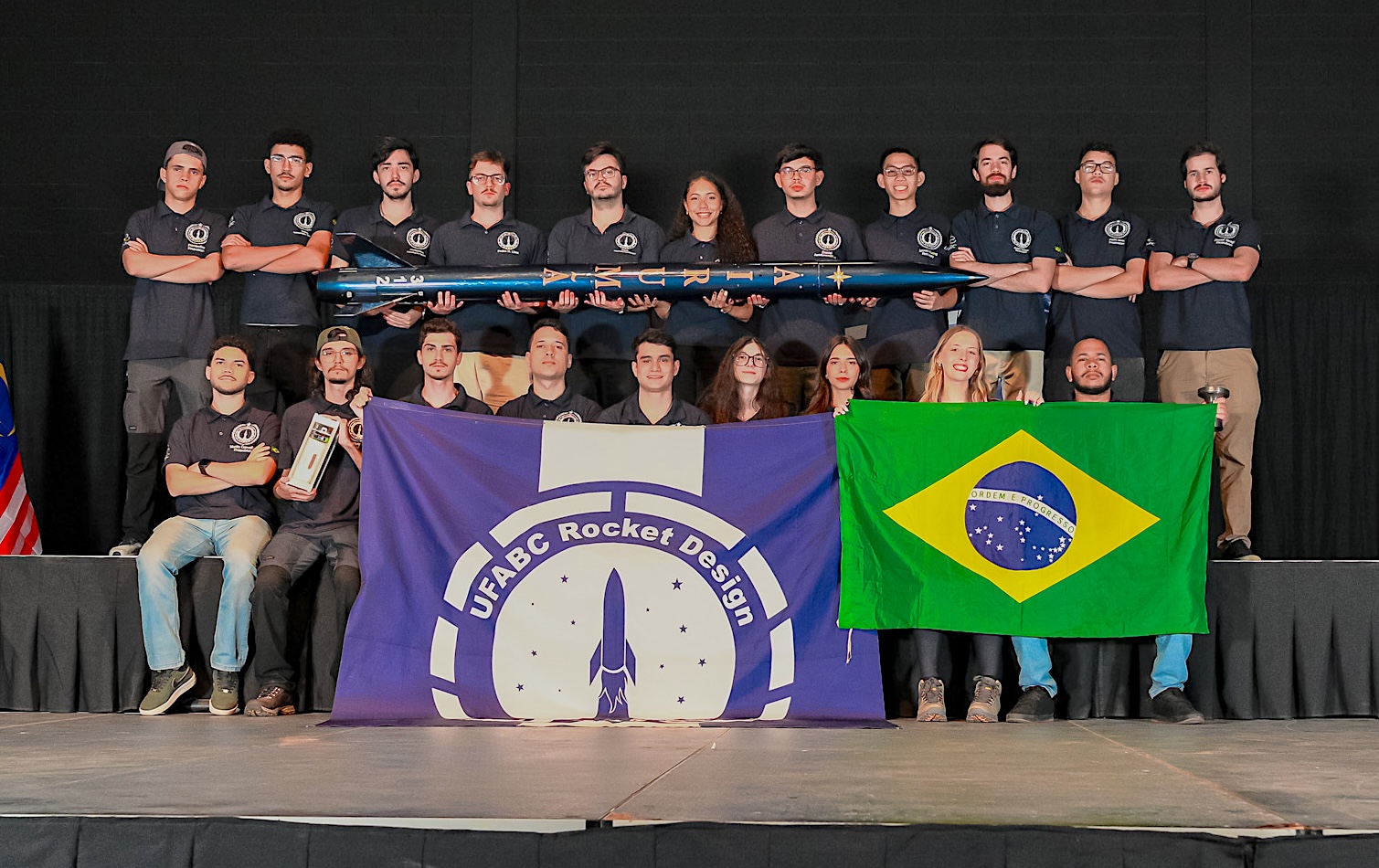
As part of the partnership, AIAA presented the Dr. Gil Moore Award for Innovation. “This award recognizes a team whose project demonstrated exceptional creativity, originality, and innovation in solving a unique challenge. It’s named in honor of AIAA Fellow Dr. R. Gilbert Moore, a rocket propulsion engineer whose career spanned nearly 70 years,” said Carla Soto, AIAA University Relations Manager, during the virtual awards ceremony. This year’s recipient was the Federal University of ABC (UFABC), Brazil.
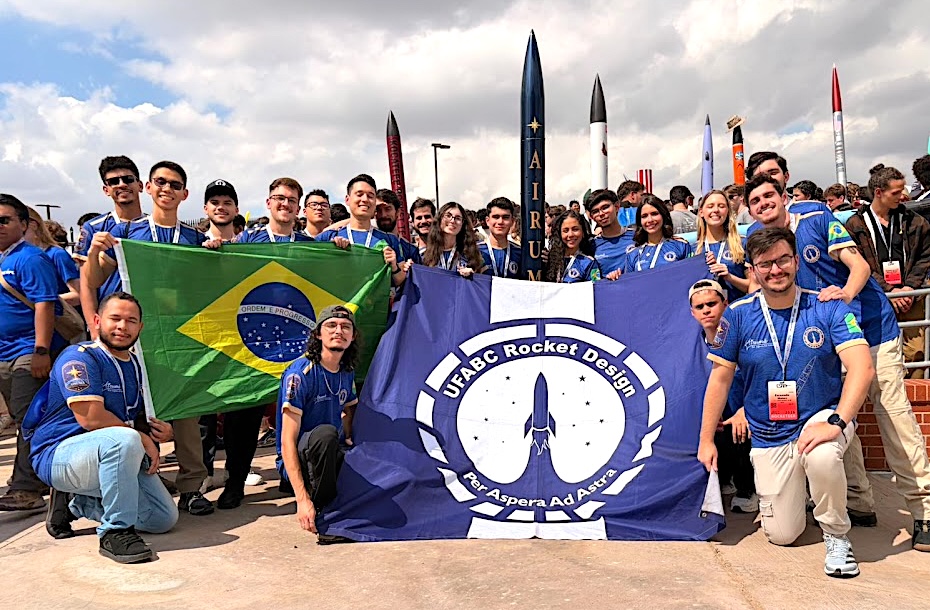
The UFABC Rocket Design team developed Project Airumã, a 38.8 kg student-designed and built sounding rocket. The project introduced a major advancement in the team’s propulsion system by replacing the traditional BATES grain geometry with an optimized Finocyl configuration. This new design produced a tailored thrust profile, delivering a higher initial thrust to ensure a safe rail exit while keeping the vehicle below the transonic regime throughout powered flight.
Beyond the propellant grain geometry, the project included the development of a complete manufacturing methodology based on Design for Manufacturing and Assembly (DFMA) principles. The team designed and refined a custom Mould Device Grain (MDG) capable of producing complex Finocyl grains using the machining resources available at the university. Engineering improvements—including optimized fillets, simplified tooling, enhanced sealing methods, and an improved extraction process—transformed a challenging concept into a reliable and repeatable manufacturing solution.
The propulsion system was successfully validated through static fire testing, demonstrating excellent agreement between simulations and experimental results, with only 0.76% total impulse error and 3.20% peak thrust deviation. This combination of theoretical development, practical engineering, and experimental validation earned the team the AIAA Dr. Gil Moore Award for Innovation, recognizing a solution that successfully combined advanced propulsion design with practical manufacturable engineering for student rocketry.
The AIAA-ESRA partnership creates opportunities to deepen AIAA’s support for student rocketry while connecting IREC participants to other AIAA programs. AIAA is excited to be back in Midland for IREC 2027, to witness new designs, innovation, and teamwork.
Related viewing