

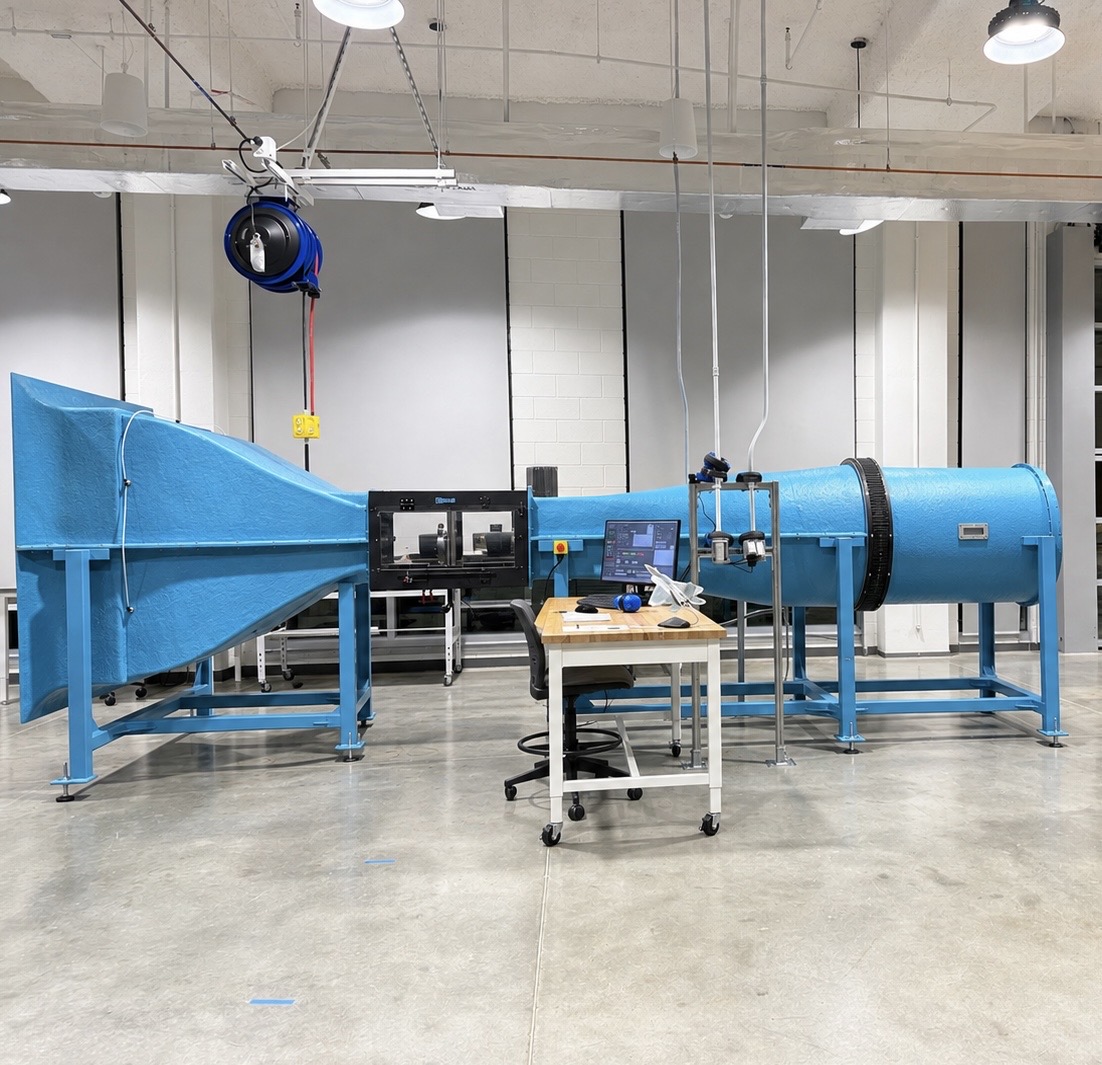
George Mason University’s Science and Technology Campus in Manassas, Virginia, welcomed students, faculty, and aerospace professionals on 4 November for a demonstration of its new Aerolab Educational Wind Tunnel (EWT). The AIAA National Capital Section joined representatives from Boeing, Lockheed Martin, and NASA at the event.
Testing Lift and Drag in the Lab
The EWT is an 18-foot experimental facility where students and researchers can study airflow and measure the aerodynamic forces on physical models under controlled conditions. The demonstration showed how airflow velocity, pressure distribution, and viscous effects produce lift and drag. With other parameters held constant, these forces scale with the square of freestream velocity, so stable test conditions are essential for reliable measurements.
The tunnel also supports study of boundary-layer development, flow separation, turbulence, and angle-of-attack effects. Small changes in surface geometry or airflow can significantly alter aircraft performance, which makes these topics central to aerospace engineering. Wind tunnel data also helps validate computational fluid dynamics (CFD): engineers compare numerical predictions against experimental results and refine their simulations.
A Regional Investment
The facility was supported by a GO Virginia initiative associated with the Nexus234 Innovation District. It contributes to regional efforts to expand technical education, encourage applied research, and build a skilled engineering workforce in Northern Virginia. Aerospace engineering relies on advanced computational tools, but physical experimentation remains essential for validating predictions. George Mason is positioning its Science and Technology Campus as a growing contributor to aerospace education and innovation in the region.
Bringing Academia and Industry Together
The demonstration also emphasized collaboration between universities and industry. Professionals from Boeing, Lockheed Martin, and NASA discussed how academic knowledge applies to real aircraft development challenges, and students learned about current industry practices, emerging technologies, and the skills the field requires. AIAA serves as the bridge between the two worlds, turning student conversations into lasting involvement through membership, professional development, and networking.
Members of the AIAA George Mason Student Branch also attended. AIAA representatives, including its Member Engagement Intern, spoke with attendees about the organization and how to get involved, reflecting AIAA’s commitment to fostering the next generation of aerospace engineers and strengthening ties within the regional aerospace community.