

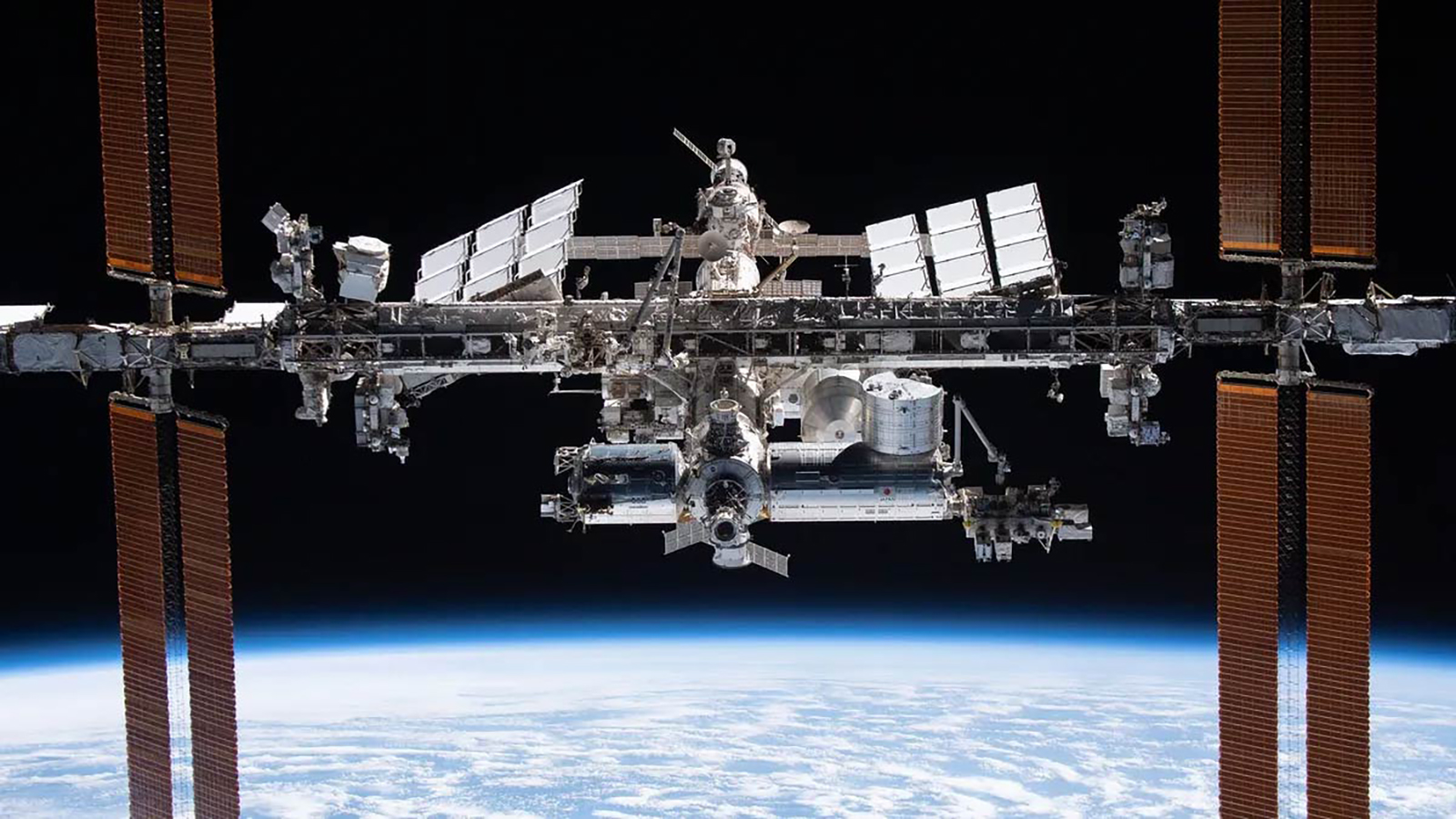
ORLANDO, Florida—In November 2025, the International Space Station (ISS) marked 25 years of uninterrupted crewed operations – a record unmatched in human spaceflight. On 15 January 2026, the day that NASA’s Crew-11 made an emergency return to Earth, a panel of experts at the AIAA SciTech Forum HUB stage discussed the station’s legacy and future of humanity in space.
The AIAA panel, “Past, Present, and Future of the ISS,” featured Jacob Keaton, NASA Senior Policy Advisor; Michael Roberts, Chief Science Officer of the ISS National Laboratory; and moderator Patrick O’Neill, ISS National Laboratory Outreach Lead. The discussion underscored how the station’s engineering triumphs, international partnership, and scientific output have shaped today’s space agenda and will influence the transition to commercial platforms and deep space missions.
“One of the themes is, there is a lot of ‘no one has ever,’” Keaton said. “No one has ever built something this big in space. No one has ever built something this big in space with a partnership that was this big. No one has ever coordinated 15 governments to fly a space station in space. And so, we were learning how to do that in real time, both engineering-wise, and putting it together with 15 governments, 15 different budget cycles, 15 different ways of looking at the world.”
Roberts explained that scientific research to benefit humanity has been aided by a continuous presence on the ISS. The station has supported more than 290 astronauts and cosmonauts in its time.
“In all that time – this 25 years of research – those crew members have supported a multitude of experiments that have not only helped define our path to moving farther away from Earth to the moon, Mars, and beyond, but more importantly, over the past 10 years, have really started to focus on research that has direct benefit here on Earth,” Roberts said.
Roberts described the ISS as a “test kitchen” where microgravity accelerates discovery. Tissue chip and organoid experiments done on the station have shortened the data return cycle for cancer therapy candidates, while materials science studies have yielded insights that improve manufacturing of semiconductors and alloys on the ground. Partnerships with the National Science Foundation, National Institutes of Health, and defense agencies have broadened the research portfolio, and recent collaborations with pharmaceutical, metal processing, and consumer goods firms illustrate how non-space-centric companies now view low Earth orbit as a strategic R&D venue, he added.
Join us at ASCEND 2026 , 19–21 May, in Washington, D.C., as leaders from NASA and the ISS National Laboratory share their insights on the most compelling research to date, the discoveries on the horizon, and why this work matters for life here on Earth. Learn more at https://www.ascend.events or view the program.
“So we look forward to this remaining five years of life of the International Space Station to extend those discoveries that benefit humanity here on Earth and help them achieve an even higher level of excellence and accomplishment on the commercial platforms that are coming online over the next couple of years,” Roberts remarked.
Keaton observed that after the space shuttle’s retirement, NASA turned to commercial providers for cargo delivery and later for crew transportation to and from the station. He described the current “decade of results” during which a crew of seven routinely conducts research while NASA prepares for a seamless handoff to private space stations. The goal, he said, is “no gap in U.S. presence in space” as commercial platforms mature.
Roberts emphasized that the past decade has shifted the ISS from pure fundamental science to applied, market-driven projects. He also noted that the next five years are crucial for cementing the station’s scientific legacy while helping the commercial sector.
Keaton highlighted the international cooperation that makes the ISS indispensable. The station continues to thrive after 11 U.S. presidents, 13 U.S. Congresses, and 15 partner nations have been involved. The program’s success rests on international cooperation, as NASA intends to preserve this framework while negotiating new partnerships for lunar Artemis missions and eventual Mars endeavors, he added.
While the ISS is planned for deorbit around 2030, its influence will persist, the panelists agreed. Keaton sees the station’s final years as a proving ground for technologies destined for other space missions – as examples he noted carbon dioxide removal, waste management, and long duration health monitoring. Roberts said he envisions the station’s “test kitchen” giving way to commercial “growth hubs” that blend tourism, manufacturing, and scientific innovation.
The ISS’s remaining operational window of about five years offers a narrow but vital opportunity to extract maximum scientific value, nurture a burgeoning commercial low Earth orbit market, and lay the groundwork for humanity’s next leap – living and working beyond Earth.