
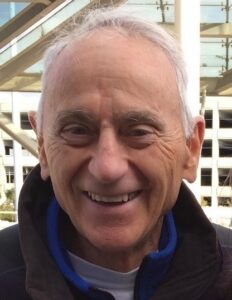
Louis A. Povinelli, one of the world’s foremost authorities on jet engine and rocket propulsion systems, died on 17 May. He was 94 years old.
Povinelli received his B.S from the University of Detroit. He became interested in propulsion while serving as a co-op engineer with German scientist Wernher von Braun at the Bell Aircraft Corporation. He conducted research on the X-1 aircraft and liquid rocket engines for the Shrike Missile.
After receiving an M.S. in Mechanical Engineering from the University of Kentucky in 1956, Povinelli went to Northwestern University for a Ph.D. in Mechanical and Aeronautical Engineering. After his Ph.D. was awarded in 1959, he was selected as a FIAT-Fulbright Postdoctoral Fellow at the Polytechnic Institute of Turin, Italy.
In 1960, Povinelli began a 60-year career at NASA Lewis Research Center (now Glenn) as an aeronautical research engineer in the Rocket Combustion Section of the Chemistry and Energy Conversion Division. He worked on liquid and solid rocket propellant, which was critical to the success of the Apollo 11 lunar landing in 1969. In 1963 he served in the Office of Science and Technology under President John F. Kennedy, assisting in the decision to establish a nuclear energy policy for the United States.
Povinelli served as Chief of the Internal Fluid Mechanics Division at NASA Lewis, His work contributed substantially to the advancement of aeronautics and astronautics in rocket propulsion, scramjet propulsion, and air-breathing engine performance in both military and commercial aircraft. The work was critical to the development of the ramjet and scramjet engines needed to power aircraft at hypersonic and supersonic speeds. His research and experimental techniques relative to air flows through such engines focused on maintaining combustion at a high rate of speed. Prior to his retirement in 2020 Povinelli served as Project Scientist for NASA’s Supersonic Fundamental Aerodynamics Project.
Povinelli’s research produced 140 publications and presentations and two U.S. patents. He was instrumental in establishing the Institute for Computational Mechanics in Propulsion located at the Ohio Aerospace Institute and served as its Director (1986–1993). He additionally served on the Air Force Scientific Advisory Board; the University of Michigan’s Aeronautical Engineering Advisory Board; and the Cleveland State University College of Engineering Advisory Council. His international work included serving on the NATO/AGARD Propulsion and Energetics Panel and serving as a consultant on hypersonics.
He was the Editor of the International Journal of Computational Fluid Dynamics and was a member of the AIAA Advisory Board for the Journal of Propulsion and Power, as well as chair of the ASME Aerospace Division, Chair of the AIAA Propellants and Combustion Technical Committee, and a member of the AIAA Fluid Dynamics Technical Committee. Povinelli was also chair of the AIAA Northern Ohio Section and he organized and chaired sessions for several national meetings.
Among his many honors were the NASA Exceptional Scientific Achievement Medal; the 1996 AIAA Air Breathing Propulsion Award; the ISABE Wu Memorial Lecturer Award; five NASA Group Achievement Awards; the Collier Trophy Team Award; the NASP Zara Award; and the NASA Space Act Monetary Award for Scientific and Technical Innovation. Povinelli was a Fellow of AIAA and ASME.