2026 will test U.S. Air Force’s bet on drone wingmen
 By Jen Kirby
 By Jen Kirby
The Air Force this year is planning to take a significant step forward on its effort to establish a fleet of “loyal wingman” drones that would fly alongside crewed fighter jets by the end of the decade.
Service officials describe this Collaborative Combat Aircraft, or CCA, program as a critical piece of the Air Force’s vision of reaching “affordable mass,” giving it semi-autonomous capabilities that are cheaper than human-piloted fighters and can beef up the size of its fleet.
Key to that vision is achieving “wingman” status, meaning the aircraft’s ability to “quarterback” with existing and future crewed fighters, including the future F-47.
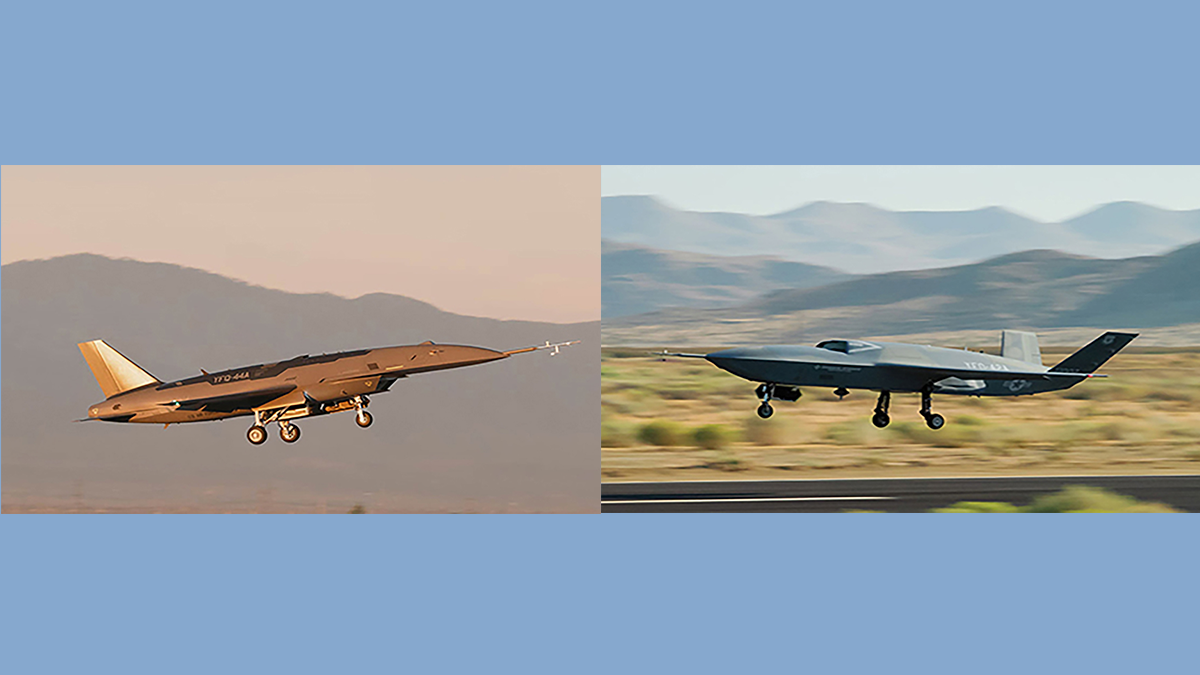
Michael Horowitz, a professor at the University of Pennsylvania and former deputy assistant secretary of defense for force development and emerging capabilities, described CCA as a “pivot point” for the Air Force. The service is slated to make a production decision this year, potentially advancing one or both of the two prototypes selected in 2024: General Atomics’ YFQ-42A and Anduril’s Fury YFQ-44A.
Moving forward with both would signal the contractors have achieved the test-phase objectives. “Another signal there, if [the Air Force] were to go forward with two, would be that they’re devoting enough resources to proceed with two — which speaks to prioritization,” said Andrew Hunter, head of Pax Per Consortia Strategies and former Air Force acquisition chief, who helped launch the CCA program during his tenure.
He added: “That’ll be a huge indicator of how the program is going, what success it’s demonstrating in terms of progress of the contractors, and then, because of the progress of the contractors, the desire on the part of the department to make it a priority and to move forward with multiple vendors.”
The size of the Air Force’s crewed fleet has diminished in the decades since the Cold War, largely due to the need to retire older aircraft and the hefty price tag to build and maintain the new jets needed to replace them.
CCA was meant to offer a solution by adding both volume and potential new capabilities, from electronic jamming to reconnaissance to decoys. “We like the fact that our air component commanders can use them in ways that they could not use piloted aircraft. They can offload a lot of risk onto CCA,” said Mark Gunzinger, director of future concepts and capabilities assessment at the Mitchell Institute of Aerospace Studies.
In 2023, then-Air Force Secretary Frank Kendall announced plans to field 1,000 CCAs as part of the Air Force’s Next Generation Air Dominance program to “provide affordable mass and dramatically increased cost effectiveness.” Kendall told Congress in 2024 the Air Force intended to purchase 100 CCAs by the end of the decade. The Trump administration has maintained the overall acquisition target of 1,000 CCAs.
The Air Force also planned for multiple “increments” of CCAs, which could allow for different mission profiles. In early 2024, the service awarded contracts to five companies to develop the first CCA prototypes, and later selected Anduril and General Atomics to continue designing and testing their Increment 1 models. The Air Force is also working with separate vendors on the software that will build out the mission autonomy for the CCA.
In August, General Atomics began flight testing its CCA, and in October, Anduril’s version made its first flight. As of early December, General Atomics “has flown two separate YFQ-42A aircraft in 2025 so far, with more jets in production or preparing for first flights,” according to a company spokesperson. A spokesperson for Anduril said it has “multiple fully-built aircraft in testing, as well as multiple aircraft in various stages of the manufacturing process.” Anduril has begun integrating weapons in its YFQ-44A and will conduct its first live shot in 2026, the spokesperson added.
Col. Timothy Helfrich, director and senior materiel leader of the Air Force’s Agile Development Office, said on a December episode of the Micro Journeys podcast that Increment 1 of the program is focused on air-to-air capabilities and will carry weapons.
The Air Force is currently refining its concept for Increment 2 this year. The aircraft in this phase could serve as an air-to-air platform, “or it could bring sensors or electronic warfare capability, whatever the total system needs to be most effective,” Helfrich said.
Even as the CCA program advances, questions remain about the exact capabilities these aircraft should have — and what that will cost.
In June, the Air Force activated the Experimental Operations Unit (EOU) at Nellis Air Force Base in Nevada to test and refine the human-machine teaming for CCAs. “They can get those reps and sets on autonomy and how to operate those Collaborative Combat Aircraft with our manned platforms in a real-world environment,” Helfrich said about the EOU during the December podcast.
The Air Force requested $804 million for the CCA program in fiscal year 2026.
The tax-and-spending legislation signed into law in July allocated nearly $680 million to accelerate the CCA program. While the fiscal 2026 defense policy bill signed in mid-December authorizes $169 million for research and development and $15 million for CCA procurement, Congress has not yet passed the full fiscal 2026 budget.
The Air Force said in 2023 it planned to spend about $6 billion on CCAs through 2028, although a fiscal 2025 budget document estimated about $9 billion through fiscal 2029.
Jon Hemler, a defense analyst with Forecast International, said maintaining planned costs will depend on the Air Force avoiding the temptation to add extra capabilities. “Let’s stop there, and not add extra sensors, extra equipment to balloon the cost,” he said. “That’s certainly something that’s happened in the past.”
Because CCAs are supposed to be loyal wingmen, they may need to spend some time with fighter pilots in the threat arena, potentially demanding greater survivability, experts say. That “means you’re probably looking at higher demands on autonomy, and you’re going to need more stealth — and that CCA is going to start to get expensive really fast,” said Travis Sharp, senior fellow at the Center Strategic and Budgetary Assessments.
This is the dilemma some experts see for the program. “It’s not enough for mass and not good enough for pure qualitative superiority,” said Jacquelyn Schneider, a fellow at Stanford’s Hoover Institute who researches autonomous systems.
Schneider views teaming between crewed and uncrewed systems as the future, but CCA as occupying a suboptimal space: half replacing the fighter jets the Air Force doesn’t have enough of, and half working alongside them — which could require more exquisite capabilities.
“It was never, ‘Is the unmanned fighter cheaper than the manned fighter?’ Never. It was how these things work together,” Schneider said. “Quite often, that means thinking about unmanned beyond a platform and more like a munition or sensor or system. Something smaller, not as big or as expensive, and far, far, far more of them.”
That’s a tall order for a program slated to be operational by 2030 — but if all goes as planned, it could demonstrate the Air Force’s ability to rapidly field new technologies.
“The CCA has become a symbol of a lot of people’s hope that we can somehow break through the status quo and generate something relatively quick that really is a breakthrough capability,” Sharp said.