Policy, technical progress expands the envelope of aviation autonomy
 By Cat Hofacker
 By Cat Hofacker
In 2025, autonomy progressed from experimental concepts to operational capability across civil, commercial and defense aviation. In April, NASA completed a major phase of the Airborne Instrumentation for Real-world Video of Urban Environments (AIRVUE) project, creating an open-source dataset to train electric air taxis for autonomous flight. NASA collected high-resolution video, lidar, and positional data to teach onboard systems to recognize obstacles including birds, towers, and ground personnel to certify future pilotless aircraft operating in dense urban airspace. NASA continued to support multiple autonomy efforts, including through the University Leadership Initiative.
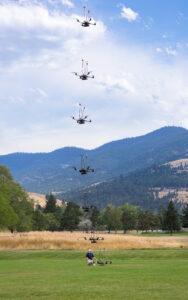
Federal agencies expanded the use of uncrewed aerial systems (UAS) for wildfire detection and situational awareness. UAS equipped with infrared cameras and adaptive control systems developed at multiple universities — including MIT, Stanford, and Minnesota — performed beyond-visual-line-of-sight (BVLOS) swarming and mapping missions throughout 2025. These tests demonstrated drones can safely navigate turbulent, smoke-filled environments while gathering real-time atmospheric data critical to firefighter operations.
In May, FAA launched Phase 2 of its BEYOND program, reporting more than 70,000 UAS flights, many BVLOS, as it refined community-based safety frameworks. Researchers and several national laboratories applied large language models to simulations for improved air traffic management, where AI-driven systems identify potential runway and airspace conflicts and generate alternate plans. The research extended FAA automation work in weather and radar decision support, advancing cognitive autonomy for human-machine teaming in the National Airspace System.
The White House formalized its commitment to drone dominance through several executive orders and Defense Department directives to accelerate development, testing and acquisition of autonomous and counter-UAS systems. The policy framework aimed to reinforce U.S. leadership in drone manufacturing, cybersecurity, and defense readiness while limiting federal procurement to trusted, domestically produced platforms on the Blue UAS Cleared List, which includes UAS approved by DOD. A parallel procurement directive streamlined approval timelines for defense-grade drones and counter-UAS technologies, expanding opportunities for qualified suppliers and clarifying the transition from laboratory testing to operational deployment, opening additional National Defense Authorization Act approval pathways through DOD’s Defense Innovation Unit.
Ukraine’s defense and research sectors continued to push the boundaries of drone innovation under wartime conditions, rapidly advancing technologies for autonomous targeting and swarm coordination. New platforms equipped with sensors and machine learning algorithms were deployed for mine and unexploded ordnance detection, integrating AI-driven mapping to support civilian demining operations.
In August, FAA released its long-anticipated notice of proposed rulemaking for Part 108, outlining a new regulatory framework for the certification and operation of advanced uncrewed aircraft. It proposed performance-based standards for detect and avoid, command and control, and airworthiness, setting the stage for routine autonomous and BVLOS operations in the national airspace.
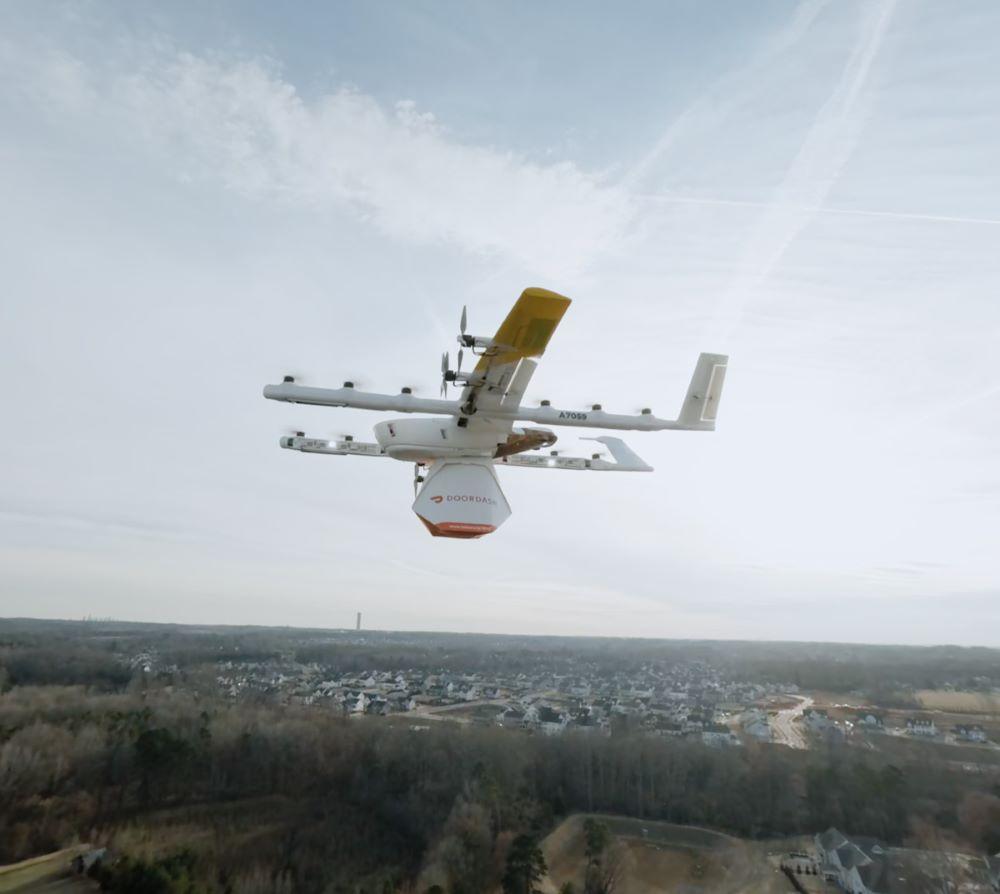
The regional air mobility sector made notable progress toward pilot-optional flight operations. In August, Archer Aviation conducted extensive testing of its Midnight eVTOL under supervised autonomy, demonstrating advanced flight control algorithms and automated airspace coordination for type certification efforts. These achievements supported broader autonomy trials across the advanced air mobility ecosystem.
Between July and September, Oklahoma-based Skydweller Aero advanced its solar-powered aircraft. Multiday autonomous flights of its 747-sized design demonstrated refining control, aeroelastic modeling, and energy management to achieve near-continuous flight powered entirely by sunlight.
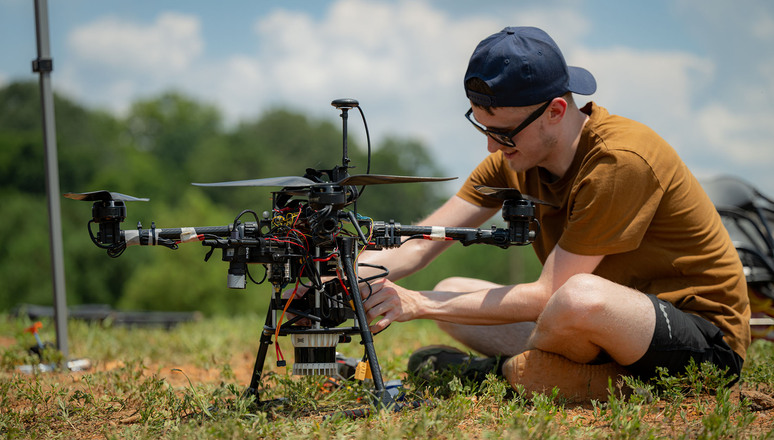
The NATO Science for Peace and Security Programme hosted an international autonomous drone competition in August at the Huntsville UAS test range in Alabama, where NATO teams demonstrated collaborative autonomy in contested environments. Nearthlab demonstrated the KAiDEN autonomous interceptor drone, capable of a 150-mph flight and AI real-time threat neutralization. NTT Group flew a lightning-triggering drone manipulating electric fields to attract lightning strikes, recognized in October among TIME magazine’s Best Inventions of 2025.
Opener image: University teams from the Netherlands, U.K., U.S. and Austria prepare autonomous drones for flight at the NATO Science for Peace and Security Programme’s international competition, held at the Huntsville UAS test range in Alabama in July 2025. Credit: NATO