Big rockets, commercial stations and moon missions further space settlement
 By Cat Hofacker
 By Cat Hofacker
Several events in 2025 pushed enabling technologies closer to putting humans permanently in space, including using the lunar environment, placing large amounts of mass into space and allowing for people to live and work in space.
A key technology for lunar settlement is manipulation and characterization of lunar regolith, including advanced space robotics. Two missions under NASA’s Commercial Lunar Payload Services (CLPS) program expanded these technologies. The Firefly Blue Ghost Mission 1 landed in March at Mare Crisium and operated for 14 days, including five hours into the lunar night. This was the first stable, upright landing of a privately developed lunar lander, and conducted a series of regolith experiments that will enable long-term habitation on the moon.
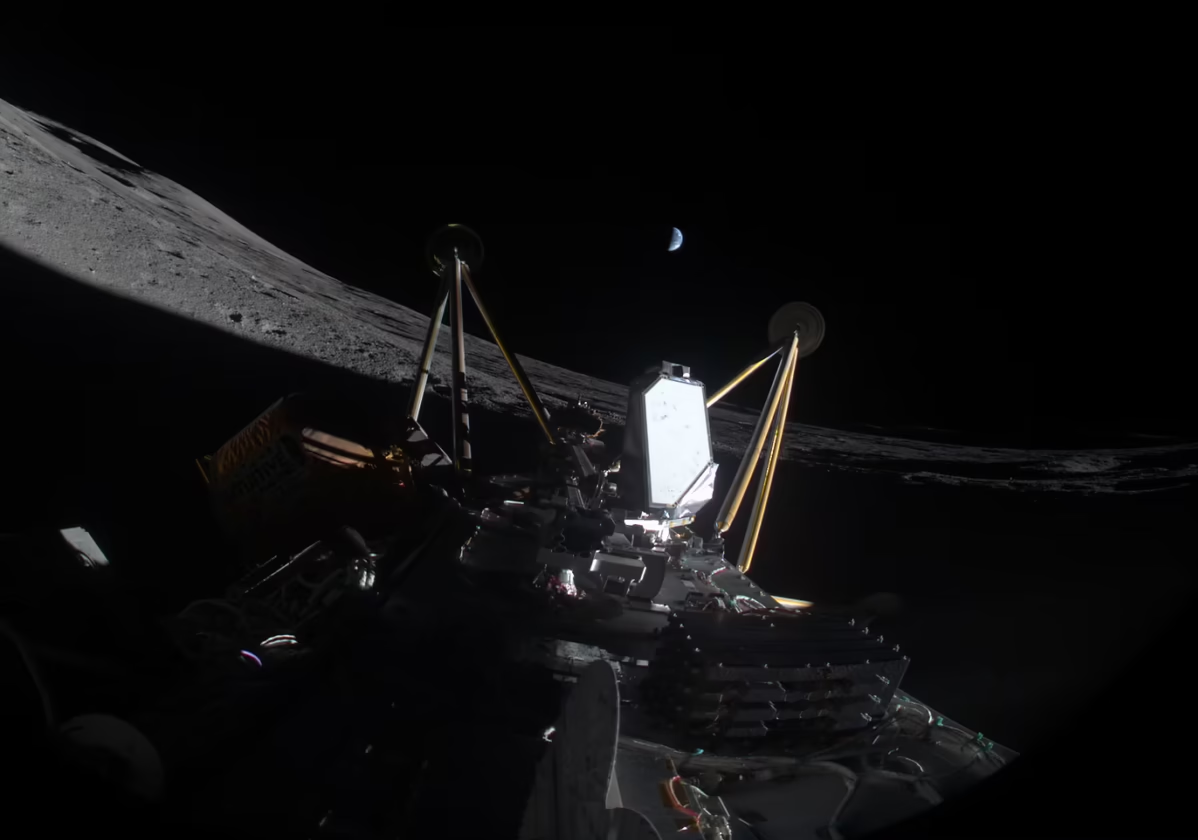
The Intuitive Machines IM-2 mission landed in March, near Mons Mouton, in a crater in the lunar south pole. Even though the lander fell on its side, it conducted some experiments by extending a drill and sending data before it became too cold and low in power to operate. Future CLPS missions are to expand the role of robots and study of the resources available to people in space, hastening the day that bases on the moon become reality.
The larger the mass that can be sent to space, the more options are available for putting up and supplying habitats and factories. Blue Origin joined the heavy-lift rocket roster in January, reaching orbit with the first New Glenn, though the company failed to recover the booster. New Glenn has a large payload fairing, with a volume 458 cubic meters and ability to send 45 metric tons of mass to low-Earth orbit.
SpaceX also continued its progress toward super-sized lift by performing four integrated flights of the Starship-Super Heavy design. All flight objectives were achieved for Flight 10 in August, and Flight 11 was conducted in October, the final flight of the second-generation Starship upper stage. Both companies plan to vastly lower the cost to orbit, and have contracts to support NASA’s Artemis moon program by providing crew and cargo landers and launching elements of the agency’s Gateway lunar space station.
Finally, commercial low-Earth orbit (LEO) space stations will allow long-term economic cases that will put more people into orbit and help those on Earth. Axiom in April prepared its first module, the PPTM — short for Payload, Power, and Thermal Module — for connection to the International Space Station in 2027. Plans call for the PPTM to later detach and float free, with more modules joining it at a later date. Another station builder, Vast, welded its first Haven-1 module in September in preparation for launch in May 2026. The Haven design fits modules together to extend the station for a variety of uses and to build novel stations for commercial and scientific use.
All told, these initiatives helped hasten the day when humans permanently live and thrive in space, from free floating bases to bases on the moon and beyond.
Opener image: The IM-2 lander on its side on the moon in March 2025. Credit: Intuitive Machines