2025 brings humanity closer to the cosmos
 By Cat Hofacker
 By Cat Hofacker
Space robotics maintained its reputation as one of the greatest means to explore the cosmos, advance technology and inspire the next generation.
Human augmentation and assistance is a long-standing tradition in the field. Throughout the year, the AI-powered, free-floating Crew Interactive MObile companioN (CIMON) — a collaborative effort between Airbus, the German Aerospace Center (DLR) and IBM — completed experiments controlling other robots aboard the International Space Station to assist astronauts. In July, the European Space Agency and DLR completed the final session of the Surface Avatar program. Astronauts controlled terrestrial robots from ISS, simulating remote operations on celestial bodies.
In March, Japanese-owned GITAI was awarded a contract by the Japan Aerospace Exploration Agency to investigate the use of robotic arm systems inside a crewed lunar rover. At the International Conference on Robotics and Automation in Atlanta, Georgia, AstroLoc 2 demonstrated increased performance for localization and navigation for free-floating robot Astrobee on the ISS. The U.S. Naval Research Laboratory also used the Astrobee to perform the first reinforcement learning control of an in-space free-flying robot in May. Finally, in June, JAXA astronauts evaluated the capability of the Kibo module’s Small Fine Arm and performed necessary maintenance.
The industry is primed for growth. Market reports indicate an almost 100% increase from $5 billion to U.S. 10 billion by 2034. In April, GITAI established a U.S.-owned subsidiary, GITAI Defense, that will operate from California. Momentus, also in California, was awarded a contract for demonstrating robotic technologies via NASA’s Flight Opportunities program. The company completed a preliminary design review for DARPA’s NOM4D program (Novel Orbital and Moon Manufacturing, Materials, and Mass-efficient Design).
Between NASA’s upcoming Artemis missions and China’s commitment to land taikonauts by 2030, the lunar surface was another large focus. In March, China University of Mining and Technology unveiled a unique space mining robot design. MoonBot from Japan’s Tohoku University completed tests in ESA’s new lunar simulation facility. In March, Colorado-based Lunar Outpost’s Mobile Autonomous Prospecting Platform rover, carrying another rover (the AstroAnt micro robot from MIT), was launched aboard Intuitive Machines’ Athena lander. Unfortunately, the lander fell onto its side inside a lunar crater, and the rovers were never deployed.
In May, Interlune of Washington partnered with agricultural juggernaut Vermeer and unveiled its new Lunar Helium-3 harvester prototype. Finally, in September, NASA selected Blue Origin’s Blue Moon Mk. 1 Lander to explore methods of delivering the VIPER rover to the moon’s south pole in late 2027.
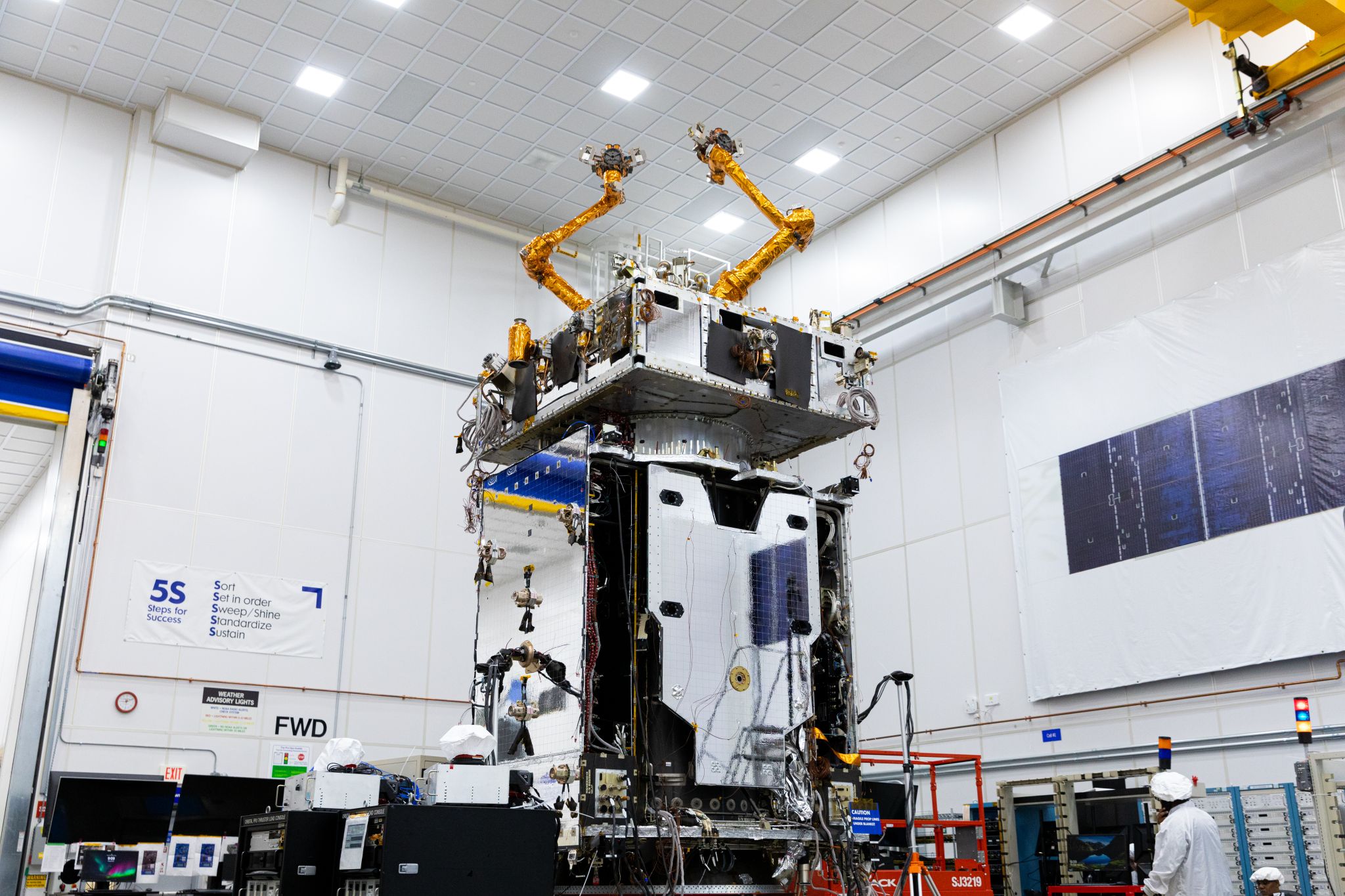
Robotic hardware continued to progress toward flight demonstrations. In September, DARPA’s Robotic Servicing of Geosynchronous Satellites (RSGS) robotic payload testing was completed after integration earlier this year onto Northrop Grumman’s Mission Robotic Vehicle (MRV) in Maryland.
Novel research often turns into the next great technology, and 2025 was no exception. In California, GITAI’s Inchworm robot concept reached Technology Readiness Level (TRL) 6. NASA awarded funding to the University of California, Berkeley’s jumping robot Salto for potential use exploring Saturn’s moon Enceladus. In September, Space Robotics Bench was launched out of Luxembourg, providing a standardized set of environments and tools to simulate and train space robotic projects in extreme and extraterrestrial environments.
Space robotics continues to be the discipline of choice for inspiring the next generation. In April, the FIRST Robotics Competition (sponsored by BAE Systems) held its championship in Houston, Texas. The competition engaged some 55,000 students, with multiple NASA centers, academic institutions and space industry players showing up to support the event and inspire the Artemis generation. In August, the NASA RockSat X program launched a sounding rocket out of Wallops Flight Facility in Virginia, carrying a robotic arm for object capture/docking from Northwest Nazarene University. In May, Stanford University won the inaugural Lunar Autonomy Challenge hosted by Johns Hopkins University’s Applied Physics Laboratory, which challenged teams to autonomously navigate the lunar surface using a digital twin of NASA’s ISRU Pilot Excavator (IPEx) robot.
Contributors: Cesare Guariniello and Kimberly Wilcher
Opener image: DARPA’s Robotic Servicing of Geosynchronous Satellites (RSGS) robotic payload was integrated onto Northrop Grumman’s Mission Robotic Vehicle (MRV) and completed testing in September 2025 ahead of a planned 2026 launch. Credit: Northrop Grumman