
The Space Resources Technical Committee advocates affordable, sustainable human space exploration using nonterrestrial natural resources to supply propulsion, power, life-support consumables, and manufacturing materials.
2025 was a banner year for ISRU-focused (in situ resource utilization) instrumentation in space, particularly with regard to the moon.
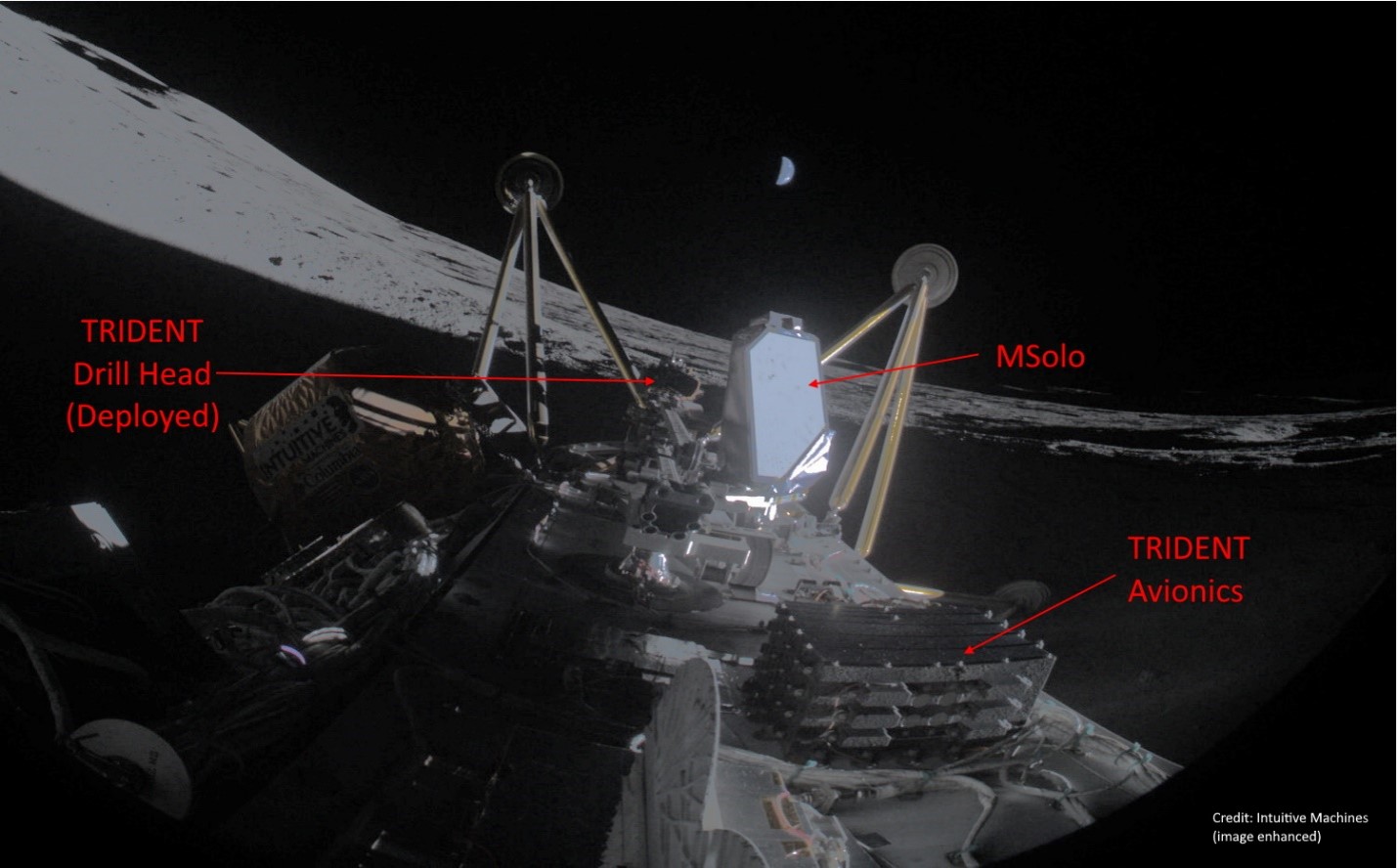
In February, Honeybee Robotics, headquartered in Colorado, operated an ISRU-focused instrument in space alongside NASA. Honeybee’s TRIDENT (The Regolith and Ice Drill for Exploration of New Terrains) percussive-auger drill and the NASA-developed Mass Spectrometer Observing Lunar Operations (MSOLO) were delivered to the moon aboard an Intuitive Machines lander as part of the IM-2 mission, funded under NASA’s Commercial Lunar Payload Services (CLPS) program. This was part of the Polar Resources Ice Mining Experiment (PRIME-1) payload. Despite an off-nominal landing that prevented TRIDENT from drilling into the surface, the drill was still able to power on and execute all of its operations: released launch locks, fully extended both z-stages, rotated and percussed auger, and operated heater and temperature sensor. Also, MSOLO demonstrated functionality in the lunar environment.
Also in March, Honeybee’s Lunar Planet Vac (LPV) and Lunar Instrumentation for Subsurface Thermal Exploration with Rapidity (LISTER) were delivered to the moon aboard Firefly Aerospace’s Blue Ghost lander, also funded under CLPS. LPV acquired approximately 10 grams of lunar regolith. In addition, LISTER, a pneumatic drill with a heat flow probe at its tip, demonstrated drilling for resource prospecting, using pneumatics down to a depth of approximately 1 meter.
All four of the above-described instruments demonstrated low-cost resource prospecting in low gravity, bringing the technology in each instrument to flight status and representing milestones in the operation of space resources technology in flight.
In June, a prototype ISRU system designed to extract oxygen from lunar regolith was integrated and run through final testing at NASA’s Johnson Space Center’s Energy Systems Test Area in Texas. This technology, named the Carbothermal Reduction Demonstration (CaRD) project, consisted of a deployable solar concentrator, optical shutter, carbothermal reactor, fluid system, avionics, gas analysis and software. Concentrated sunlight was focused on simulated lunar regolith within the reactor, inducing a solar carbothermal reaction that produced oxygen. Multiple components were developed at NASA’s Glenn Research Center in Ohio. The ultimate goal of this system is to significantly reduce the cost and risk of a sustained human presence on the moon by reducing the amount of oxygen that would have to be delivered from Earth.
Finally, in July, Georgia Tech launched its Space Research Institute (SRI). This hub is meant to foster a collaborative community, including scientific, engineering, cultural and commercial research that pursues broadly integrated and innovative projects with global impact on Earth and in space. Additionally, in research published in July, metal and metalloid production from lunar regolith simulants was demonstrated via carbothermal reduction. Using activated carbon under inert conditions, JSC-1A, LMS-1 and LHS-1 simulants were thermodynamically and experimentally studied over a range of environments to assess metal and metalloid production as functions of oxide and mineral composition. The impact of this technology research, similarly to the oxygen-producing ISRU described above, was to reduce the cost of lunar exploration by reducing the amount of metal that would have to be brought to the moon from Earth.
Contributors: David Dickson, Robert Moses, Aaron Paz, Shaspreet Kaur, Kevin Hubbard, Julie Kleinhenz, Andrew Dempster, Laurent Sibille
Opener image: PRIME-1 hardware aboard the IM-2 “Athena” lander on the lunar surface in March 2025. The lander is on its side with PRIME-1 facing skyward and its drill fully extended. Credit: NASA Glenn Research Center