NASA’s Crew-11 to launch amid uncertainty over space program funding


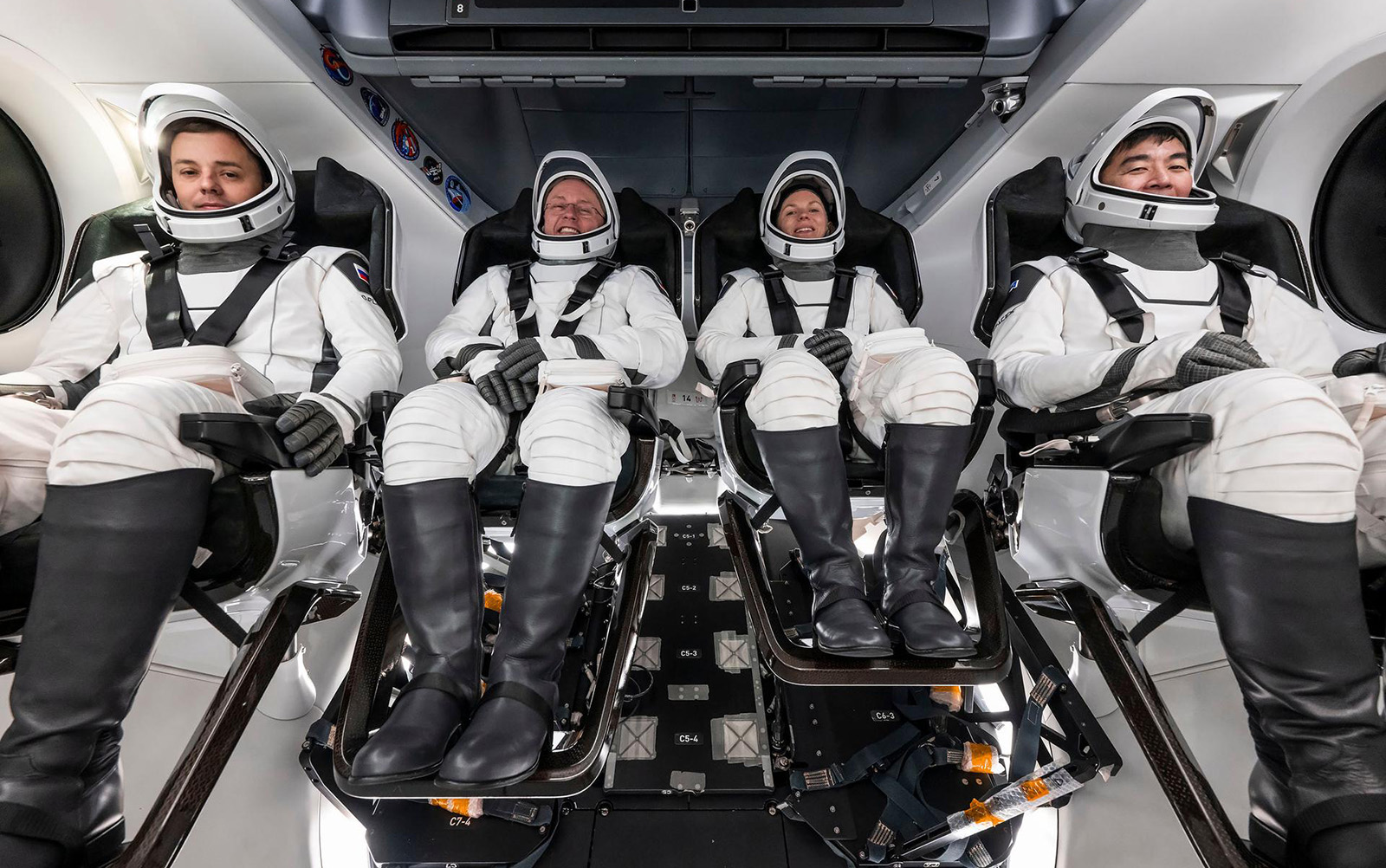
The Crew-11 astronauts during an early July rehearsal in their SpaceX Dragon capsule. From left: Oleg Platonov, Mike Fincke, Zena Cardman, and Kimiya Yui. Credit: SpaceX
Update: NASA and SpaceX scrubbed Thursday’s launch attempt due to a sudden buildup of thick, dark clouds near Launch Complex 39A. The next opportunity is 11:43 a.m. Eastern on Aug. 1.
NASA’s Crew-11 astronaut launch to the International Space Station, planned for July 31, comes as the agency is assessing proposed large-scale budget cuts and what they could mean for future launches to the ISS.
The Trump administration’s fiscal 2026 budget request, released in May, proposes cutting NASA’s overall funding by 24%. The budget for NASA’s Science Mission Directorate, which includes funding for research conducted onboard ISS, would be slashed by half under the proposal.
The launch of the three Crew-11 astronauts and one cosmonaut, in their SpaceX Crew Dragon capsule atop a Falcon 9 rocket, is planned for 12:09 p.m. Eastern on Thursday from NASA’s Kennedy Space Center in Florida. If all goes as planned, commander Zena Cardman, pilot Mike Fincke, and mission specialists Kimiya Yui of Japan and Oleg Platonov of Russia will arrive at the space station at 3 a.m. Eastern on Aug. 2.
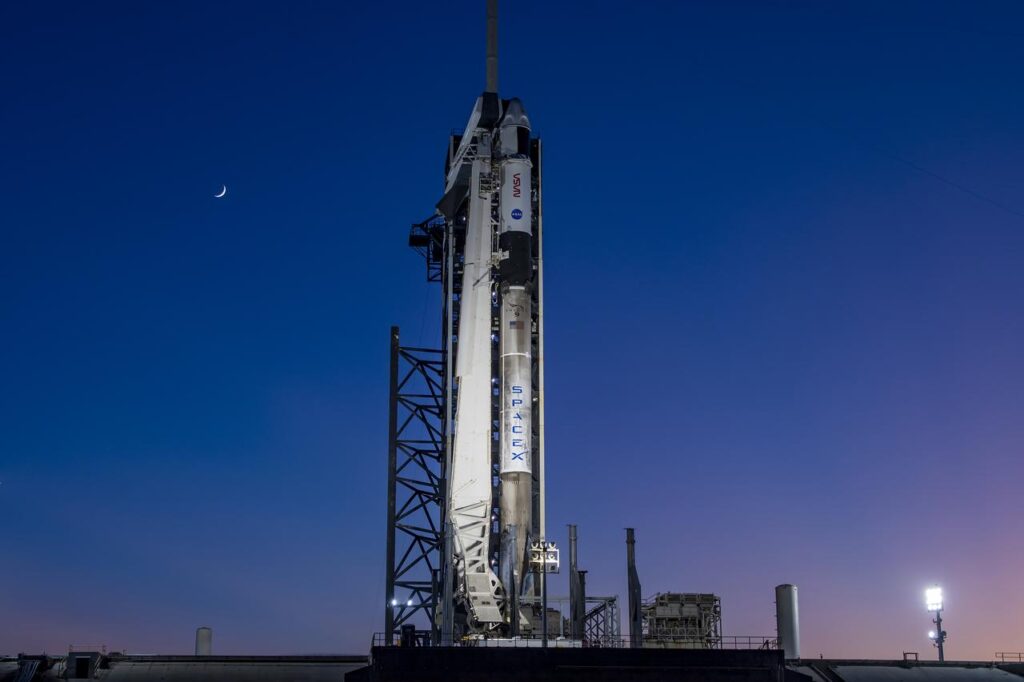
Routine launches of four-astronaut crews, who then spend roughly six months at the station, have been the standard since SpaceX began ferrying astronauts to and from ISS in 2020 under NASA’s Commercial Crew Program. Through this initiative, NASA partially funded the development of privately owned and operated capsules, a strategy intended to help foster a competitive market for human spaceflight while also providing the agency multiple successors to the retired space shuttle orbiters.
The agency is in the process of extending Crew-11’s stay on ISS to eight months, partly to align with the launch and rotation cadence of the Russian crews, NASA officials said during a July 10 press conference. But in the future, it’s not clear how often crew launches would occur and how many astronauts would be aboard each because of budget uncertainty, said Clayton Swope, a senior fellow in the Defense and Security Department at the Center for Strategic and International Studies, a Washington, D.C., think tank.
“NASA seems to be taking it on a day-by-day basis, and right now that means they are focused on Crew-11,” Swope told me. “It’s basically, ‘We’re making the donuts like we always have, until someone tells us not to.’”
The administration’s proposed budget would reduce the “space operations” part of NASA’s funding, which includes ISS launches and operations, to $2.8 billion, down roughly 30% from the fiscal 2025 amount.
NASA declined to answer questions about the impact of the budget cuts, writing in an emailed statement that the “top level funding identified in the Technical Supplement is all we have to share at this time.”
Swope said NASA is still trying to reconcile short-term budget cuts with directives in President Donald Trump’s sprawling legislative package signed earlier this month, which adds $10 billion to NASA’s budget to facilitate its return to the moon and future lunar landings scheduled for the late 2020s.
“Ultimately, you can continue to operate on a day-by-day approach, but you could eventually lose sight of the bigger picture, including competition with China,” Swope said. “And China has a relatively new space station in orbit, whereas we are planning to retire ours by 2030.”
Paul Slaboch, an associate professor of mechanical, aerospace and acoustical engineering at the University of Hartford, noted that NASA is considering extending astronaut stays at the ISS to account for budget cuts and the potential for fewer launches.
“They can do longer durations in space and fewer flights, but that isn’t necessarily desirable given what we have learned about the health effects of living in space for long terms,” Slaboch told me.
NASA also remains reliant on SpaceX for crew transportation to the station, while the agency continues to evaluate the troubled Boeing Starliner capsules. A Starliner carried two astronauts to the space station in 2024 for a flight test, but NASA decided not to bring them back on it due to ongoing assessments of helium leaks and thruster malfunctions that occurred while Starliner was en route to ISS. NASA has said Starliner may fly next in early 2026 with cargo only to gather more data about the design.
Astronaut Fincke said in the July 10 press conference that NASA wants more options to get to space. “It is really important that we have more opportunities and more capabilities to fly into space, and that’s why the Commercial Crew Program is still working hard with Boeing to get Starliner to be a viable transportation system up and down to the space station,” he said.
In addition to Crew-11, NASA has contracted with SpaceX to complete three more crewed flights, at a pace of two launches per year.
Asked about those contracts, NASA said in an emailed statement that if it determines more missions are needed, the agency “could consider future procurement actions including requests for information and additional contract modifications.”
“However, no decisions have been made,” the agency added. “NASA routinely assesses the station’s manifest as operations and agency needs evolve. NASA will share updates as they become available.”
Slaboch said he anticipates that NASA will continue to work with Boeing on getting Starliner certified.
“Competition is good, and being reliant on a single entity is not ideal,” Slaboch said. “They surely want Starliner as an option no matter what the future holds.”