


Numerous states are deploying innovative strategies to expand their commercial space ecosystem to grow their economies and play a bigger national role
Washington, D.C. – A growing number of states are taking proactive steps to marshal their public and private sectors and academia to grow the commercial space industry, offering incentives to encourage new partnerships, attract startups, and identify dual-use technologies to expand their regional and national space footprint.
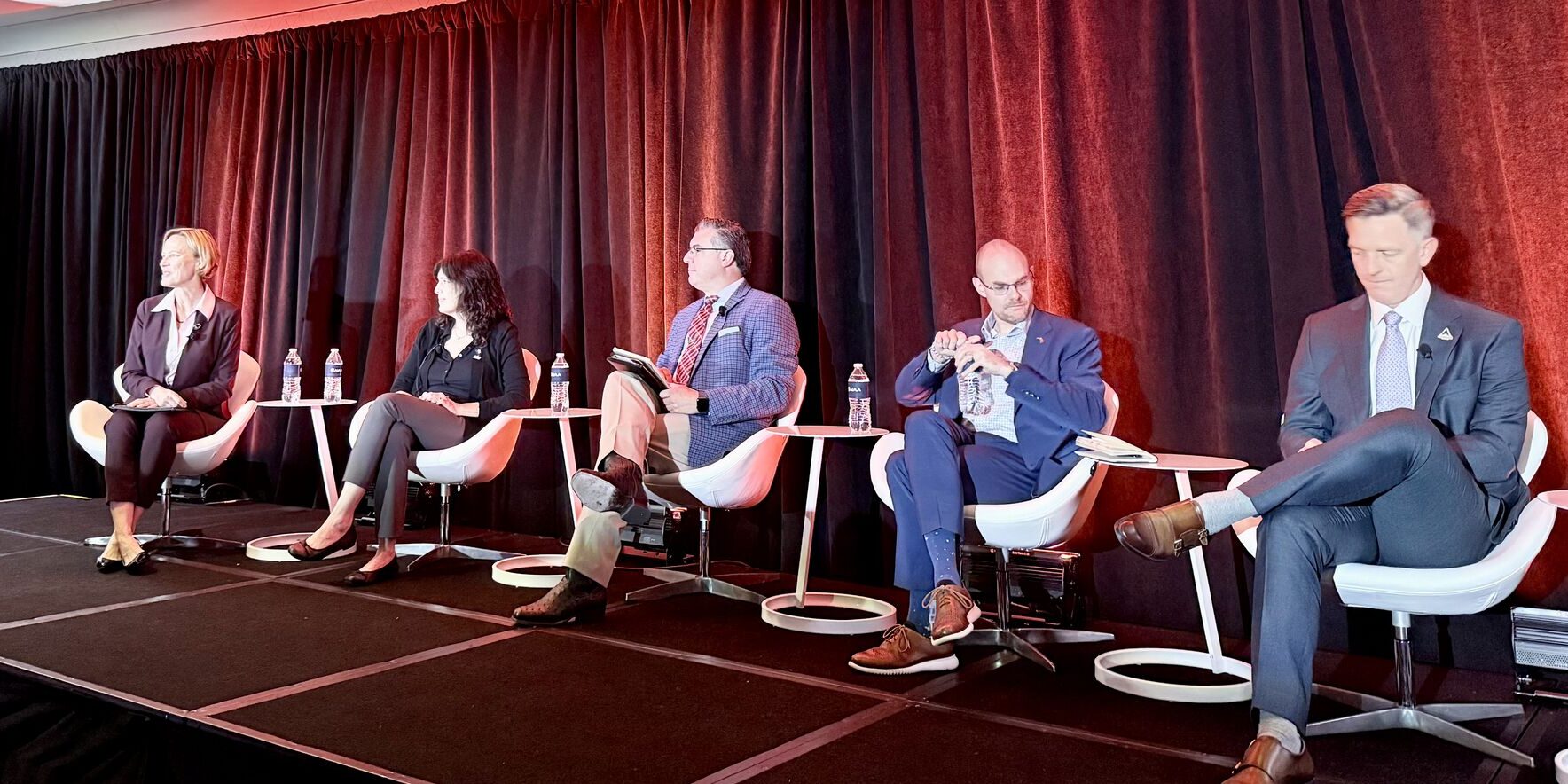
“We have relied on federal systems for so long, but what states are doing right now is dynamic, it’s effective,” said Heather Pringle, CEO of The Space Foundation, who moderated a panel at ASCEND 2026 on “How Regional Strategies Are Fueling Commercial Space Investment.”
On one level states are competing – for commercial investment, federal government contracts, and to recruit and retain the skilled workforce of the future. But there is also growing recognition that different areas of the country bring unique capacity and talent to the national space economy.
“We are in a second space race,” said Mark Ignash, Director for Strategic Initiatives and Ecosystem Development for the Michigan Office of Defense and Aerospace Innovation, which was established in 2024 and recently released its first five-year strategic plan. “We compete, we do. But I would also submit there is phenomenal opportunity for us to partner and collaborate because…it is truly a national imperative that we are able to operate as a national [space] economy. And I do believe we all bring certain skills and assets and tools that we can really leverage together.”
On the panel at ASCEND 2026, space leaders from Maryland, Michigan, Texas, and Virginia offered insights into how their states and regions are taking proactive steps to fuel the commercial space industry.
Maryland
Georgie Brophy, vice chair of the Maryland Aerospace and Technology Commission, outlined what she considers Maryland’s opportunity to leverage the state’s legacy of federal research and development facilities.
“I think what makes us unique right now is we are pivoting to create this commercial changeover,” she said. Maryland is “taking this incredible expertise that we have in our national labs and in our [government] installations and pivoting that to help people become starters of new companies and to basically pivot into this commercial space industry.”
She cited Maryland-based organizations such as NASA Goddard Space Flight Center, the Naval Research Laboratory, and Johns Hopkins Applied Physics Laboratory as a draw for space companies.
“We have this extraordinary infrastructure of talent” and a “pipeline coming out of our universities across the state,” she explained. “We have companies that have built up around these institutions.”
A major focus is getting the word out on what Maryland has to offer. “I think one of our biggest challenges – it’s not necessarily the talent, it’s not necessarily infrastructure or the companies – it’s helping people understand what’s there,” Brophy said, and “proselytizing, shouting to the treetops.”
Michigan
In Michigan, Ignash said that the state’s heritage as a global leader in manufacturing and technology, from the auto industry to large-scale production of military platforms, offers a natural multiplier for commercial space development and dual-use technology.
“The assets and pieces we bring to this puzzle are really the manufacturing, R&D, and talent and workforce base we have,” Ignash added. “We’re able to pivot quickly.”
He cited Michigan’s leadership during World War II in reorienting the auto and other industries to making tanks and aircraft, and more recently unleashing its R&D and manufacturing prowess for vaccine development and production of personal protective equipment (PPE) during the COVID-19 pandemic.
Now, Michigan is seeking proposals for a Space Innovation Hub. One of the goals is to “connect the dots,” Ignash explained, and support the commercial space companies that have already set down roots in the state, including in the areas of space debris removal, in-orbit servicing, space propulsion, and more.
Michigan also has begun to steer “matching funds” for federal dollars, he said, “to help lower the barrier to entry.” So far, beneficiaries, he said, have mostly been small and medium-sized companies.
Texas
Texas is preparing to dole out Texas-sized grants to grow its commercial space economy.
“We have a very large surplus of funding right now, which has been that enabler…to begin issuing grants,” Norman Garza, executive director of The Texas Space Commission, which was created by law in 2023. “In 2023, $150 million was appropriated by the legislature, and in 2025 they doubled down and $300 million was appropriated,” he told the ASCEND audience.
The commission also is focusing more attention on economic development corporations across Texas to see how it can help with cash flow for commercial companies, so they are not overly dependent on federal contracts.
“We’re also trying to have conversations at the local and the regional level across…with the communities that want to position themselves,” he said. “How can the local community also enable their success?”
Another example of state-level investment he cited: Texas A&M has received $200 million to finance a facility near NASA Johnson Space Center called the Texas A&M Space Institute, with an expansive testing facility that will have “one side with by a lunar ‘surfacescape’ and the other will be a Martian ‘surfacescape,’” Garza said.
Virginia
The Virginia Spaceport Authority has been around for three decades and the state is home to the Mid-Atlantic Regional Spaceport, which is commercially licensed by the FAA and heavily funded by the state budget.
“We’re very operationally forward,” said Sean Mulligan, the spaceport authority’s CEO. “We’re kind of unique in that there aren’t that many vertical spaceports, period.”
He credited the “continuous investment from Richmond…to develop operational capabilities to help support commercial and government space…That has been enabled by hundreds of millions of dollars of investment into launch pads and payload processing facilities and integration facilities and control rooms.”
A newer goal, he explained, is to expand the ecosystem around the spaceport to make commercial and government endeavors collectively more impactful and efficient – what he described as “trying to [attract] the supply chain and manufacturing and everything that comes with it that wants to be resident near a launch pad.”
Virginia leaders, he added, are “trying to enable that all to occur through strategic investments in multi-user facilities.”
“How can we enable our commercial customers to succeed?” he asked. “How can we reduce frictions in this very complicated, dynamic changing world of commercial space?”
That also means “making the price point for using this infrastructure as viable as possible,” Mulligan added.