

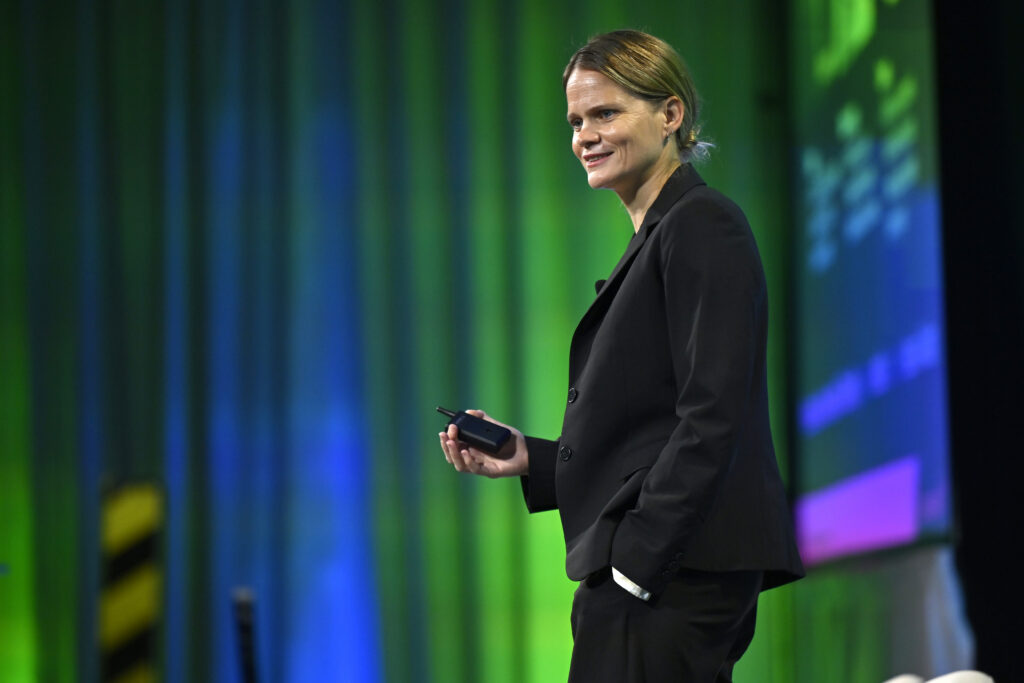
SAN DIEGO — Renee Pasman offered a working definition of artificial intelligence that cut against the prevailing excitement. “I tend to think of AI as software that has non-deterministic outcomes,” the vice president, chief information officer, and digital transformation executive for Lockheed Martin Aeronautics told an AIAA AVIATION Forum audience on 9 June.
For Pasman, the priority is “increasing the acceleration of our workflows… not replacing them, not even in some cases substantially changing them, but making sure that we have the ability to meet the speed required by today’s world.”
That lens also shapes which technical problems she wants to tackle first. “As I think about the technological barriers that we might have for large‑scale application of AI, the ones that I’m most interested in solving earlier are the ones that unlock that workflow acceleration because that is not only what, in a lot of cases, the technology is ready for, but it is also what we need… to meet today’s needs and to find that next great leap in innovation,” Pasman explained.
That theme carried into a Forum 360 panel discussion where AI advocates urged the aerospace community to separate the technology’s genuine near-term value from the surrounding hype.
“The way we talk about AI generates the hype,” said Pasman, whose job includes leading 1LMX, Lockheed Martin’s mission-driven digital transformation program.
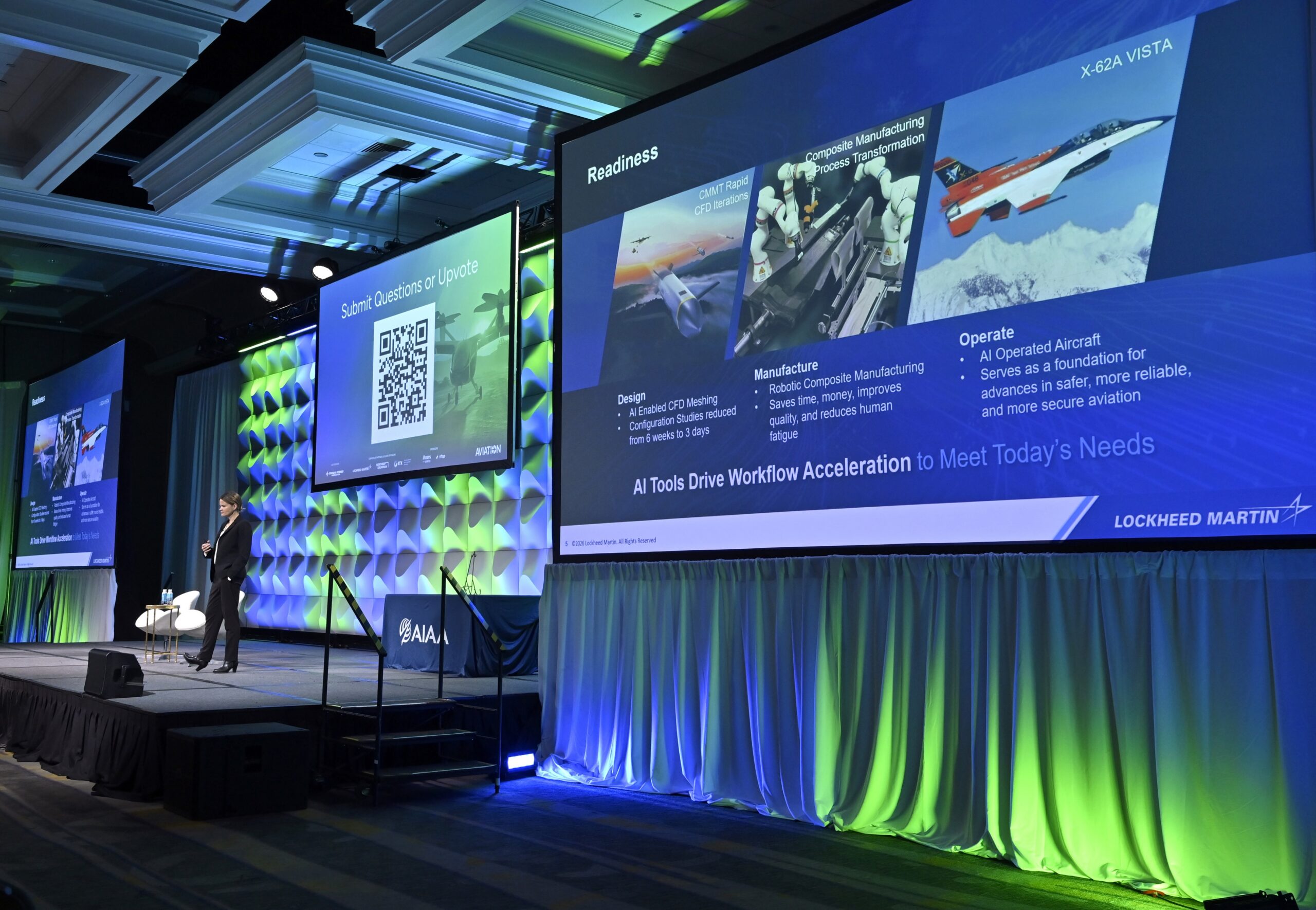
She shared where AI is working inside Lockheed Martin today. In design, she said AI‑enabled CFD tools are already “reducing configuration study time significantly” by automating mesh updates – but warned, “just because I can run my CFD faster, is it really better? That’s where… judgment comes in.”
On the factory floor, she pointed to robotics and computer vision that “save time and improve quality” in production and sustainment, while stressing that real surge capacity still depends on “manufacturing engineers… the artisans, the production professionals, and [the] supply chain team.” And in operations, she cited the U.S. Air Force Test Pilot School X‑62A as a testbed for autonomous behaviors and for defining the “guidelines and guide rails” that will govern AI’s role in future flight.
AI Impact on the Workforce
But Pasman also addressed what AI cannot do on its own: drive its own adoption. “Tools only accelerate workflows if the team uses them,” she said. “Adoption and change management become incredibly important, and that is not necessarily a technological challenge but a human one.”
Refusing to use AI, she said, would be like refusing to use a computer. But she warned of a subtler risk: the erosion of training pipelines for early-career engineers if AI automates the tasks that have traditionally built foundational skills. AI in education is like calculators, she said — they exist, “and yet most of us still know how to do math.” Her concern is not the technology itself, but what happens when students accept its outputs without the critical thinking to evaluate them.
AI’s growing influence actually “highlights the importance of strong educators, strong teachers, strong professors” who can model good use of the technology, Pasman noted. Their job, she added, is to ensure students use AI well without losing foundational skills like critical thinking and contextual judgment.
The top-ranked question during the audience Q&A centered on job loss and workforce disruption: whether AI would “replace” people, especially developers and engineers. Pasman treated that framing as its own kind of hype. She pushed back on the idea that whole professions will simply disappear, drawing parallels to past technological shifts: “When you think about technology and how it’s advanced over the years, there’s always been changes in the job market as new technologies come online. There are jobs that are no longer available, but we all use computers today.”
On highly publicized tech layoffs or fears that “AI coding will now replace all software developers,” Pasman acknowledged there were kernels of truth – AI coding agents are “pretty good” at work junior developers used to do – but they bring trade-offs like increased cost and loss of training opportunities. Her bottom line was that AI will reshape work, not erase it.
“I…expect that we will see a lot of job opportunities open up, whether those are in the development of AI or with unique applications of AI… I think… we’ll see a lot more opportunity than downside as things go forward.”
Managing AI Risk
When asked how she is controlling the risks of agentic AI leaking Lockheed Martin IP, Pasman responded, “Welcome to my day job.”
She then turned the question around: “How do you control that risk without inhibiting innovation?”
If the company is too restrictive, Pasman said, it will impede collaboration. That’s why Lockheed Martin takes a multi-part approach that includes a governance framework for the ethical use of AI and clear policies around data. “We truly understand where our data is and how it can be shared,” she added.
Audience Says “AI is just AI”
Pasman’s remarks resonated with Tricia Williams and Rae Lutters, principals at Unify Consulting, an AI management consulting firm and new AIAA Corporate Member.
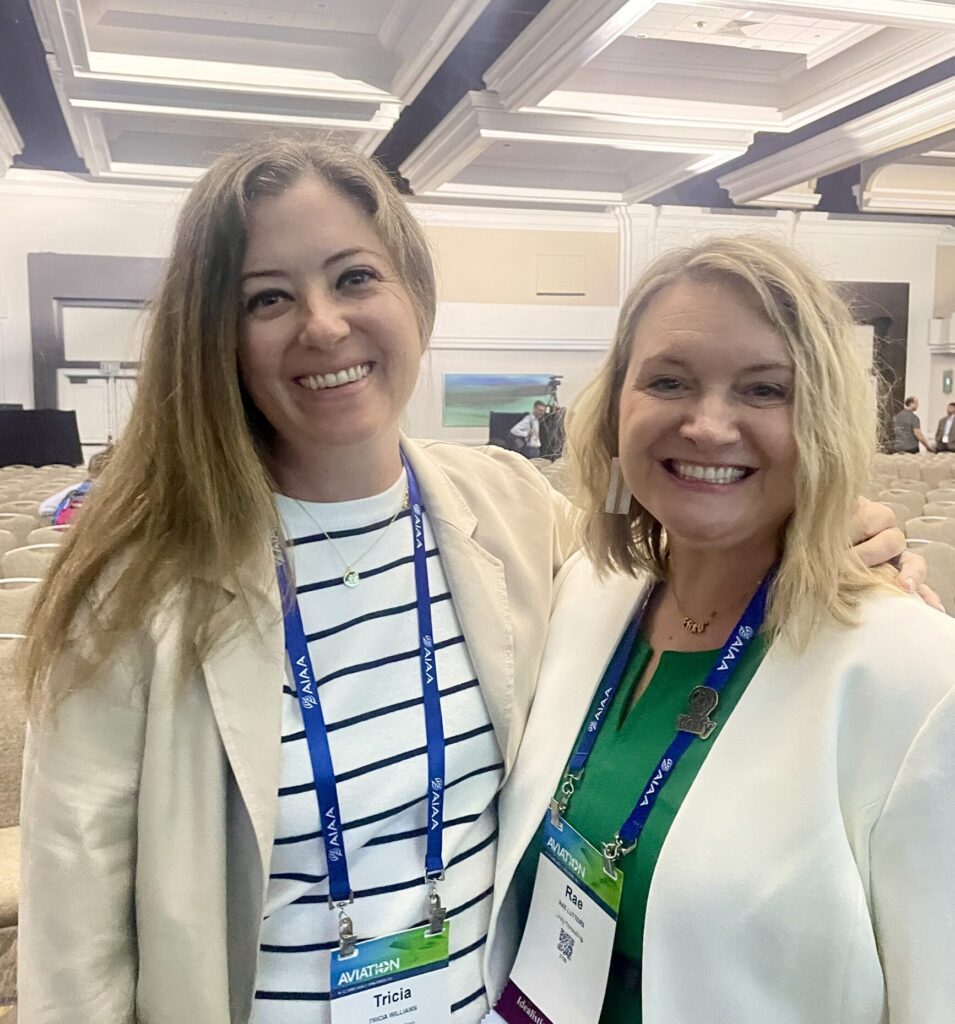
“I really liked what she said about the hype versus reality, because the hype is going to fix everything. AI is just AI… it’s going to have capabilities to help us be better, learn quicker, but I really do believe that we need to have the right frameworks in place,” said Lutters, who recently joined Unify as vice president of Sustainability and Aerospace after a 25-year career at Boeing. “How do you bring the entire workforce along with you? What are your boundaries, and how do you ensure that you’re still going to have that critical thinking?”
Williams, the firm’s vice president of Business Strategy and Consulting Services, agreed with Pasman that fears that AI will trigger mass layoffs are largely overblown. She sees AI enhancing human work. “We are looking for how we can improve our workflows to be faster, smarter, more efficient, so that we can spend more time doing the strategic work… it’s not replacing us, it’s augmenting us,” she said.