

Hydrogen offers a great potential to commercialize zero emission aviation and fuel, using up to ~1/3 less energy and having lower costs at scale to produce than SAF. The symposium highlighted the latest advances in hydrogen aerospace and liquid hydrogen.
Left unabated, Aviation is projected to emit over 20% of all greenhouse gas emissions by 2050, according to an article by the Institute of Sustainability & Environmental Professionals. Reducing aircraft emissions in any significant way therefore requires decarbonization. Though sustainable aircraft fuel (SAF) offers a near-term solution to reduce greenhouse gas emissions, there are still local emissions like NOx, and SAF comes at a significantly higher cost than current fossil-derived jet fuels. Hydrogen offers a sustainable path to both greatly reduce emissions and with scale will offer a cost reduction for aviation. The H2-Aero Symposium was created to support the mission to decarbonize both aerospace and the airport with hydrogen.
At AIAA AVIATION Forum 2026, the 5th annual H2-Aero Symposium featured a concerted industry, academia, and government push to commercialize hydrogen in aerospace propulsion and fuel. Approximately 25 organizations presented on the latest advances in hydrogen storage, fuel cell, and even hydrogen turbine demonstrations. Major airframers attending included Airbus, Boeing, and Embraer, while propulsion companies such as Rolls-Royce and Pratt & Whitney and startups such as Beyond Aero and ZeroAvia presented their progress over the last year.
European regulators, European Union Aviation Safety Agency and the UK’s Civil Aviation Authority, described their joint certification efforts with the the FAA. Multiple universities highlighted advances in liquid hydrogen (LH2) knowledge development such as Washington State University’s LH2 flow testing and UC Irvine’s transfer loss simulation effort to support the SAE AE-5H Hydrogen Airport Committee. Several other higher education organizations explored design optimization, economic lifecycle estimations, and a review of hybrid power architectures.
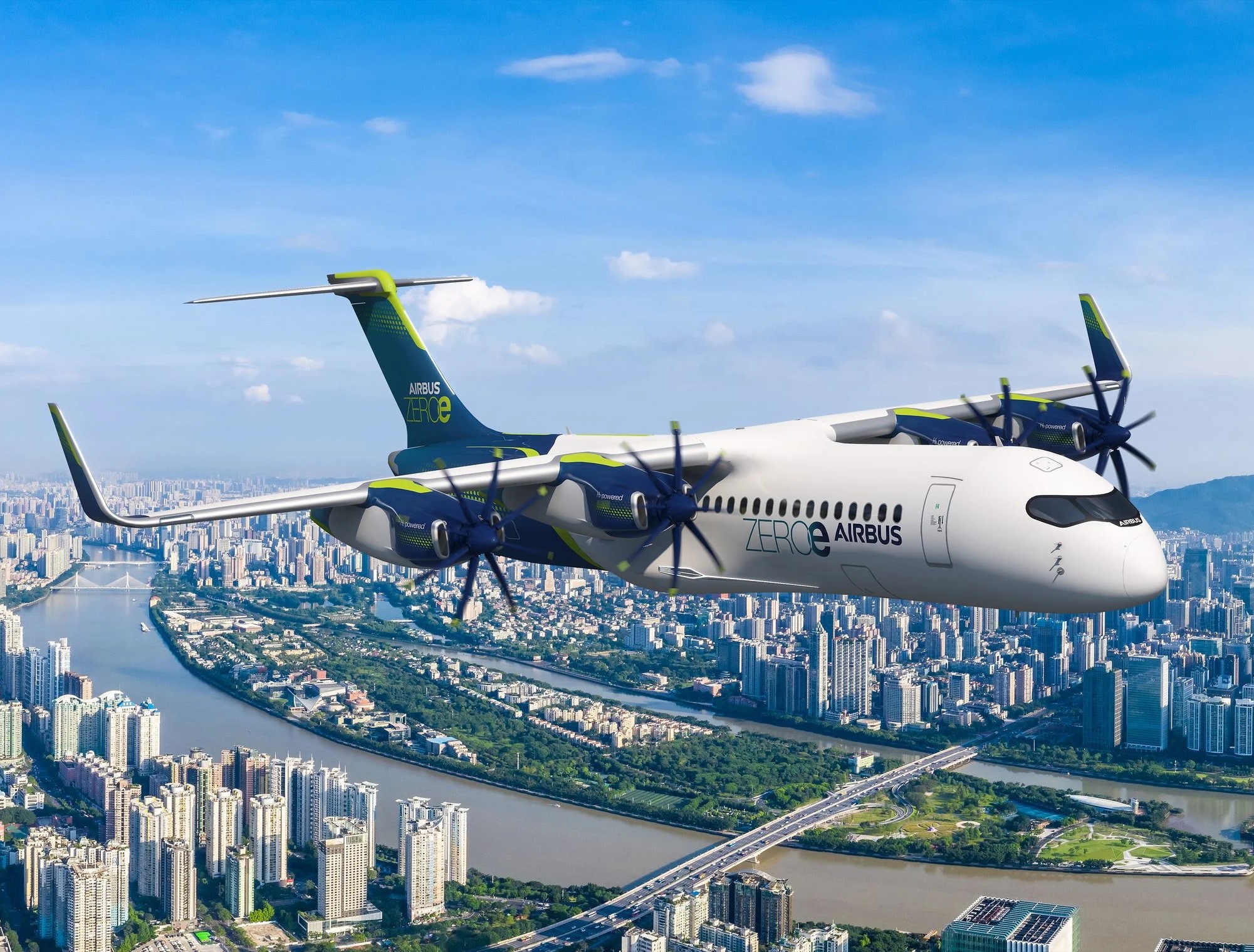
Airbus’ ZEROe
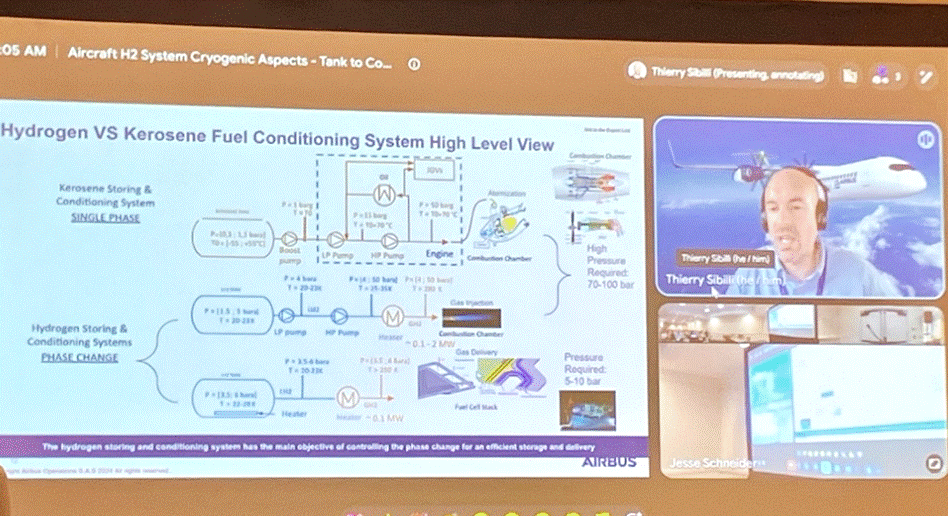
Airbus’ Hydrogen Physics, Methods and Overall H2 System Lead Thierry Sibilli presented work on the design, testing, and modelling of the overall liquid hydrogen system for its upcoming ZEROe development aircraft. Sibilli showed the history of hydrogen development from many EU and international projects and the differences between hydrogen and kerosene fuel systems. Recently Airbus and Washington State University have developed a hydrogen multiphase instrumented test bench, which is also able to capture live images of cryogenic hydrogen to help understand the challenges related to the use of a multiphase fuel. Professor Jacob Leachman, Ph.D., of Washington State University expanded on this two-phase cryogenic flow research, showcasing the team’s groundbreaking test stand and ongoing collaboration with Airbus. He also shared engineering recommendations for controlling thermoacoustic effects and mitigating flow instabilities.
ZeroAvia’s Progress Toward Commercialization
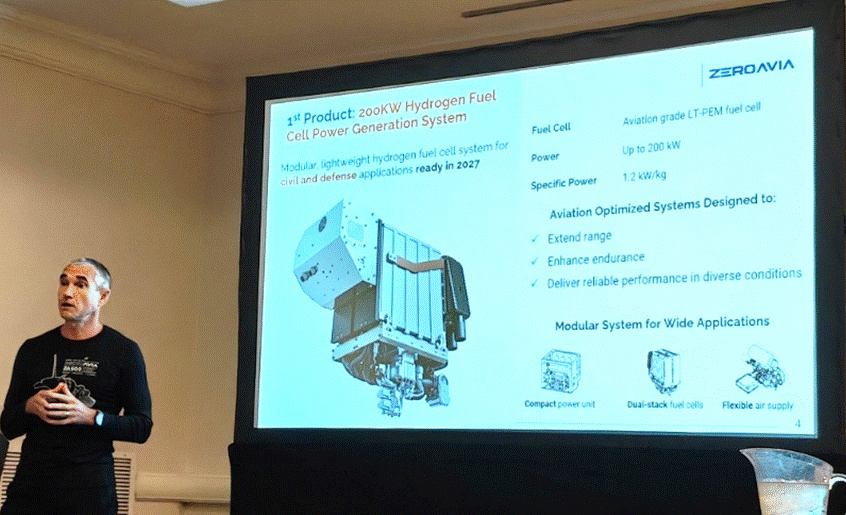
Val Miftakhov, CEO Emeritus and Board Member of ZeroAvia, reported how the company is in process with certification of a 200kW hydrogen fuel cell propulsion system with a specific power of 1.2 kW/kg. The modular, lightweight hydrogen fuel cell system for civil and defense applications should be ready in 2027. The aviation-optimized system can serve as a compact auxiliary power unit, extend range, improve endurance, and operate across diverse aerospace applications. Miftakhov also showed a roadmap for their ZA600 unit (600kW) for a growing defense pipeline and zero emissions propulsion of civil aircraft.
Archie West later discussed ZeroAvia’s development at Cotswold Airport (Kemble, UK), pioneering cryogenic liquid hydrogen (LH₂) fueling for aviation, including safety-first refueling facilities.
JetZero Blended Wing Aircraft
JetZero Head of Propulsion, Romar Frazier, presented the company’s Commercialization Roadmap Enabling the Cryogenic Hydrogen Airliner. Along with industry and government partners, such as NASA and EU’s EasyJet, JetZero is developing a unique blended wing aircraft, using conventional turbines, first using SAF and e-fuel. In parallel, it is developing an architecture for zero emissions flight through the use of liquid hydrogen to be burned using modified turbines. The unique structure of the blended wing body lends itself to be able to carry 250 passengers with both fuels. Some of the liquid hydrogen strategy was developed collaboratively with NASA’s AACES Project in partnership with the University of Illinois Urbana-Champaign and ZeroAvia. While some companies continue exploring fossil fuels such as natural gas, JetZero, Rolls-Royce, Embraer, and Boeing agreed that hydrogen is the sustainable fuel most capable of powering future aircraft at scale.
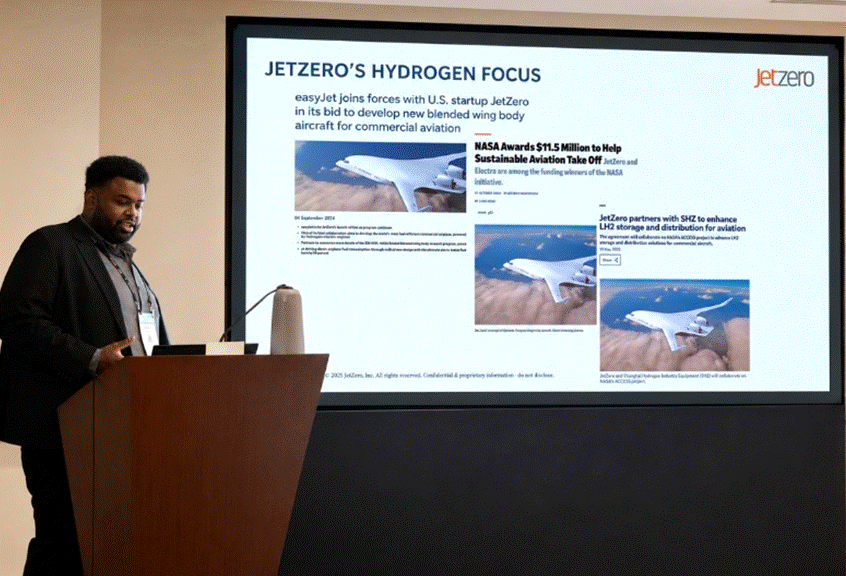
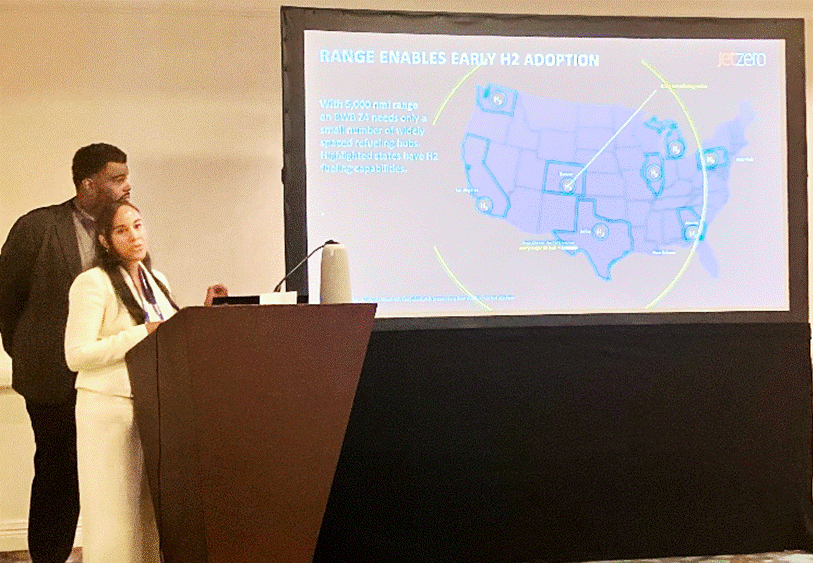
Karmel Graham, senior sustainability strategist at JetZero, spoke of the hydrogen infrastructure strategy to commercially deploy a Blended Wing Body Aircraft with 5,000 nautical mile range. The aircraft needs only a small number of widely spaced refueling hubs in the United States, Europe, and Asia for initial deployment. The business plan includes specific international airports around the world with future H2 fueling capabilities. These hubs would cost roughly the same as a single airport terminal renovation. Graham noted that an LAX airport terminal expansion cost $1.5 billion, which is more than the cost of one very large hydrogen hub, whereas a small hydrogen hub would be around $150 million: New LH2 hub costs are projected to fall by more than half by 2034 and by another 50% by 2040. If pursued aggressively, hydrogen fuel is projected to be the most cost-effective sustainable fuel.
Beyond Aero’s Hydrogen Business Jet
Beyond Aero is developing a hydrogen business jet with gaseous hydrogen infrastructure. CEO Eloa Guillotin noted the company’s pillars for success include:
- Serving an existing market need for business flights using zero emission aircraft
- Leveraging mature PEM fuel cell and gaseous hydrogen technologies to streamline commercialization and certification
- Rapid iteration demonstrating progress toward goals
The company is planning a fuel cell powertrain with 2.4MW (6 x 400kW) and up to 193 kg hydrogen capacity with 6 carbon fiber reinforced Type IV tanks, leveraging decades of ground vehicle advancements and certification. Guillotin indicated that Beyond Aero is tapping into a $30 billion market to satisfy 80% of the European routes and 86% of the U.S. routes while reducing operating costs by up to 50%.
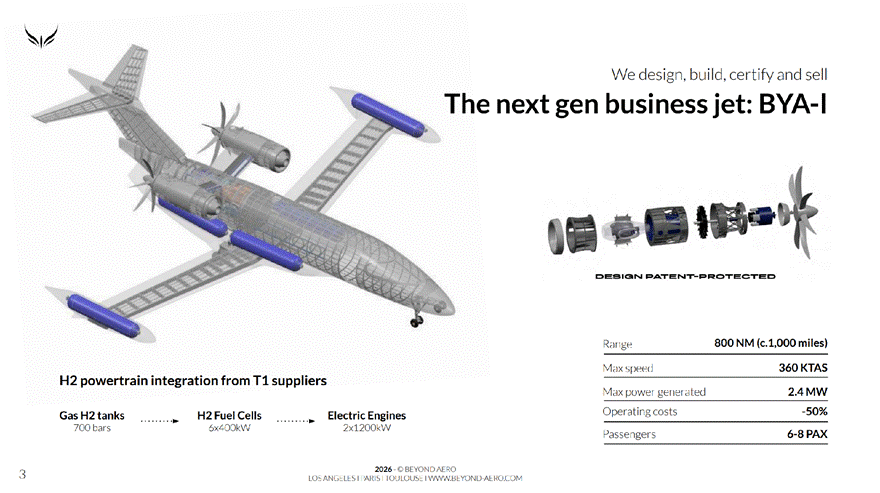
Having achieved TRL 6 with their fuel cell and hydrogen in-house test benches, Guillotin indicated that they will be ready for flight testing for certification around 2030, when hydrogen is projected to be ~<17% cheaper than jet fuel.
Rolls-Royce Modified Rolls-Royce Pearl 15 Engine
Marko Bacic, an Engineering Fellow in Control Systems and Gas Turbine Functionality from Rolls-Royce, presented Rolls-Royce and EasyJet Hydrogen Technology Demonstrator Engine Program. Bacic showed a modified Rolls-Royce Pearl 15 engine that reached full take-off power while running on 100% gaseous hydrogen during ground testing at NASA Stennis Space Center. This achievement marks the first time a modern jet engine has reached full take-off thrust using hydrogen, providing valuable insights into the feasibility of hydrogen as an alternative to conventional aviation fuels. The engine has been tested across the full flight envelope, including simulated taxi, takeoff, cruise, reverse thrust, and shutdown, while achieving maximum power.
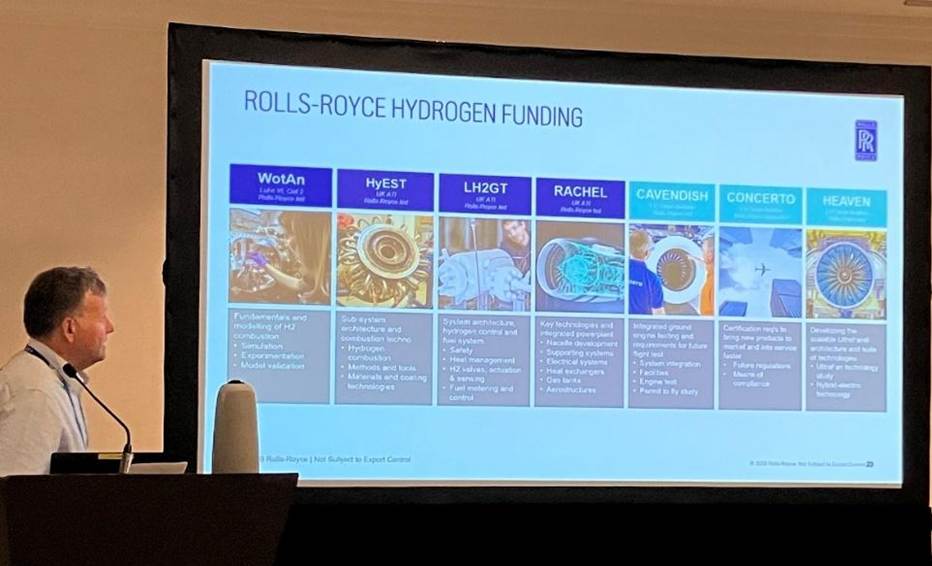
Rolls-Royce’s partnership with EasyJet had support from a number of government-backed programs advancing hydrogen flight from Aerospace Technology Institute’s HyEST, RACHEL and LH2GT program, Germany’s LUFO 6 WOTAN program, and the CAVENDISH program backed by InnovateUK and the European Union’s Clean Aviation joint undertaking.
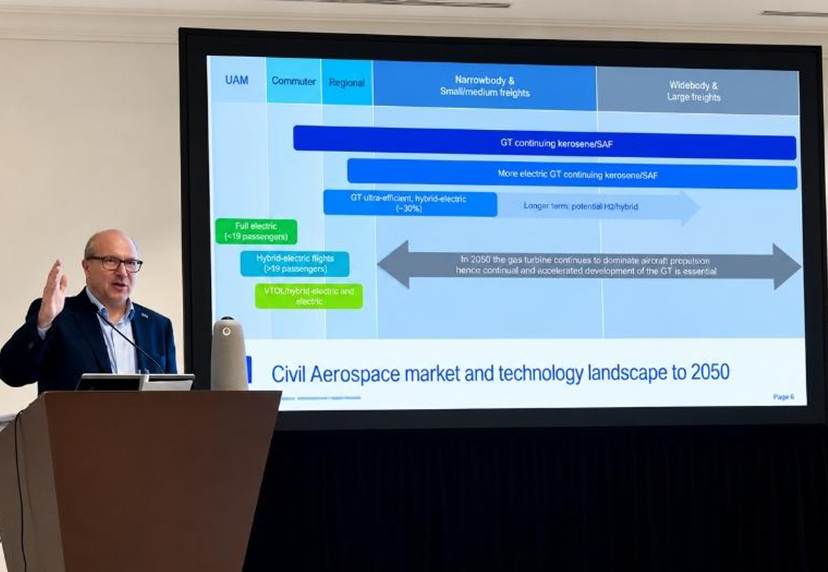
Hervé Morvan, Rolls-Royce Chief of Future Platforms, gave a presentation on hydrogen cryogenics. The Rolls-Royce Roadmap included an overview of potential powertrains to 2050 including electric, hybrid, and hydrogen for the spectrum of aircraft from UAM to widebody. Until 2050, Rolls-Royce believes turbines will be still needed for narrowbody to widebody aircraft, but liquid hydrogen has the ability to replace kerosene at scale.
Embraer’s Hydrogen Flight Path
Other airframer highlights included Vinicius Di Nucci, Head of Zero Emissions at Embraer, who showed Embraer’s roadmap and strategy to achieve zero-emissions flight. Zero-emission aviation is one of six “innovation verticals” Embraer is focusing on as it prepares for its next generation of aircraft. Di Nucci showed a preview of Embraer’s fuel-cell propulsion test rig as it explores the potential of hydrogen as a fuel to decarbonize aviation.
Certification Development Efforts
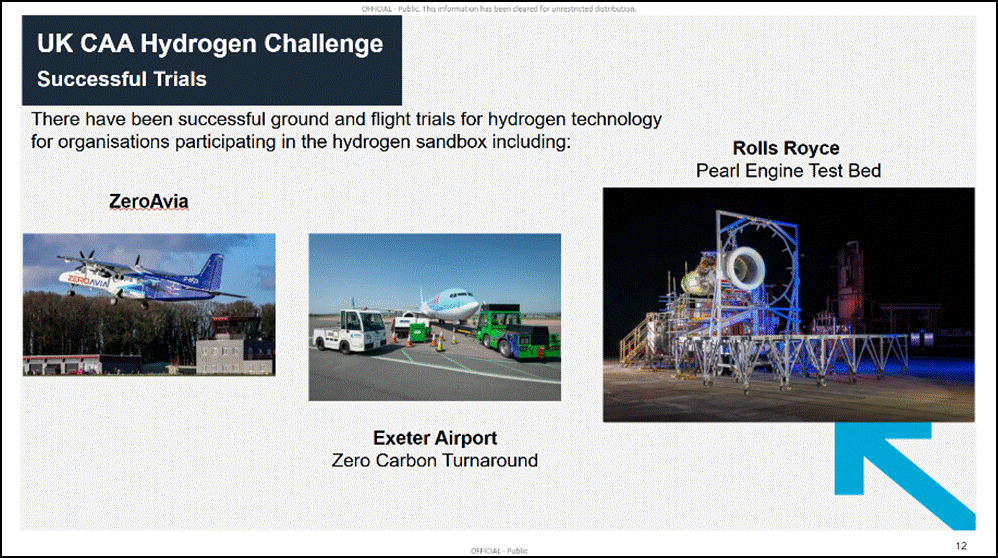
Helen Leadbetter, the Zero Emissions Flight Lead for the UK Civil Aviation Authority (CAA), and Linda Brussaard, lead of H2 Technologies & New Electrical Systems for the European Union Aviation Safety Agency (EASA), discussed a cooperative certification development effort. They also indicated this is a joint activity together with the FAA. The UK CAA Hydrogen Sandbox Challenge, a government-funded effort, has the goal of supporting the development work needed for bringing hydrogen propulsion and fuel to TRL 6 and beyond. The UK CAA has collaborated on hydrogen projects such as ZeroAvia’s flight and liquid hydrogen fueling as well as Exeter Airport’s Ground Support Equipment “Zero Carbon Turnaround” and, more recently, Rolls-Royce’s Hydrogen Turbine Demonstrator with NASA Pearl Engine Test Bed.
H2-Aero Pulls Together a Community of Experts
During his “Decarbonizing Aerospace and Airports with Hydrogen” presentation, symposium Chair Jesse Schneider, CEO/CTO of ZEV Station, emphasized the role of synergies for the infrastructure for zero emission ground and air transportation, as well as creating multimodal hydrogen airport hubs.
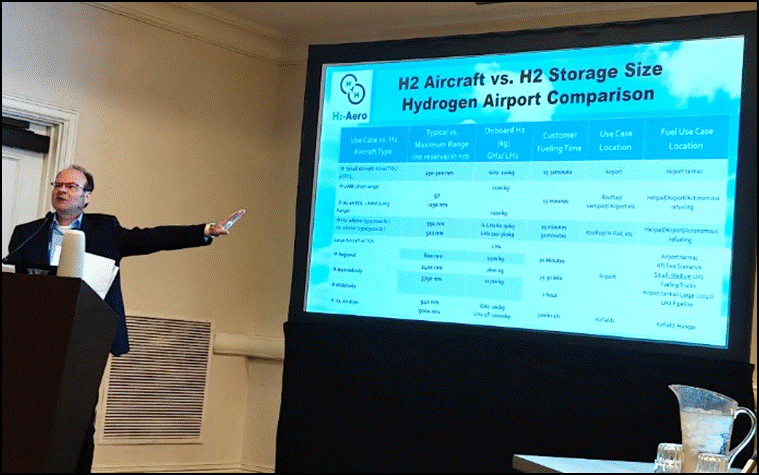
Schneider described H2-Aero as an “it takes a village” effort, bringing together industry, academia, and government to decarbonize aviation and airports. This includes the aerospace industry, certification bodies, technology companies, standards organizations, university and government research laboratories. A white paper, first published in 2023, “Multimodal Hydrogen Airport Hub,” contains calculations of the fuel needs for each type of hydrogen aircraft; this effort spawned the creation of the SAE International AE-5H Hydrogen Airport Committee.
The H2-Aero white paper also did a comparison of hydrogen to SAF as an aviation fuel. The findings are that e-fuels used to create most SAF use ~ 3x more energy to produce liquid hydrogen at scale (approximately 218 MJ vs 788 MJ). Over time, hydrogen is expected to become both more cost-effective and significantly less energy-intensive to produce and distribute. The white paper will be updated in late 2026 to showcase the latest technology advances shown at H2-Aero, and specify hubs for airports leveraging ground vehicles (e.g., hydrogen buses) and hydrogen aircraft with a model to scale to replace jet fuel and SAF.
On 11 June, the SAE International Hydrogen Airport Committee (SAE AE-5H) met in conjunction with EUROCAE at AIAA AVIATION Forum. The workshop focused on liquid hydrogen fueling, coupling, and aircraft storage safety, as well as gaseous hydrogen, with the industry and regulators (EASA and CAA).
Many thanks to all those presenting and the session chairs, Phillip Ansell (University of Illinois Urbana-Champaign), chair of the AIAA Sustainability Committee, and Jim Sherman (AIAA) for your great collaboration and teamwork.