

Founder and CEO Blake Scholl argues that rapid iteration and passenger-first economics are the only path to a viable supersonic market.
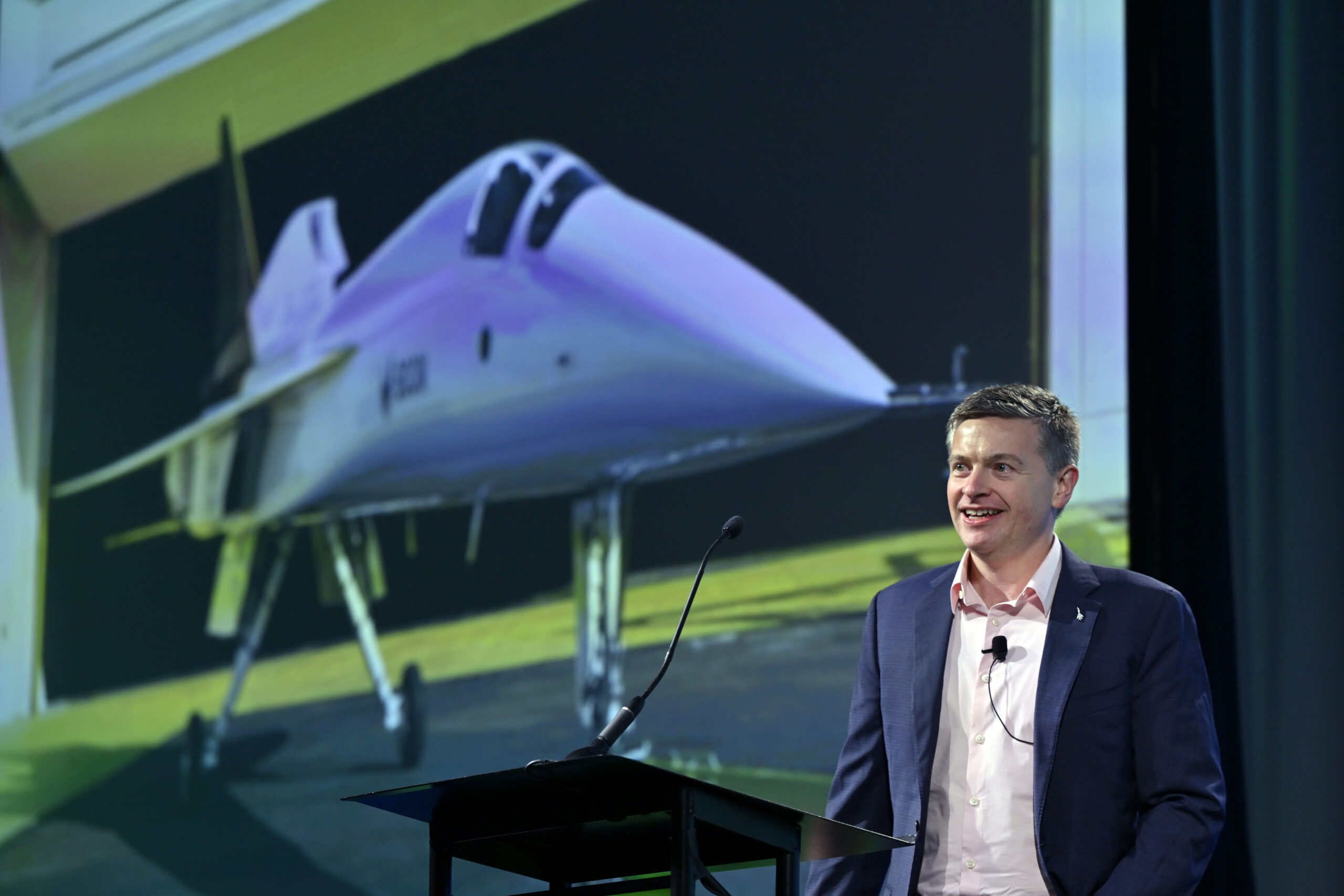
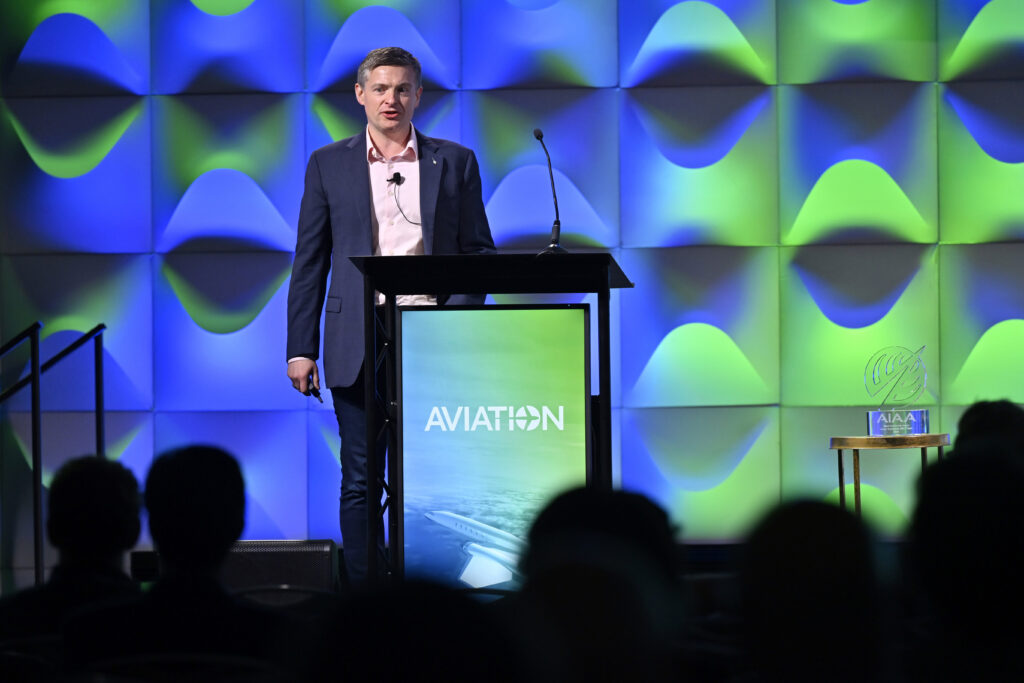
SAN DIEGO – At AIAA AVIATION Forum plenary on 11 June, Boom Supersonic Founder and CEO Blake Scholl argued that the next jet age will belong not just to faster airplanes, but to aircraft designed around the people inside them.
“You can’t just design ideal aerodynamics, cram the passengers in as an afterthought, and hope it all goes well,” Scholl told the aerospace engineering audience. “The airplane has to make sense – technically, economically for airlines, and as an experience that passengers want to fly on over and over again.”
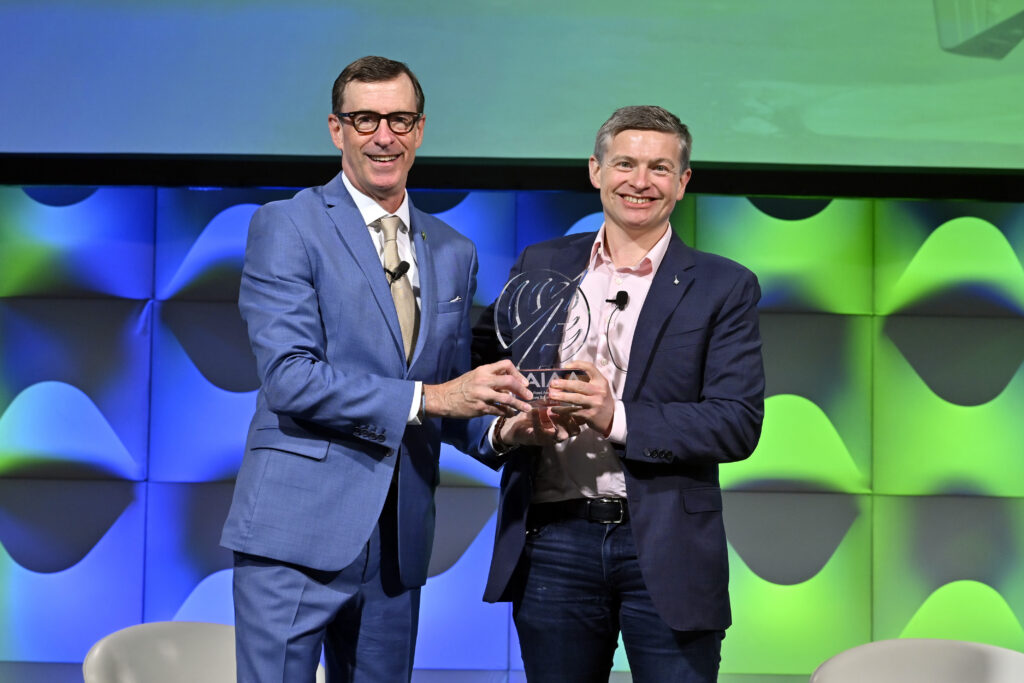
That passenger-first philosophy is guiding Boom’s bid to become the first independent company to deliver Mach-speed commercial travel without an audible boom over land – a milestone the firm has begun to validate with its XB‑1 demonstrator. In January 2025, the aircraft broke the sound barrier, becoming the first independently developed supersonic jet, and earning the company the 2026 AIAA Reed Aeronautics Award, the highest honor the Institute bestows for notable achievements in aeronautics.
A Nontraditional Founder
Scholl was in his mid-20s working in tech in Seattle when he became personally obsessed with supersonic flight after spotting one of the final Concorde aircraft on the evening news. He set up a Google alert for “supersonic tech,” but nothing happened for a decade.
“There was more progress in supersonic music than in supersonic flying,” joked the former Amazon and Groupon online marketing executive, concluding that if he wanted a supersonic ticket, he’d have to build the airplane himself.
Scholl founded Boom Supersonic in 2014 in Centennial, Colorado, bringing first-principles thinking and software-style iteration to an industry where aircraft programs typically take decades.
Learning from Concorde
Scholl insists Concorde’s failure was not a technology problem but a product–market-fit problem. The 100-seat aircraft offered cramped seats at roughly $20,000 per ticket in today’s dollars and still flew half-empty on its flagship New York–London route.
Boom’s planned next-generation supersonic commercial airliner, Overture, is built around a different revenue logic. On a modern widebody, the first roughly 64 business-class seats drive about half the revenue and 80% of operating profit, Scholl said. His proposition: strip out that profitable cabin, put it in a supersonic airframe, and let airlines charge similar fares while making more money per seat.
Unlike Concorde, which had one profitable route, Boom’s vision for an affordable supersonic jet “would have hundreds of profitable routes and change the way tens of millions of people fly,” he said. United, American, and Japan Airlines have already placed orders or pre-orders for Boom Overture.
Following SpaceX’s Vertical-Integration Model
Scholl’s central design principle comprises a three-legged stool: aerodynamics, economics, and passenger experience, all developed as one integrated system. He links this philosophy directly to SpaceX’s vertical-integration playbook.
“I’ve come to believe we were crazy to do this any other way,” he said, comparing Boom’s decision to build its own Symphony turbofan to SpaceX’s in-house Merlin and Raptor engines. “It’s hard to imagine the success story that was SpaceX had they gone outside for rocket engines.”
Instead of heavily relying on external suppliers that often include long lead times, Boom embraces its own iteration loop, where the R&D shop and the company’s Symphony Engine Facility are designed to go from raw materials to completed jet engine parts under one roof.
The strategy extends to manufacturing. Boom’s in-house manufacturing capability lets engineers move from CAD to finished hardware in under 24 hours. Custom digital tools – including a whole-aircraft optimization environment and a real-time blade design system – allow a single engineer to adjust engine geometry and see structural and aerodynamic effects almost instantly.
Boomless Cruise and Changing the Rules
A critical enabler of Boom’s business case is “boomless cruise”– flying above Mach 1 without a perceptible sonic boom at ground level. The temperature gradient in the atmosphere beneath cruising altitude refracts shock waves back upward in a phenomenon called Mach cutoff. Boom’s on-board compute enables this phenomenon to be calculated in real time, ensuring no Boom reaches the ground. An executive order repealed the overland Mach 1 speed limit, with the FAA now working on final rulemaking.
Related Reading: Aviation Startups Showcase Disruptive New Aircraft Coming by 2050
Execution Is the Only Remaining Risk
Ground-power versions of Boom’s Symphony engine have already attracted more than $1 billion in orders, helping finance the airliner program while generating reliability data in a non-safety-critical environment.
During the Q&A, Scholl acknowledged his one significant regret: treating the XB‑1 as a one-off demonstrator rather than building multiple experimental aircraft. “That slowed learning and made the program far harder than it needed to be.”
Asked about the biggest risk facing supersonic’s future, he did not hesitate: “It’s actually all just execution. We know the market wants this. We know the technology is there. The risk is that we make a mistake we don’t recover from.” History, he warned, is “very unforgiving to failure.”
But if Boom and others succeed, he envisions a generation that will grow up taking supersonic travel for granted. “What happens when we can traverse the planet quicker than we can today at fares most of us can afford? What happens when we have to convince the next generation of kids that we didn’t always fly supersonic?” he asked. “That’s the future I want to live in.”
Both Daniel Turchiaro and Kaushik (Kash) Anantha, early-career engineers and graduates of Embry‑Riddle Aeronautical University, found Blake Scholl’s message inspiring.
“It’s very interesting being present for changes in the industry,” said Turchiaro, who contrasted Scholl’s agile culture with aviation’s “legacy mentality” and tendency to operate in large, disconnected teams. “That all takes time away from working on a project in a constructive, iterative way.”
Anantha, in just his second week on the job, said hearing how Scholl “started from nothing and learned everything on his own” makes him “more optimistic that young people like me can push boundaries and make successful and innovative products like Overture. It’s pushed me to go beyond traditional methods of thinking.”
Student Meet and Greet with Blake Scholl
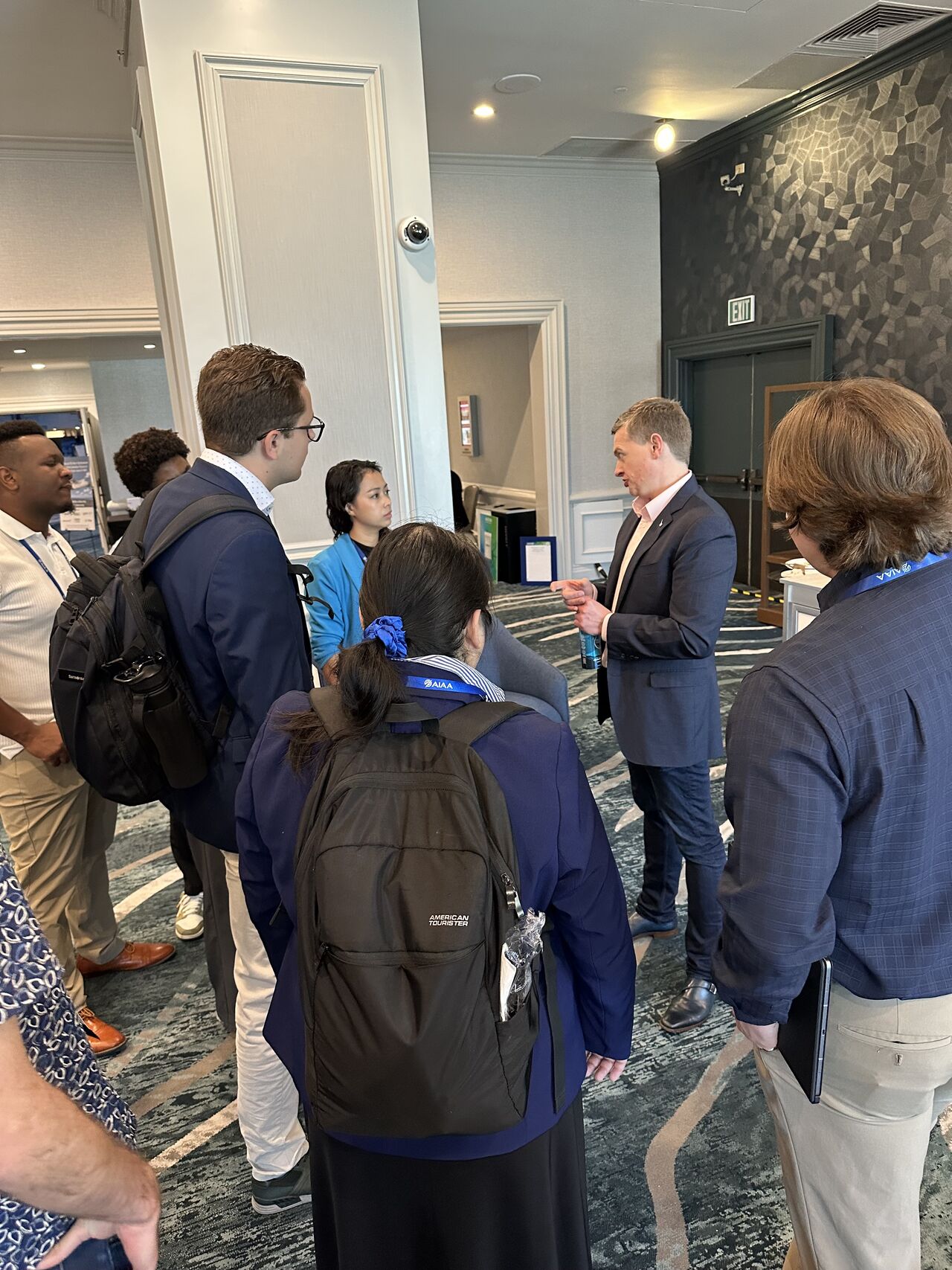
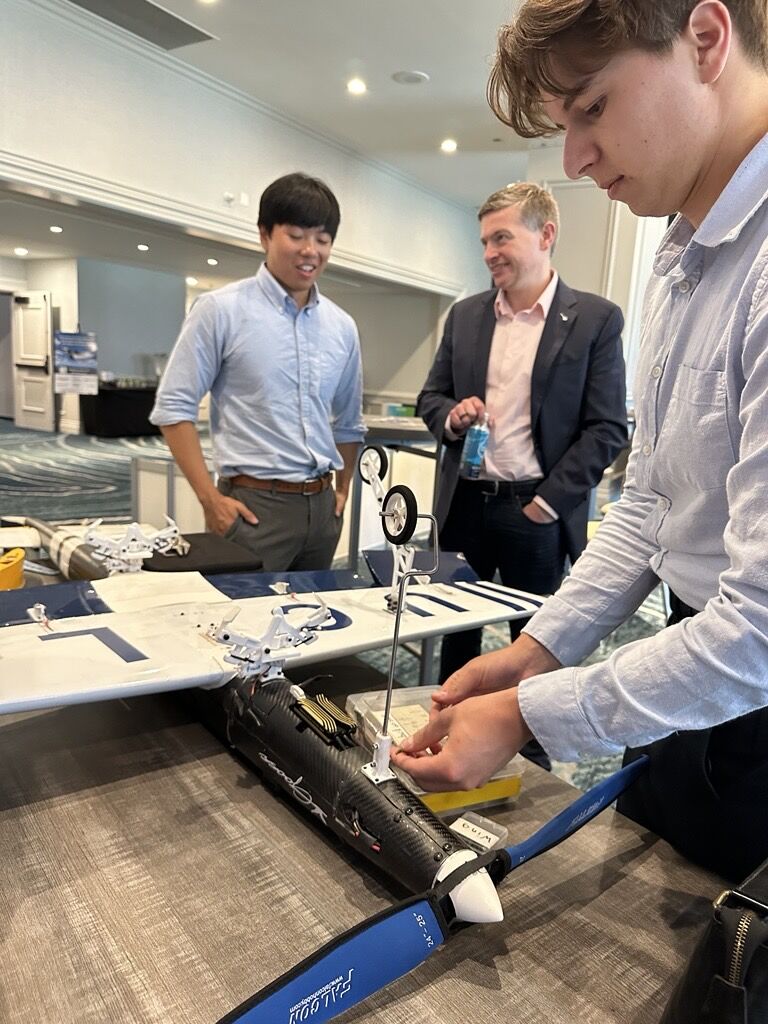
After the stage, Scholl talked with future aerospace engineers in the Student Lounge.
He also met teams from San Diego State University, UCLA, and University of Southern California who participated in this year’s Design/Build/Fly Competition.