

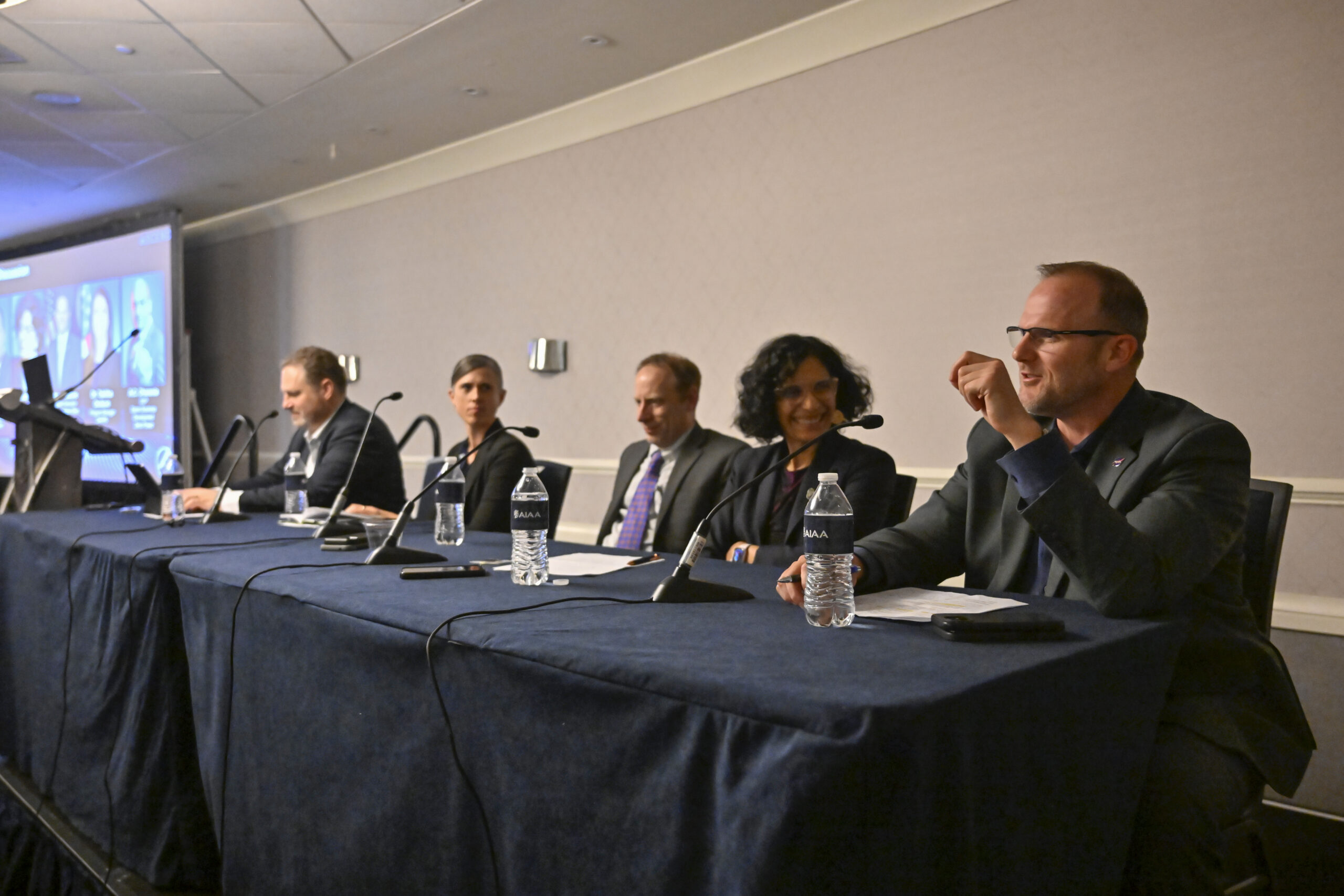
A workshop on nuclear capabilities in space dove into the opportunities and challenges that have surrounded this powerful technology since the first space race.
The workshop at AIAA’s ASCEND event in Washington, D.C., was hosted by Brian Weeden, Director of Civil and Commercial Policy at The Aerospace Corporation’s Center for Space Policy and Strategy. It kicked off with a lively discussion of nuclear power in space, then transitioned into interactive roundtables on related topics.
Bhavya Lal, professor at the RAND School of Public Policy, narrated the decades-long trends that have stymied deployment of nuclear power on orbit – notably, little to do with nuclear itself.
“The technology has never been the bottleneck,” Lal said. “What has failed each time is the system around the reactor: the mission case, the scope, the discipline, the political continuity, the leadership architecture. If anyone tells you the American space nuclear program is a technical problem, send them to me. I will tell them that we’ve spent sixty years and over twenty billion dollars proving them wrong.”
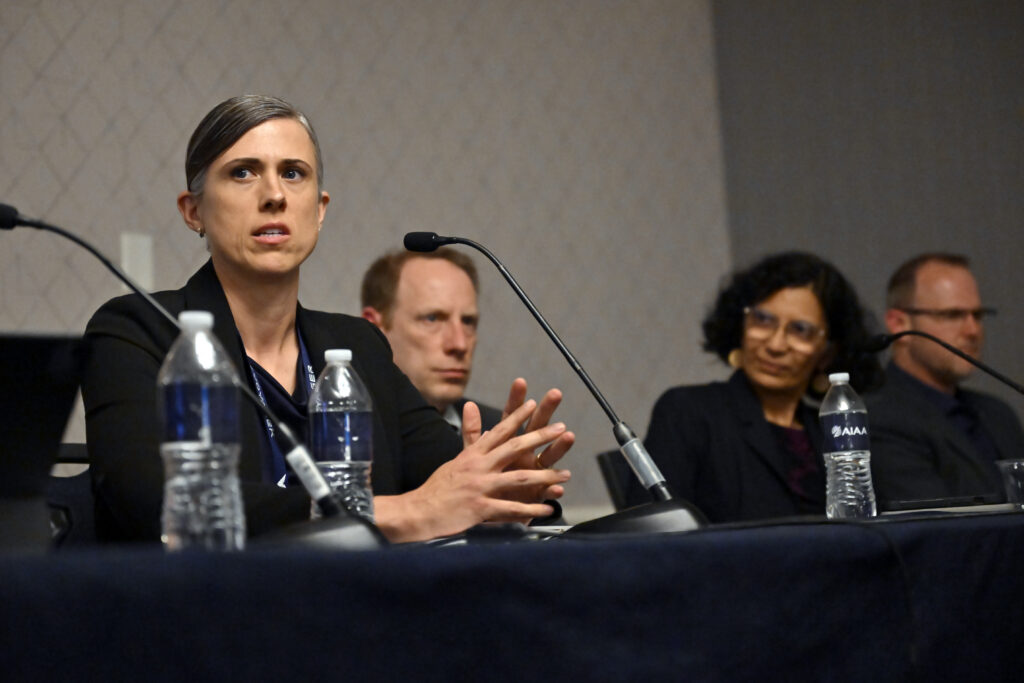
Tabitha Dodson, program manager in DARPA’s Defense Sciences Office, concurred: “The United States hasn’t really evolved our nuclear space technology since the fifties or sixties — when we were coming out of the steam age.” In her overview of current research, she noted radioisotope power systems and direct-energy power conversion systems as priorities.
An executive order calling for the United States to operate a nuclear reactor in space by 2028, and on the lunar surface by 2030, was called “ambitious” by Aaron Miles, coordinator for strategic capabilities at the White House Office of Science and Technology Policy. But ambition may be what is required here.
“We’re really trying to get the right balance of ambitious and achievable. Lunar surface reactor development efforts and in-space reactor efforts can benefit each other,” Miles said.
“There are technical challenges,” he admitted, “But there is nothing in the technical space that’s been identified that should preclude achievement of these objectives, on the objective timelines. There are significant challenges and potential for challenges on the regulatory pathway.”
Steve Sinacore, program executive at NASA’s Space Reactors Office, is charged with a technical and regulatory pathfinder on this subject, the Space Reactor-1 (SR-1) Freedom mission and space nuclear electric propulsion (NEP) demonstration.
“The goal of SR-1 is not to do everything — it’s to ‘right-size’ it,” he explained. “Get it on a launch vehicle that currently exists, at a scale and size that’s extensible to future missions, and reuse as much hardware as possible. Ideally, you’re looking for a common tech platform that can be used both for in space and surface.”
The panel and subsequent roundtables will be distilled in a report to be published soon by The Aerospace Corporation.