

ORLANDO, Florida—The United States is in the midst of a “space revolution,” but the hands that will inherit the Earth and the space surrounding it is in short supply.
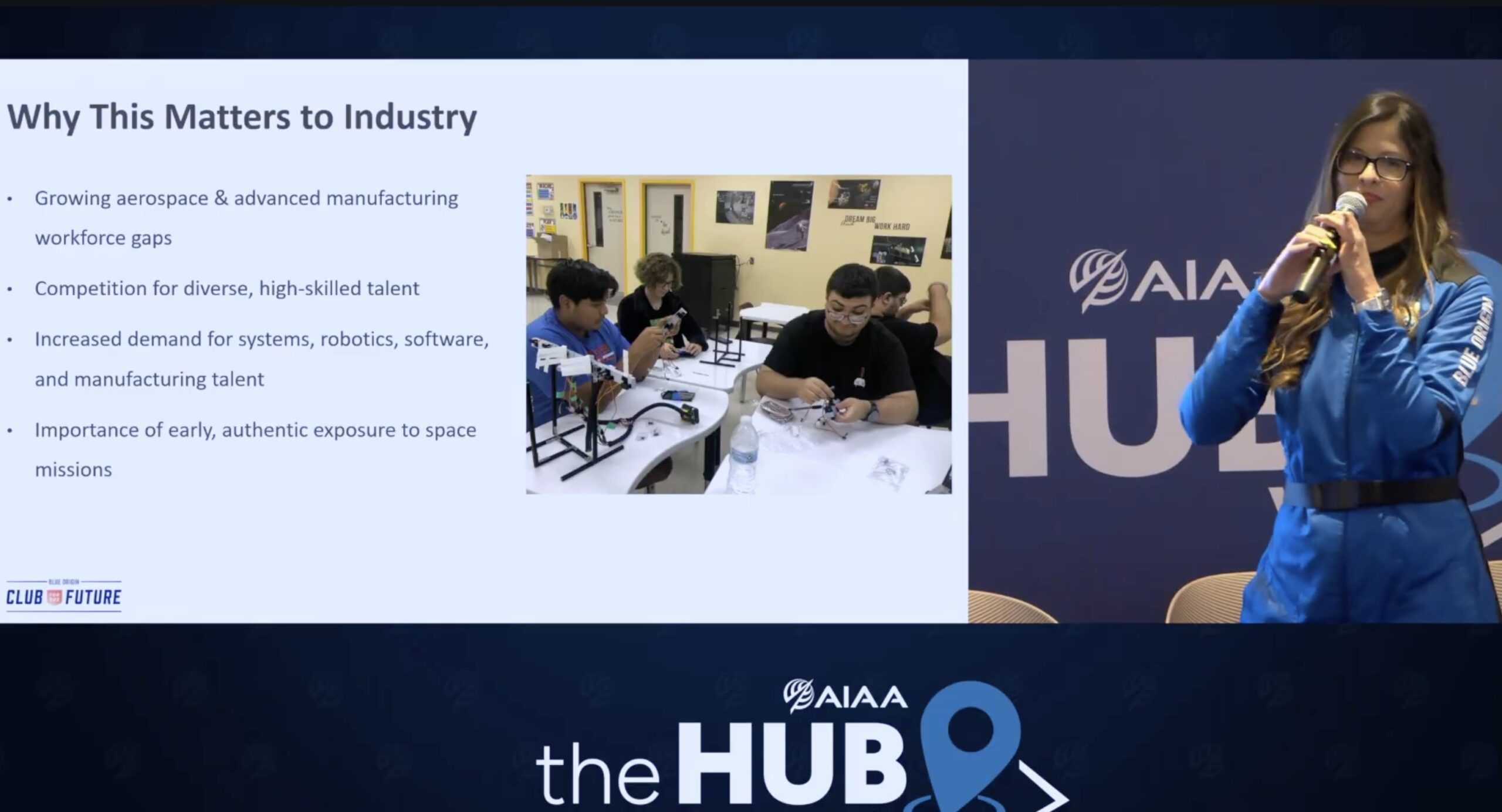
“We need more hands on deck,” said Amy Medina Jorge, astronaut and middle school teacher from Texas who flew on Blue Origin’s New Shepard NS-32 mission in May 2025. Medina and Kristen Yip of Blue Origin spoke on the HUB Stage at AIAA SciTech Forum 2026 about building the talent pipeline for space.
Interest in spaceflight is exploding. Over the past three years, Blue Origin alone has swelled from about 6,000 to more than 11,000 employees, and the broader commercial sector now rivals—or exceeds—NASA’s historic role in advancing exploration, said Yip, Education Program Manager for Blue Origin’s Club for the Future, focusing on STEM outreach for K-12 students.
That rapid expansion has exposed a widening advanced‑manufacturing and aerospace skills gap. Companies need engineers who can move from theory to hardware, who understand robotics, autonomous systems, and the regulatory nuances of commercial drone operation—all competencies that traditionally begin in middle‑school labs and high‑school workshops, Medina said.
“The gap isn’t just a hiring problem; it’s a pipeline problem,” she explained. “If we don’t start building those skills now, we’ll be scrambling for talent when the next generation of lunar habitats and Mars‑bound vehicles comes online.”
Medina’s own journey – the first Hispanic female teacher to ride a commercial vehicle in space – illustrates a new model for STEM education: put a teacher in space, then let that experience cascade back into classrooms worldwide. While aloft, she flew a suite of experiments—seed germination studies, a bio‑sensor for physiological monitoring, and a CubeSat coded by her students that transmitted data during the suborbital trek.
“The flight gave my students a tangible connection to the work they’re learning,” Medina said. “Before the launch we discussed the payload, they wrote code, and after we compared the CubeSat telemetry and the data we gathered in a parabolic flight. That full‑cycle research experience is exactly the kind of hands‑on, data‑driven learning that industry needs.”
She also distributed digital postcards—personalized messages that were flown on the suborbital vehicle and returned as “space‑art” souvenirs. Partner organizations in Latin America turned the postcards into boarding‑pass‑style outreach tools, allowing Spanish‑speaking students to see themselves reflected in the mission’s narrative. “Seeing a teacher who speaks their language in orbit creates a sense of belonging,” she noted, “and that emotional hook is what turns curiosity into a career choice.”
Yip outlined how Club for the Future translates experiences into change. The organization supplies free standards‑aligned lesson plans that connect what students are learning in the classroom to careers in STEAM and space to teachers across the United States and abroad. She emphasized that the model is scalable: “We aren’t looking for a one‑off teacher‑astronaut. Every flight, every astronaut, every engineer can become a conduit for a classroom,” she said.
The speakers agreed that the traditional “college‑first” pathway is insufficient for the near‑term needs of commercial space firms. Companies require certified skill sets—for example, FAA‑approved commercial drone pilot licenses—that can be earned in high school. Medina’s school offers a drone‑pilot certification track, and she plans to expand it to include micro‑gravity experiment design and CubeSat integration, directly mirroring the competencies sought by Blue Origin, SpaceX, and emerging lunar‑habitat contractors.
Since its inception in 2019, Club for the Future has distributed more than 20,000 lesson kits, facilitated more than 150 digital‑postcard missions and trained approximately 3,000 teachers through webinars and in‑person workshops. “Our goal is to inspire future generations to pursue STEAM careers,” Yip said.
The speakers concluded with a call to action for engineers, manufacturers and policymakers: invest in the pipeline now, or risk a talent shortage when the next generation of orbital factories, lunar refineries and Mars transit vehicles launch. They urged industry partners to sponsor classroom kits, host mentorship days, and, where possible, allocate seats on upcoming flights for educators.
“Space is no longer a niche government activity,” Yip said. “It’s an ecosystem that thrives when every stakeholder—engineer, teacher, astronaut, student—acts as a force multiplier. The model we’ve shown today proves that a single teacher’s journey to space can ripple outward, creating a cadre of future engineers ready to build the habitats, propulsion systems and autonomous robots that will carry humanity forward.”