

Simulating activity on the lunar surface is essential as the United States pursues its plan to return to the moon to stay. But it’s not just craters and regolith: a robust simulation goes beyond physics to model power, interactions, and even economic incentives — as participants in the LUNAverse initiative discussed this week at ASCEND.
The simplest way to think of LUNAverse is as a “digital twin” of the moon, but The Aerospace Corporation’s Dennis Paul described it as a “common operating picture” for everyone planning to go there.
“The moon is wide open,” he said. “Nobody owns it, but everybody’s going to go there. So how do we as a community work together?”
That community is international, cross-discipline, privately and publicly funded, and often with a digital engineering environment of their own. The job, as Paul said, is not to take over and offer one system “to rule them all,” but offering a multi-compatible platform for collaboration. To that end, a software development kit (SDK) is being readied for a limited release this summer.
“It’s about data sharing, standardization, coordination, collaboration and integration amongst a very large and diverse community,” he explained. “Space Force, Department of Commerce, international partners… Everybody got digital engineering religion real fast because they recognize how big and how complex the problem is. You need something like this to help you bring it together and explore it.”
Questions from the audience raised numerous potential issues, like compatibility, trust, and security — many of the issues the panel expects to learn about by testing the system with early adopters when the SDK is distributed.
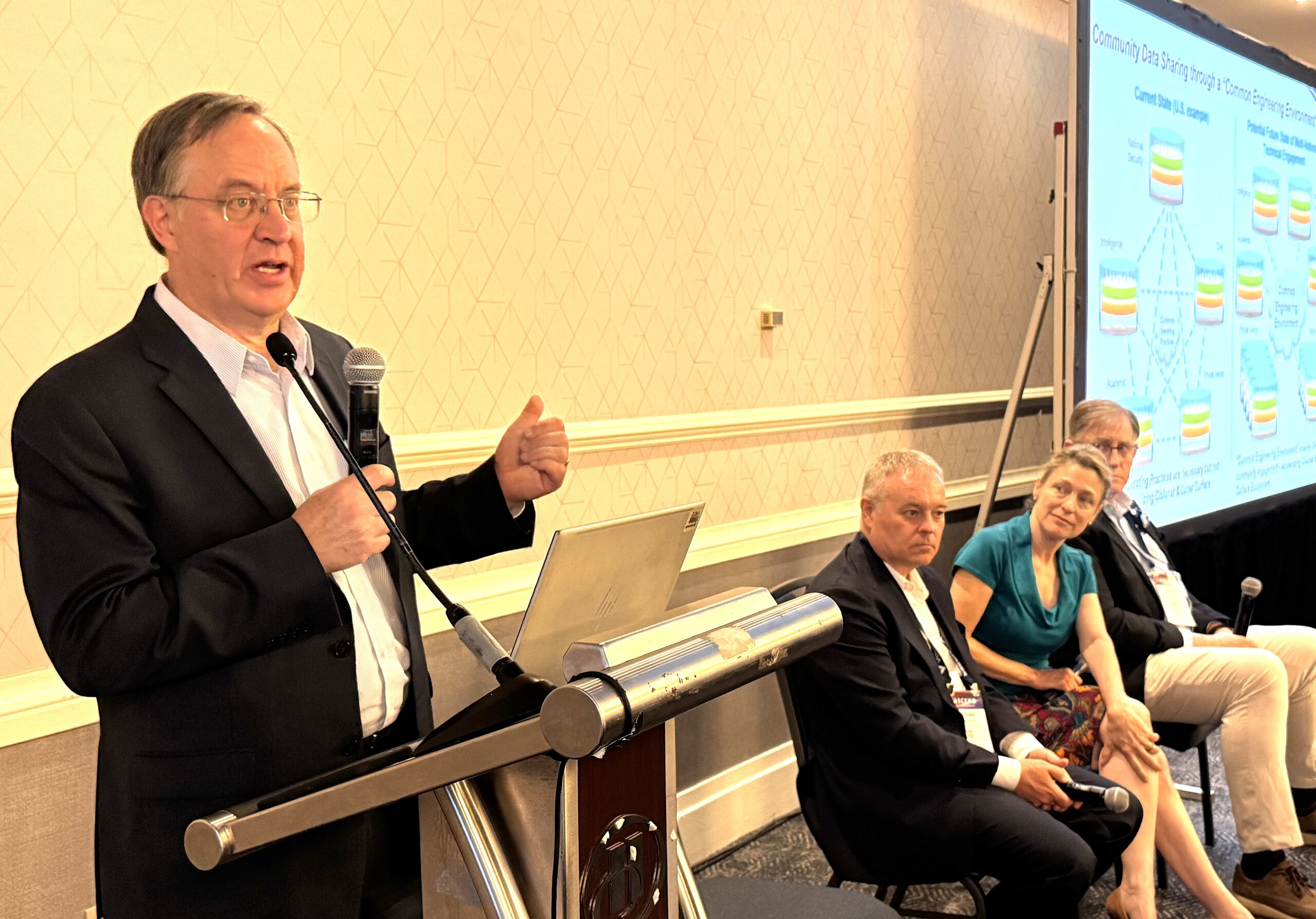
The panel, shown in the photo above, also included Michael Mealling, General Partner at Starbridge Venture Capital; Lee Steinke, Chief Operating Officer of CisLunar Industries; and Dan Dumbacher, Professor of Engineering Practice at Purdue University.