

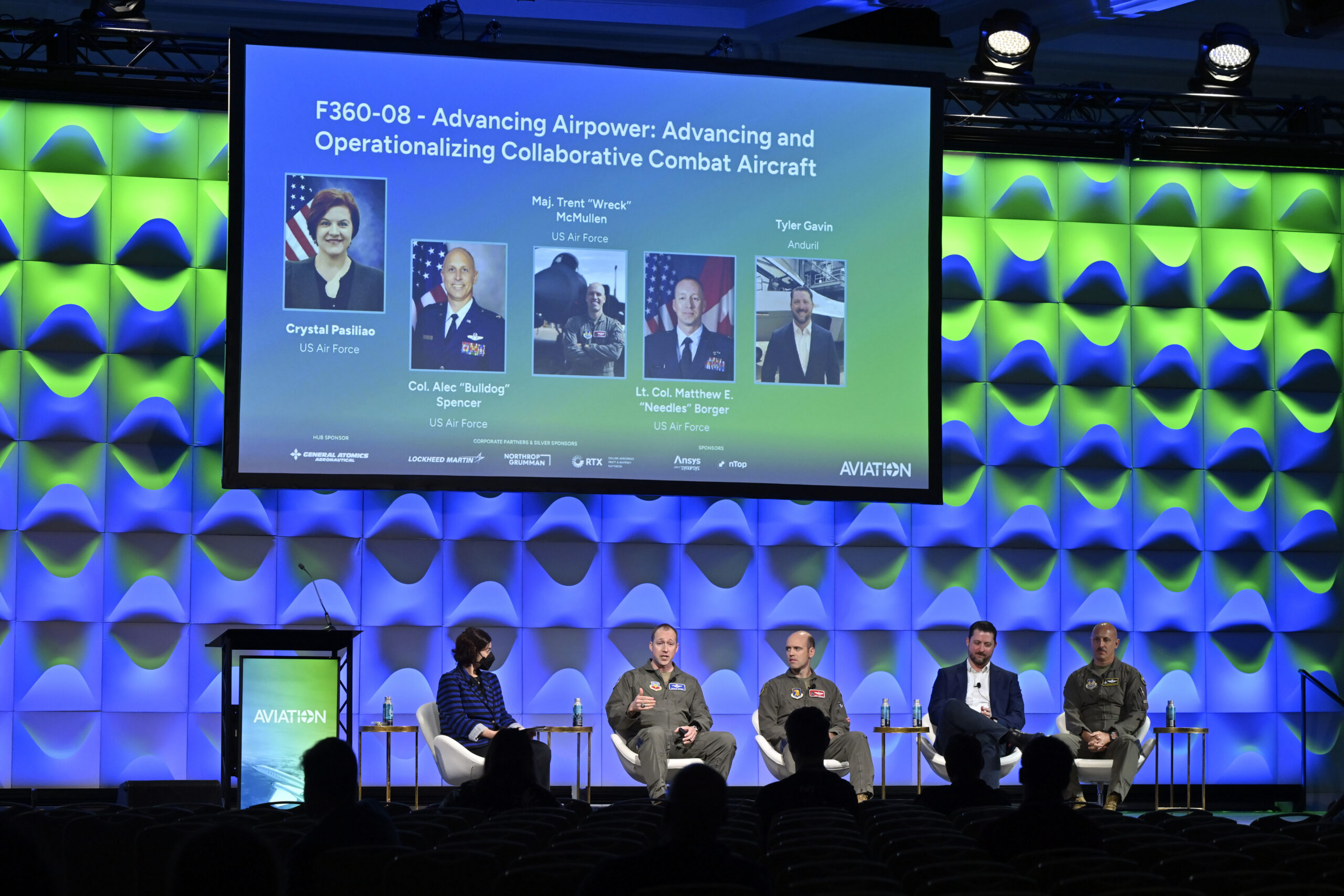
At AIAA AVIATION Forum 2026, leaders detail live teaming flights, rapid test surrogates, new CCA production line capable of 150 aircraft/year
SAN DIEGO – Air Force leaders and industry partners working on the Collaborative Combat Aircraft (CCA) Program said at the AIAA AVIATION Forum 2026 that the United States can no longer rely on long, linear acquisition timelines if it hopes to keep pace with technologically sophisticated adversaries.
“Cost, schedule, performance…are no longer the metrics anymore. It’s missionized outcomes,” said Col. Alec “Bulldog” Spencer, director, Air Force SEEK EAGLE Office, speaking on the “Advancing Airpower” panel, urging, “How do we get something that solves the warfighter problem now?”
Spencer was joined by colleagues from Air Combat Command, the Eglin Air Force Base, and Anduril’s Fury CCA program.
Lt. Col. Matthew “Needles” Borger, deputy division chief, ACC Autonomous Collaborative Platform System Management Office, noted that adversaries are producing more aircraft, more weapons, and more capable systems across multiple domains. That has eroded the de facto air dominance the U.S. Air Force once assumed. CCA are intended to “claw back” that advantage by adding affordable, autonomous systems that extend the reach and survivability of fifth- and sixth-generation fighters, Borger explained.
CCAs respond to intent-based commands, letting a single operator manage multiple aircraft while focusing on higher-order tactical decisions. Borger framed this as a way to maximize human-machine teaming by offloading procedural tasks to machines, so humans can stay focused on judgment and adaptation in the “gray space” of warfare.
Speed Through Competition and Open Systems
A recurring theme across the panel was the need for speed. Borger contrasted the CCA approach with traditional aircraft programs that often take 15 to 20 years from design to initial fielding. In the CCA program, the Air Force is moving from design to initial production in under three years.
One way they are doing that is by having multiple primes compete concurrently on Increment 1 platforms while autonomy developers work in parallel. Mission systems software is being developed by firms such as Shield AI and RTX, and is already flying on test aircraft. The air vehicles themselves are being designed to government reference architectures with open mission systems so that software from one vendor can run on another’s platform.
This is intended to avoid vendor lock and to ensure that future increments of CCA can still communicate and interoperate with earlier versions. Borger stressed that Increment 1 is not the final answer, but the first step in an evolutionary family of systems.
AI XQ‑58 Flights Shape CCA Tactics
Maj. Trent “Wreck” McMullen, an F-15 pilot and Advanced Capabilities Division Chief with the 40th Flight Test Squadron at Eglin Air Force Base, described how his team is translating CCA concepts into real-world lessons. Eglin operates two XQ-58 uncrewed aircraft as surrogate platforms that approximate the size and basic configuration of a CCA.
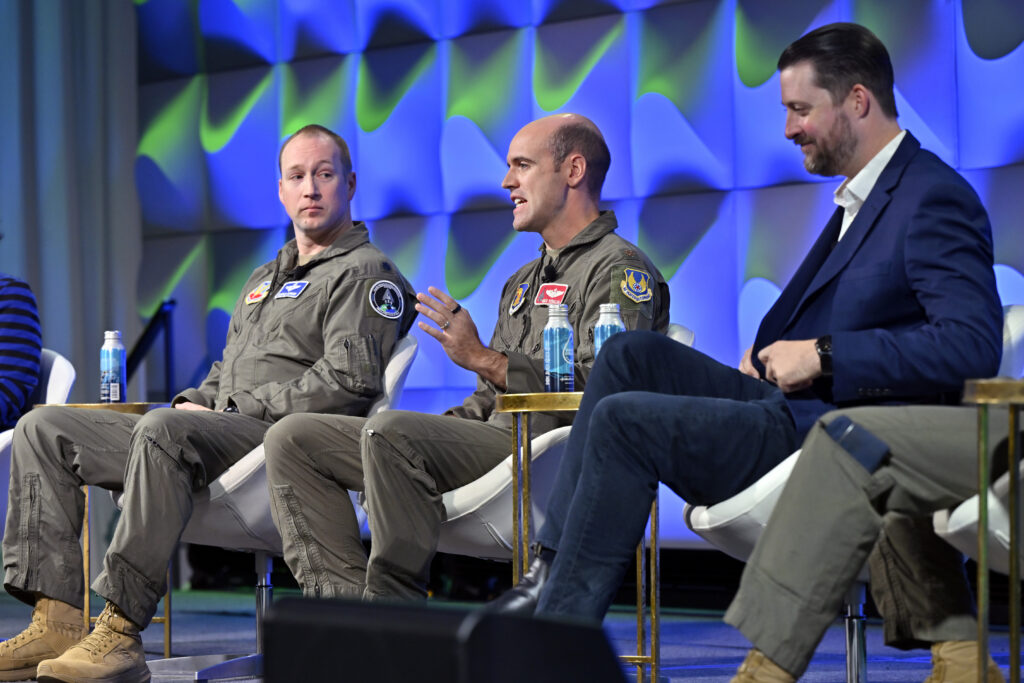
McMullen explained that the test team has followed a crawl, walk, run progression. Early flights focused on basic autonomous navigation and safety checks. Subsequent work expanded into one versus one beyond visual range intercepts with agents ranging from scripted heuristics to deep reinforcement learning. Most recently, Eglin executed a two versus two beyond visual range scenario in which an F-15E and F-16 worked with two XQ-58s under autonomous control.
The primary objective in that event was to understand pilot workload and situational awareness when a human “quarterback” manages both their own aircraft and multiple autonomous teammates. The team came away with recommendations on pilot vehicle interface design, including how best to display autonomy intent and status in the cockpit.
McMullen emphasized that the hardest part has not been creating AI agents. The real challenge has been integration with legacy hardware, data links, and requirements that were not originally written for autonomy. His hope is that developmental test can inform what works and what doesn’t so that programs of record receive better defined and more realistic requirements.
Fury CCA Enters Weapons Test Phase
From the industry side, Tyler Gavin, chief engineer for Fury International at Anduril, offered a view into how a new entrant is answering the Air Force’s demand for speed and flexibility. Fury is Anduril’s CCA family of systems. Gavin explained that the company deliberately skipped the traditional model of putting a stick and throttle in a box and treating the vehicle as another remotely piloted aircraft.
In February, Fury conducted its first mission autonomy flight with Shield AI’s Hivemind software. Flight autonomy carried the aircraft to Eglin’s dedicated test airspace. Control then shifted to Hivemind, which executed a series of mission test cards. Afterward, control was switched to Anduril’s own mission autonomy stack, which ran the same cards. Gavin said this validated the government’s open architecture approach by demonstrating that multiple mission autonomy providers could operate on the same airframe during a single sortie.
In parallel with autonomy, Anduril has been performing inert weapons flights to prepare for live fire demonstrations later this year. The company also has collaborated with the Air Force Experimental Operations Unit to used Fury in a simulated austere environment to explore Agile Combat Employment. According to Gavin, maintainers and operators were trained within a week, and a later sortie proved that a single maintainer could turn the aircraft for its next mission.
Recognizing that the CCA concept only pays off at scale, Anduril has invested in a production facility (Arsenal-1, its first hyperscale manufacturing facility) in Columbus, Ohio. That factory is already building prototype aircraft and is sized to deliver up to 150 vehicles per year as the program transitions to production.
Air Force Streamlines Weapons Approvals with Data
Col. Spencer from the SEEK EAGLE Office addressed the other half of combat airpower: pairing platforms with weapons. As the Air Force authority for aircraft store compatibility on fighters, bombers, and select other aircraft, the office serves as “the glue between a platform and a weapon.” Historically, that has required extensive wind tunnel campaigns, computational fluid dynamics, and flight separation tests.
Spencer wants to move from what he called a “show-me state” of exhaustive flight testing to a more analogy-based approach backed by high fidelity modeling.
He has also tried to change the internal culture from seeking a 99.9% solution on every clearance to accepting an 80% solution when the warfighter has an urgent need. Engineers are expected to describe residual risk clearly rather than eliminate it entirely. Spencer, as the approving authority, then accepts that risk on behalf of the Air Force, especially in cases where delays could cost lives or squander combat opportunities.
Balancing Risk, Ethics, and Trust
Audience questions pressed the panel on risk and ethics in fielding autonomous systems that could be used for lethal missions. Panelists drew a distinction between autonomy that follows human intent and artificial intelligence with independent agency.
Borger pointed to Department of Defense Directive 3000.09, which requires humans to remain in control of lethal decisions. In practice, autonomy can help identify threats and recommend engagements, but operators still validate hostile status and authorize weapons release. McMullen said his test teams have carried that principle into airborne experiments by requiring autonomous agents to request permission before executing simulated shots, even in advanced deep reinforcement learning scenarios.
The panelists acknowledged that autonomy also introduces novel challenges, from potential spoofing of communications to complexities in debriefing opaque “black-box” models. McMullen argued that building trust will require the ability to interrogate AI agents after missions and understand why particular decisions were made, in the same way pilots are questioned in a debrief.
For now, the race is on to turn early flight demonstrations and digital experiments into a durable operational ecosystem of crewed and uncrewed systems working together at scale.