Europe joins the constellation-launching game with debut of Ariane 64
 By Paul Marks
 By Paul Marks
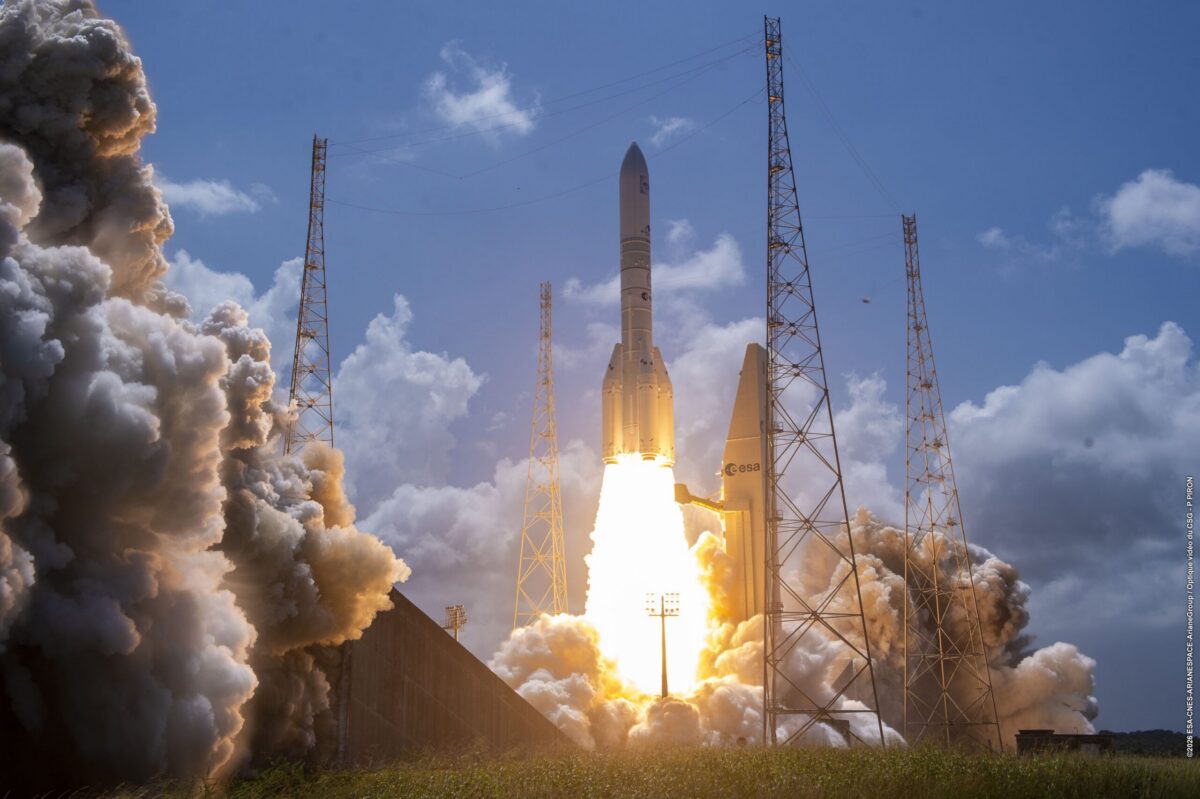
Europe’s most powerful heavy-lift rocket, the Ariane 64, aced its inaugural flight today, propelling 32 satellites for the Amazon Leo constellation into low-Earth orbit.
This Ariane 6 variant is equipped with four strap-on solid rocket boosters (SRBs), doubling the design’s payload-to-LEO capability to 21.6 metric tons, compared to the variant that flies with two boosters.
On launch at 1:45 p.m. local time from Europe’s Spaceport in Kourou, French Guiana, the brilliant flare of the igniting SRBs lit up the sky. Shortly after liftoff, the rocket pitched over, correcting its trajectory to head northeast over the Atlantic, leaving the rainforest behind it.
“The Ariane 64 launch today is a major step forward for Europe’s launch capability,” Matt Archer, director of launch and in-space assembly and manufacturing at the UK Space Agency, told me by email.
The eight-story-high boosters separated cleanly from the 62-meter rocket at 2 minutes and 40 seconds into flight, as scheduled. That was followed soon after by the jettison of the rocket’s 20-meter-long carbon fiber fairings that shrouded the mast to which the satellites were attached, the reinforced plastic flexing wildly as it fell to the ocean.
All of the satellites had deployed as of 2:20 p.m. Eastern, Amazon Leo confirmed via X, bringing the constellation to 185 of the 3,232 planned for the “Gen 1” network. Amazon must reach 1,616 satellites by July 30, under the terms of its authorization from the U.S. Federal Communications Commission, and has until July 2029 to deploy the rest.
Today’s launch was the first of 18 Ariane 6 launches that Amazon ordered in 2022, Arianespace’s largest order to date. Sixteen of those will utilize an advanced version of the SRB, dubbed P160C, that each provides 3700 kilonewtons of thrust from 156 tons of solid fuel.
“The set of evolutions that will be implemented throughout the months ahead will enable us to increase launcher performance by 20%,” said Arianespace spokesperson Daphne Joseph-Gabriel via email.
This launch featured another first: The second stage’s use of an intelligent auxiliary propulsion unit (APU) which delivered a continuously low thrust during satellite dispensing, so the departing spacecraft would not collide after separation from the dispenser mast.
Arianespace said the APU, which uses a 3D-printed gas generator, uses liquid hydrogen and oxygen from the Vinci upper stage engine’s tanks, and “is qualified for several hours of operation with multiple in-flight ignition capabilities.”
The 64’s debut was eagerly awaited by the 23-nation European Space Agency. Director General Josef Aschbacher told reporters in January that today’s flight would be a “very important milestone” — not least because it allows Europe to compete in the global orbital constellation delivery market.
The 64’s “increased carrying capacity is important for future ambitions, both commercially and strategically,” Archer of the UK Space Agency said. “But there is still a journey Ariane must go on to accelerate the cadence of launches and become more cost competitive.”
Arianespace CEO David Cavaillolles concluded the mission broadcast by saying that the next 64 launch is also for Amazon — “and I will be revealing the exact date in the coming weeks.”