AIAA Associate Fellow Senneff Died in March 2026


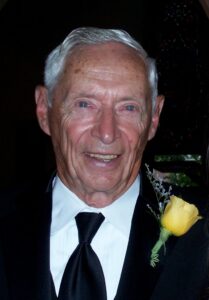
A core member of the Bell Aerosystems team that developed the Agena upper stage engine that propelled over half of U.S. payloads to space from 1960 to 1970, he also had another career before Bell, when then Lieutenant Senneff flew 74 combat missions in the P-47 over Europe in World War II.
Senneff enrolled at the University of Illinois in 1942 intending to study aeronautical engineering. After a single semester, the Army Air Corps had other plans. By early 1944, at age 20, he was flying P-47 Thunderbolts out of Pisa with the 86th Fighter-Bomber Group’s 525th Squadron, tasked with the unglamorous but essential work of interdicting German supply lines – railroad bridges, locomotive yards, troop concentrations. He described one such mission against a bridge to the historian of the Aero Club of Buffalo in 2011: “We went in from a reasonable altitude, but the Germans had guns on top of the hills, the middle of the hills, the bottom of the hills and all over the hills. We would dive down to a bridge at the bottom of the hill, and they would shoot at you all the way down and all the way up. It was kind of exciting.”
After the war he returned to Illinois, completed his bachelor’s degree, and in 1950 an M.S. in aeronautical engineering. He then joined Bell Aircraft in Wheatfield, NY, just as their new rocket group was developing the engines for the Bell Shrike missile – a flying testbed – and Bell Rascal, a supersonic air-to-ground guided missile. He was soon leading water testing of the thrust chamber injectors on both missiles, a role that led him to “being wet most of the time.”
Senneff’s first opportunity to design his own injector was for the Bell “Hustler” engine, built to turn the B-58 Hustler’s free-fall bomb/fuel pod into a Mach 4 guided missile. That effort was cancelled, but when Lockheed needed an engine to power their proposed WS-117L upper stage, subsequently named Agena, they chose a modified version of the Hustler engine, which was eventually named Agena as well. The Agena upper stage and Bell engine soon became the workhorse of America’s early space age, powering the first U.S. missions to the moon, Venus, and Mars, the five lunar orbiter missions that surveyed landing sites for Apollo, and the Gemini-Agena Target Vehicle on which Gemini astronauts perfected the rendezvous and docking procedures critical to Apollo success.
Agena was also used on over 200 Corona, Gambit-1 and Gembit-3 film-return reconnaissance spacecraft, the result of which, according to a contemporary program manager, was that “We knew more about the Soviets than they knew about themselves.” By the end of the Agena program in 1987, six versions of the engine had launched 361 spacecraft, all with injectors designed by Senneff, by then Chief of the Bell thrust chamber group.
Bell’s next major rocket program was the Lunar Module Ascent Engine that lifted the Apollo astronauts off the surface of the moon to rendezvous with the Command Module. Often considered the most critical item in the Saturn V stack as it had no backup, Senneff was responsible for the injector and ablative thrust chamber. Though the Bell engine was eventually completed with a Rocketdyne injector, Senneff’s injector was used during the entire development program up to and including the engine’s first firing in space on the unmanned Apollo 5 mission. One of his last programs at Bell was the Minuteman III Post-Boost Propulsion System, 400 of which are still on alert as the land-based segment of the U.S. strategic nuclear triad.
After retiring from Bell in 1987 he taught the capstone aerospace engineering design course at the University at Buffalo, towed gliders with the Niagara Soaring Club, served as a flight instructor across Western New York, finally stepping back flying in his late eighties.