

1926
Jan. 1 — Henry J. E. Reid is appointed engineer-in-charge of the NACA Langley Memorial Aeronautical Laboratory. He remains in this position for 34 years, retiring in July 1960. NASA, Aeronautics and Astronautics 1915-1960, p. 21.

Jan. 6 — In Germany, Aero Lloyd and Junkers combine as the government-subsidized Deutsche Luft Hansa A.G. Commercial. This marks the final consolidation of numerous airlines into one state-supported entity. Local interstate and inter-urban airlines retain their independence but are incorporated into the overall system through working arrangements. Aviation, Feb. 15, 1926.
Jan. 17 — In a letter to U.S. Commerce Secretary Herbert Hoover, Daniel Guggenheim announces that he has designated $500,000 for the Daniel Guggenheim Fund for the Promotion of Aeronautics, and is prepared to provide an additional $2 million. This fund will support the improvement of aircraft and aviation until freight and passenger services can be carried out on a self-supporting basis. The Guggenheim Fund later makes marked contributions with its investments in airline development, safer aircraft designs and blind flying. Aviation, Jan. 25, 1926, pp. 106-107.
Jan. 29 — U.S. Army Lt. J. A. Macready sets a U.S. altitude record, reaching 38,704 feet in a modified Engineering division XC0-5 over McCook Field in Dayton, Ohio. The large two-seat biplane was built by Le Pere Aircraft at the Engineering Division Shop at McCook Field. NASA, Aeronautics and Astronautics 1915-1960, p. 21; Flight, Feb. 4, 1926, p. 68.
1951
Jan. 16 — The U.S. Air Force initiates development of the Atlas ballistic missile under the top secret Project MX-1593, a follow-on to the MX-774 initiative that studied multiple concepts. Convair Astronautics wins the contract on Jan. 23 and promptly begins two design studies, one for a pure ballistic missile and the other for a boost-glide vehicle. NASA, Aeronautics and Astronautics 1915-1960, p. 66.
Jan. 16 — The Convair B-36D makes its first appearance in Europe, when six of the long-range heavy bombers complete a U.S. Air Force training flight from Carswell Air Force Base in Texas, to Lakenheath, England. The following day, an Air Force RB-36D, the strategic reconnaissance version of this massive bomber, makes a record endurance flight of 51 hours, 20 minutes without refueling. John Wegg, General Dynamics Aircraft and their Predecessors, p. 96.

Jan. 23 — Douglas completes the first flight of the XF4D-1 Skyray, a naval interceptor with an extremely low aspect ratio delta wing. This prototype is powered by an Allison J35-A-17 turbojet, but production F4Ds are subsequently equipped with more powerful Pratt and Whitney J57-P-2 turbojets. A total of 420 are built through 1958. Gordon Swanborough and Peter Bowers, United States Naval Aircraft Since 1911, pp. 179-180.

Jan. 30 — Bell Aircraft Corp. begins construction of a $3 million helicopter plant in Fort Worth, Texas. This will become the center of all Bell helicopter production. A.J. Pelletier, Bell Aircraft Since 1935, p. 15. The Aircraft Year Book, 1951, p. 78.
Jan. 31 — Pan American Airways pilot Charles Blair sets a trans-Atlantic speed record in a specially modified North American P-51C Mustang Excalibur III, flying from New York to London in 7 hours, 48 minutes. During the flight, Blair nearly passes out from lack of oxygen. His flight eclipses a previous record of 8 hours, 55 minutes set by a Boeing Stratocruiser in 1949. Charles F. Blair, Red Ball in the Sky, pp. 91-108.
1976
Jan. 5 — The U.S. Department of Transportation begins hearings on whether to permit the British-French Concorde supersonic transport to operate in the United States. Chaired by Transportation Secretary William Coleman, the sessions become contentious and last almost a month. The main objections are the potential physical, environmental and psychological damage caused by the shock waves the planes generate when breaking the sound barrier. In the end, Coleman determines the Concordes can fly a limited schedule of flights for no more than 16 months to allow their environmental impact over certain routes to be studied. Frank H. Winter and F. Robert Van der Linden, 100 Years of Flight, p. 433.
Jan. 7 — The People’s Republic of China for the first time expresses interest in placing an astronaut in orbit, according to the Kuangming Daily newspaper. The article indicates that the country’s recent recovery of the China 4 satellite marks a solid foundation for the recovery of future crewed spacecraft. Frank H. Winter and F. Robert Van der Linden, 100 Years of Flight, p. 433.
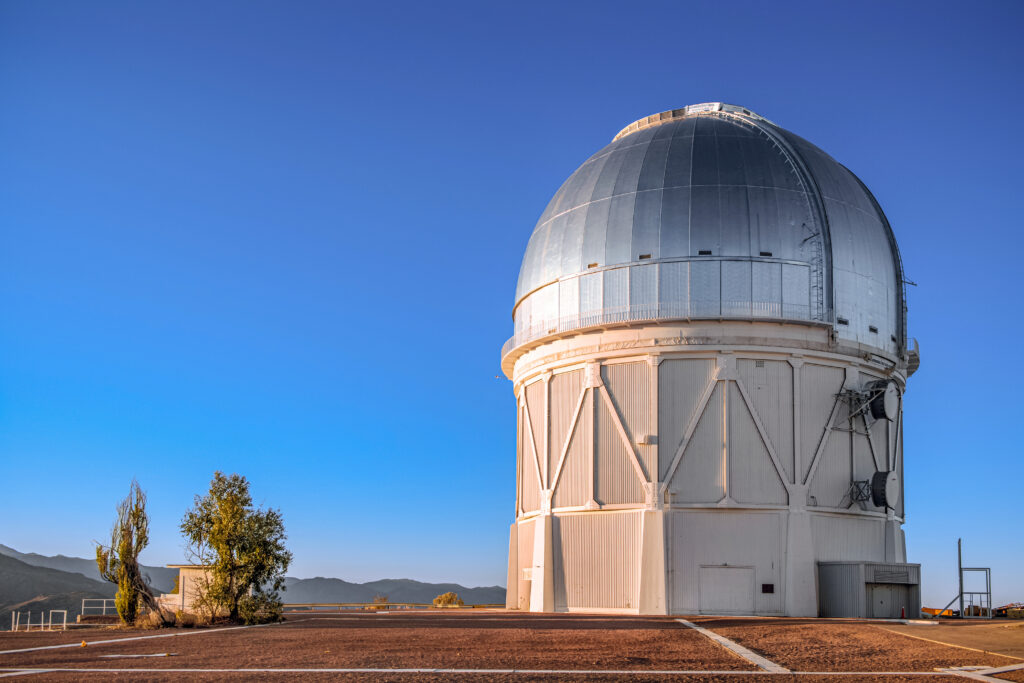
Jan. 13 — The V.M. Blanco, the largest optical telescope in the Southern Hemisphere, begins operations on a mountaintop about 500 kilometers north of Santiago, Chile. The 13.7-meter-long telescope’s steerable portion weighs 300 tons but is so delicately balanced that one person can move it by hand. The telescope is in the new Cerro Tololo Inter-American Observatory, which is run under contract by the U.S.’s National Science Foundation in cooperation with the University of Chile at Santiago and others. National Science Foundation Release PR 76-4.
Jan. 17 — A Delta rocket launches the Communications Technology Satellite, designed jointly by U.S. and Canadian technicians, from Cape Canaveral, Florida. CTS is the world’s most powerful communications satellite and the result of a five-year program that aims to demonstrate new technology, conduct communications technological experiments and develop new communications methodology in conjunction with ground-based components. New York Times, Jan. 30, 1976, p. C11, and NASA News Releases 76-9 and 75-316.

Jan. 20 — A specially modified Vought A-7D Corsair II attack bomber flies for the first time equipped with an all-composite port wing, made from a blend of graphite and boron in an epoxy resin. Eight modified A-7Ds will fly with U.S. Air National Guard units to test the practicality of this new technology. Frank H. Winter and F. Robert Van der Linden, 100 Years of Flight, p. 433.
Jan. 21 — British Airways and Air France inaugurate the first passenger flights aboard the Concorde supersonic airliners, culminating 13 years of development. The inaugural flights from London to Bahrain and from Paris to Rio de Janeiro, respectively, commence simultaneously. These overwater routes allow the aircraft to fly twice the speed of sound and cut transit times in half. Flights are limited to seating for 100 first-class passengers who are also able to see the curvature of the Earth while en route. New York Times, Jan. 22, 1976, pp. 1, 9.
2001
Jan. 4 — Hindustan Aeronautics Limited TD-1 prototype completes its first flight. This Tejas multirole light fighter, designed and built for the Indian Air Force and Navy, is intended to replace the aging Soviet-designed Mig-21 fighters currently in service. The TD-1 leads to the production of the HAL Tejas, a small supersonic delta-winged aircraft powered by a single U.S.-made GE F404 afterburning turbojet. After a lengthy development, the aircraft enter service in 2015. Jane’s All the World’s Aircraft 2002, p. 102.
Jan. 10 — American Airlines announces it is acquiring all of the assets of the struggling Trans World Airlines for $500 million. The merger is completed in December. R.E.G. Davies, Airlines of the Jet Age, p. 167.
Jan. 27 — The Progress M1-5 docks with the Mir space station, carrying the 5,900 pounds of propellant required for the station’s controlled deorbit in March. Plans call for the M1-5 to fire its thrusters three times to lower Mir toward the atmosphere over the Pacific Ocean, where any surviving debris will splash down away from inhabited areas. NASA, Astronautics and Aeronautics: A Chronology, 2001-2005, p. 2.

Jan. 31 — NASA’s Mars Global Surveyor completes its primary mission, collecting some 58,000 images since its arrival at the red planet in September. “By any conceivable measure the scientific impact of Mars Global Surveyor has been extraordinary,” Global Surveyor Project Scientist Arden L. Albee said in a press release. Among the orbiter’s most significant findings was the detection of ancient lakebeds, the strongest evidence to date that Mars once had liquid water. NASA News Release, Jan. 31, 2001.
Also during January — Air Canada begins a trial of in-flight email and internet services for its frequent flyers. Flight International, Jan. 23-29, 2001, p. 16.