
Eve full-scale prototype performs ‘just like the simulator’ in first flight test, company says


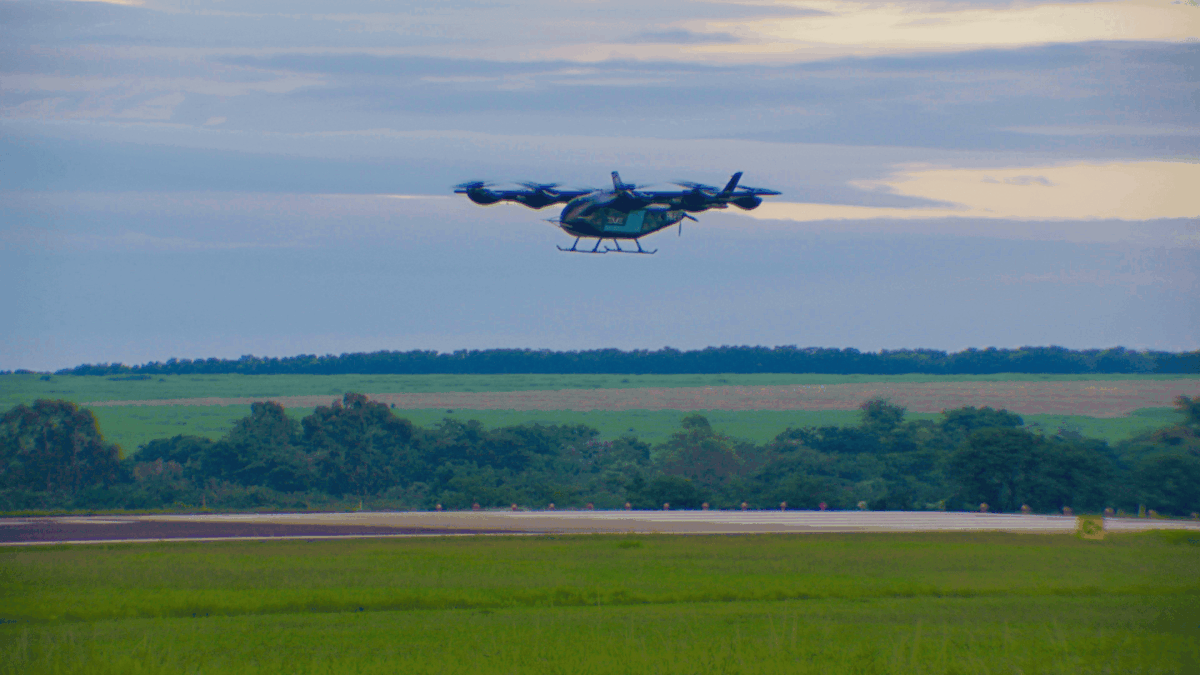
The inaugural flight of Eve Air Mobility’s full-scale electric air taxi provided early proof of the accuracy of the company’s simulators and models, executives said.
The test took place Friday morning in cloudy, calm conditions at Embraer’s test facility 300 kilometers northwest of Sao Paulo, with Embraer pilot Gerson de Oliveira Mendes at the remote controls of the aircraft.
The flight itself only lasted about a minute — spinning up the propellers, lifting off vertically to hover at 40 feet and then landing said Luiz Valentini, Eve’s chief technology officer.
Nevertheless, he said it marked a solid foundation for the publicly traded company, majority owned by Embraer, as it seeks to progress to tests in 2026 in which the aircraft transitions to forward flight. Because Embraer has plenty of experience with forward flight, Valentini said Eve is likely to linger for a while on hover and transition to forward flight before moving on to longer cruise flights.
“Hovering is, to be frank, a phase of flight that we don’t have any experience from any previous programs here at Eve or Embraer. So we feel that we need to work on that some before we study transition, and transition is really important for us,” he said. “We don’t have a date, really; we will just finish the scope of the hover flight test first.”
The flight also confirmed the expected performance of Embraer’s fifth-generation fly-by-wire concept Eve is using, along with the eight fixed-pitch lifter propellers and the electric motors that power them, which were purchased from Vermont-based BETA Technologies.
Eve plans to manufacture six conforming prototypes to conduct the unfolding flight test campaign leading to type certification by Brazil’s Civil Aviation Agency, or ANAC. The company expects type certification, first deliveries and entry into service in 2027.
During Friday’s flight, the pilot sat in a truck — Eve’s ground station — for test flights while about a dozen engineers monitored various aircraft systems closely via screens in a nearby telemetry room at the airport, Valentini said. Parameters including motor and battery temperature, state of charge and revolutions per minute were all within expected ranges, he said.
There is no cockpit in the test aircraft, as it is replaced with the battery for these flights.
“We skipped tethered flights. We didn’t think that was worth the complexity of doing the tethering,” Valentini said. “But we did spin up the propellers to liftoff thrust with the aircraft tied down to the ground leading up to this.”
While no regulators were present for the first flight, ANAC, FAA and European Union Aviation Safety Agency representatives will attend continuing tests, the company said in a news release.
Valentini said he and the pilot were pleased with the test. “The pilot told us it felt like he was flying the simulator. And for us, that’s really important, because it means that the test that we have done so far and the way that we build our models really represent the vehicle,” he said.