Astrobotic gets NASA, Space Force funding to build reusable suborbital rockets
 By Keith Button
 By Keith Button
Pittsburgh-based Astrobotic announced Friday it has received a combined $17.5 million in contracts from NASA, the U.S. Space Force and the Air Force Research Laboratory to develop reusable rockets to test new rocket engine configurations and spacecraft technologies.
Under the terms of the three contracts, Astrobotic is to develop three distinct suborbital designs, all based on the Xodiac-A that it acquired in 2022 when it purchased Masten Space Systems. The majority of the payloads that will fly aboard the new variants will be experiments and technologies from NASA and the military, said Sean Bedford, Astrobotic’s senior director of business development and a former Masten employee.
However, university researchers and commercial companies also stand to benefit, Bedford predicted. He pointed to the “democratization of space” that larger reusable rockets by Blue Origin, Rocket Lab, SpaceX and providers in Europe and China have delivered for the space industry. Test flights that previously cost somewhere around $2 million today can be conducted for about $200,000 with reusable rockets, he said.
“On the orbital side, I think it’s undeniable at this point what reusability has done for the industry,” Bedford said. “We are coming at this in the suborbital side and, at a smaller scale, recognizing a lot of these same benefits.”
The new designs — the first of which is targeted to start flying in 2026 — could reduce reliance on today’s sounding rockets, which are often expendable, and instead allow testers to “fly it on Tuesday, land it back down at the launch site, collect the data, review what’s been done, review how it performed, make a couple of tweaks here and there, and then fly it again on Thursday,” he said.
Plans call for two of the new designs to be similar in size to the 3.35-meter-tall Xodiac-A. The Xodiac-B, funded by a $1.9 million contract from the Space Force and AFRL, will be designed for flights up to 500 meters in altitude for testing rotating detonation rocket engines and other kerosene-fueled engine designs. The Xodiac-C, designed for testing sensors and flight navigation and guidance hardware and software for lunar and planetary landers, is funded by a $1.6 million NASA contract.
Xodiac-C is to include a software package called Sensei that allows the customer’s own autonomous flight software to control the flight of the rocket within certain bounds, Bedford said, much like how a driving instructor can control a drivers ed car with a passenger-side steering wheel and brake. Astrobotic also plans to offer Xodiac-C customers the opportunity to perform flight tests at the company’s 10,000 square meter mocked-up lunar test field at the Mojave Air & Space Port, complete with moon craters and white stucco terrain.
The third variant, called Xogdor Block 1B, is funded by a $14 million grant from NASA. Xogdor is to stand about 9.1 meters tall and be capable of carrying 200-kilogram payloads, compared to Xodiac-A’s 50-kg capacity. Xogdor is being designed to fly multiple times per week and carry payloads at supersonic velocities to altitudes above 100 kilometers, where it could provide microgravity conditions.
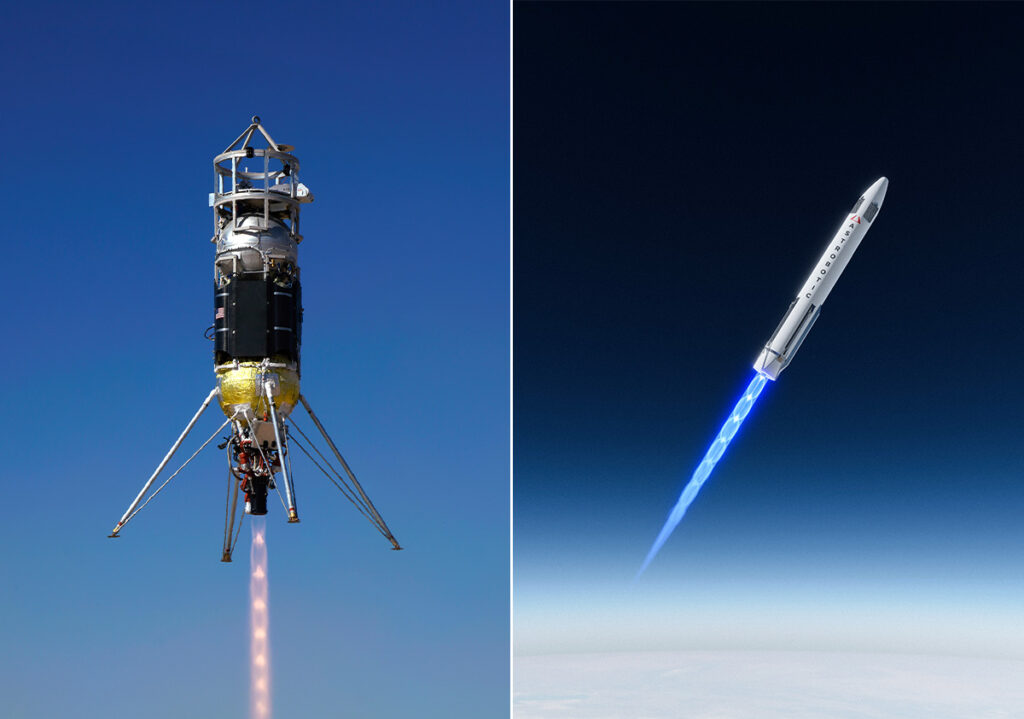
Astrobotic is now purchasing parts to begin building all three rockets, Bedford said, and the intent is for all to be hover rockets — capable of launching and returning to the same launch pad, tail first. Xodiac-B is planned to perform a flight demonstration in early 2027, while Xodiac-C is slated to fly by the end of 2026. Xogdor is scheduled to fly in 2028.
Future iterations of Xogdor could carry test payloads at hypersonic velocities, Bedford said.
“Ultimately, we would like to expand the performance envelope to be able to address a lot of the emerging demand for hypersonics,” he said. “We’re a small, scrappy team. We’re focused on getting Xogdor to flight at the moment, so I can’t say exactly what our plans are after that.”