Companies prepare LEO stations as agencies focus elsewhere
 By Cat Hofacker
 By Cat Hofacker
Commercial low-earth-orbit (LEO) destinations advanced from concept to construction, laying the groundwork for a post-International Space Station orbital economy.
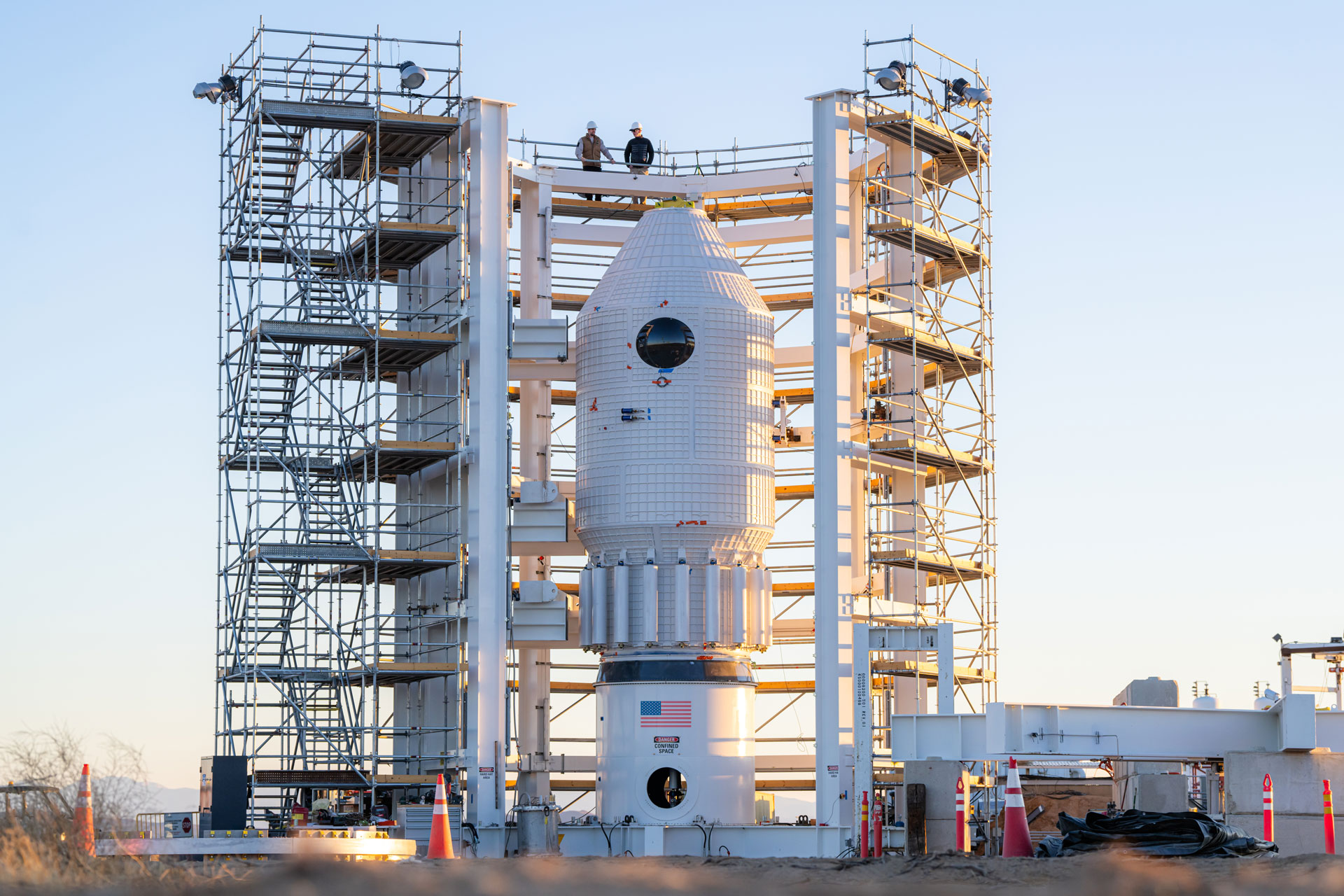
In January, Vast of California began the test campaign for its Haven-1 primary structure, following NASA-STD-5001, using a qualification model at its Mojave, California, facility. Pressurized at 180 kilopascals (gauge pressure), all strain gauges stayed within acceptable ranges. Pressurized to 120 kilopascals and held for 48 hours without replenishing, the leak rate was indiscernible. In April, the company announced an agreement with NASA to conduct environmental testing at the agency’s Neil Armstrong Test Facility in Ohio, which is to begin in early 2026. The facility provides infrastructure for large-scale thermal, vacuum, acoustics and vibration tests.
Also in April, Vast announced three payload partners for the Haven-1 Lab: the Japan Manned Space Systems Corporation; Florida-based Interstellar Lab; and California-based Exobiosphere. It also signed an agreement with the Florida-based Center for the Advancement of Science in Space (CASIS), which manages the ISS National Laboratory, to support its scientific research. The company revised its target launch date for Haven-1 to no earlier than May 2026, on a SpaceX Falcon 9 rocket. In November, the company’s Haven Demo spacecraft was sent to orbit aboard a Falcon 9 to test propulsion, flight computers and navigation software for Haven-1.
The Starlab space station project, led by Voyager Space of Colorado and Airbus Defence and Space, completed its preliminary design review in March. Upon confirming that its design met NASA and international standards for safety and feasibility, Starlab moved into full-scale production. In September, Voyager selected Louisiana-based Vivace Corporation to manufacture the Starlab primary structure. Voyager expects to launch the station in 2029 aboard a SpaceX Starship.
In an August press release, Axiom Space of Texas highlighted its achievements during the previous 100 days. Among them were the completion of its Ax-4 crewed flight to ISS and the final weld of the PPTM (Payload Power and Thermal Module) by Thales Alenia Space for the Axiom Station.
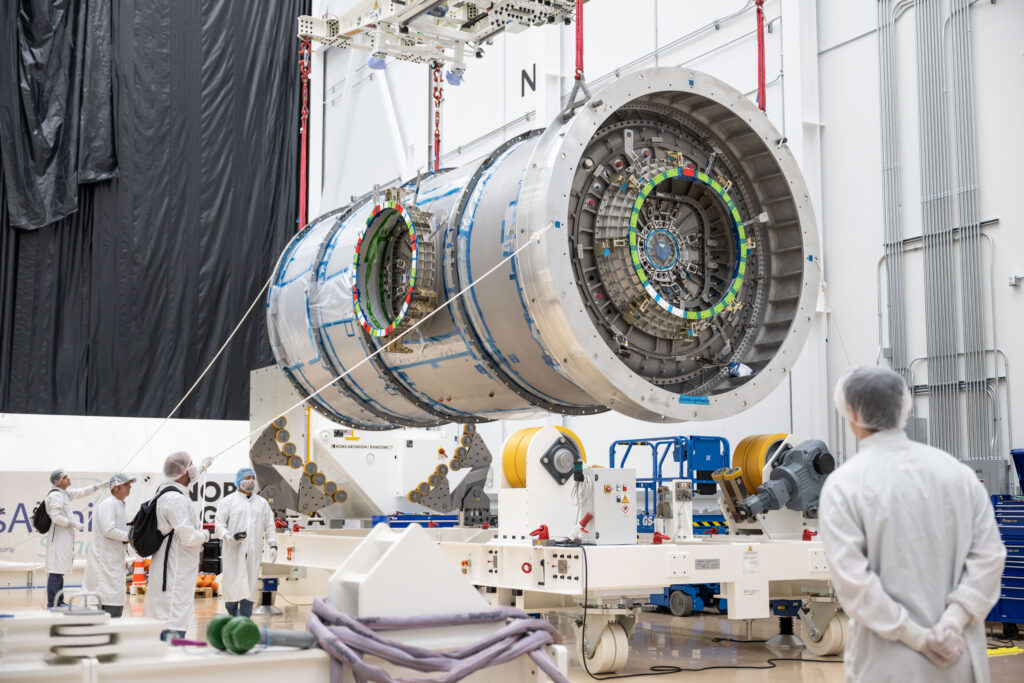
In April, NASA’s Gateway lunar space station program received its Habitation and Logistics Outpost (HALO) module. The primary aluminum structure, fabricated by Thales Alenia Space, arrived at Northrop Grumman’s facility in Arizona for outfitting and testing. Due to the module’s large size, the delivery required an Antonov Airlines’ AN-124-100 aircraft. The current plan is to launch HALO, mated with the Power and Propulsion Element, on a SpaceX Falcon Heavy rocket in December 2027.
At the Chinese Tiangong space station in September, two taikonauts installed additional debris shielding during a six-hour spacewalk.
In other news, China in February announced a plan to develop a research facility 1,800 meters deep in the South China Sea. It is to be completed by 2030, with facilities to accommodate crews of up to six scientists for mission durations of up to a month. Unlike the NASA Extreme Environment Mission Operations project, which has used the Aquarius module a mere 19 meters below sea level off the coast of Florida as an analog for outer space habitats, the focus of this Chinese endeavor will be on its own local cold seep ecosystem. Still, with its reliance on an isolated, confined, extreme environment, it has significant commonalities with space architecture. Led by the Chinese Academy of Sciences’ South China Sea Institute of Oceanology, it follows a plan announced two years earlier by NOAA to build an “underwater space station of the ocean” near the Caribbean Island of Curaçao, where scientists may study the ocean environment for “extended periods of time.”
Opener image: California-based Vast in January 2025 began the test campaign for its Haven-1 primary structure, using a qualification model. Credit: Vast