

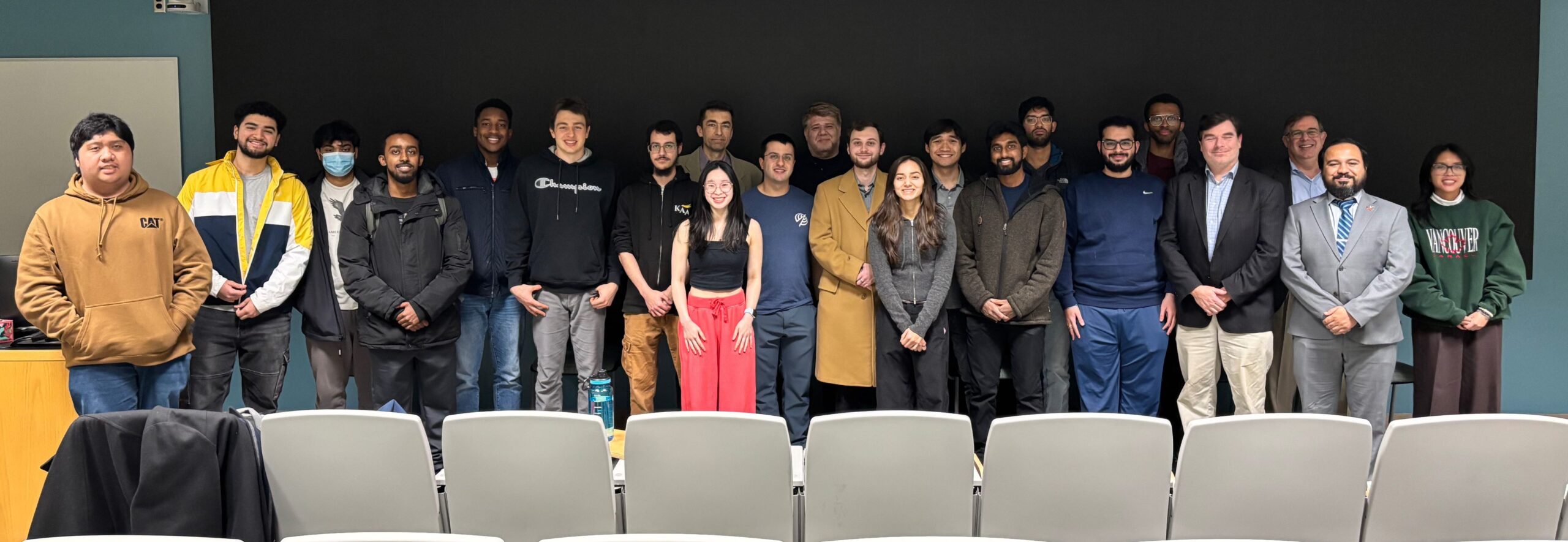
On 8 December, representatives from AIAA, American Society of Mechanical Engineers, Society of Naval Architects and Marine Engineers, Society for the Advancement of Material and Process Engineering, and American Society of Naval Engineers joined forces at George Mason University to speak with students in Professor Leigh McCue’s “Developing the Societal Engineer” course that focuses on the professional responsibility of being a mechanical engineer, including ethics, current events, and professional trends.
Professor McCue, an AIAA Associate Fellow, designed this session to help students understand a fundamental truth: being a successful engineer requires more than technical expertise. The multi-society panel emphasized that the technical skills are the foundational layer for the students, but they will also need to excel in collaboration, communication, and relationship-building to be truly successful today.
“Group projects don’t end with graduation,” Brian Calvary, Director of Membership for AIAA, told the class. “Throughout your career, you’ll work with diverse teams, and the challenges and opportunities you face now are preparing you for what’s ahead.”
The collaborative discussion highlighted three key professional development areas: communicating effectively across disciplines and to non-technical audiences, building a robust peer network for collaboration and knowledge-sharing, and connecting with professionals who can guide career growth. Students engaged in lively Q&A, exploring how professional societies support members beyond their student years and throughout their entire career trajectory.
The visit demonstrated how engineering societies work together to support the next generation, while each offers unique value within their disciplines. Students learned about active student branches at GMU, including AIAA’s, and opportunities to get involved immediately.
This collaboration represents the engineering community’s investment in tomorrow’s professionals: building connections, sharing knowledge, and fostering the networks that will shape our industries’ future.