In second NASA admin hearing, Isaacman urges moon-Mars push amid China race


President Donald Trump’s nominee for NASA administrator on Wednesday sketched out a wide-ranging vision for the agency, as lawmakers vowed to vote on his nomination next week.
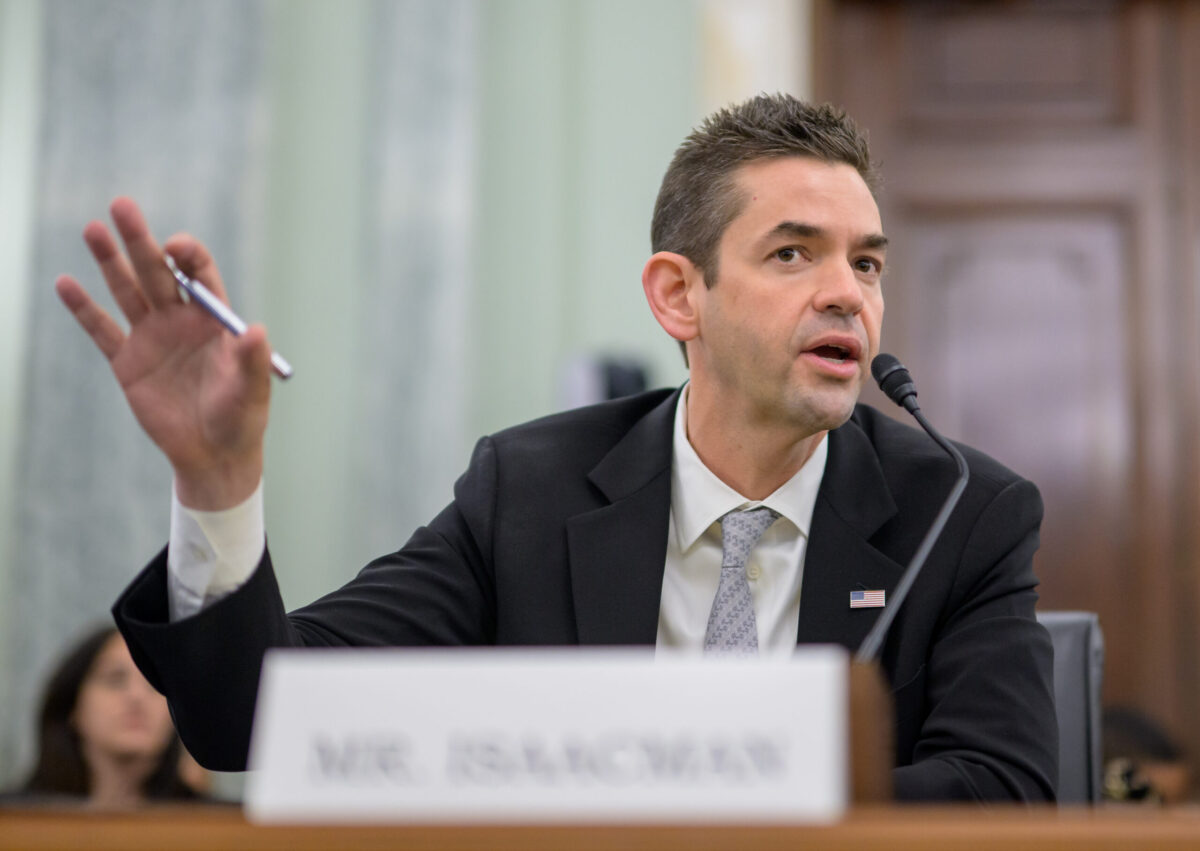
In testimony before the Senate Committee on Commerce, Science, and Transportation that touched on everything from the proposed Golden Dome missile defense shield to the future of the International Space Station, lunar landers, Mars ambitions and the growing role of private-sector competition, Jared Isaacman emphasized that America could “never accept a gap in our capabilities … not in low-Earth orbit or our ability to reach the moon.”
“The last time I sat before you, I introduced myself, my qualifications and the challenges and opportunities ahead,” Isaacman said in his opening statement. “This time I’m here with a message of urgency. After more than a half-century, America is set to launch NASA astronauts around the Moon in just a matter of months.”
He added: “I know it’s not lost on anyone in this room that we are in a great competition with a rival that has the will and the means to challenge American exceptionalism across multiple domains, including in the high ground of space. If we make a mistake, we may never catch up. And the consequences could shift the balance of power here on Earth.”
Should he be confirmed, Isaacman would take the helm at NASA as the agency prepares to launch humans beyond LEO for the first time since 1972, and conclude 10 months of leadership by acting administrators. Transportation Secretary Sean Duffy has been leading the agency since July, when the former acting administrator, Janet Petro, returned to her role as director of NASA’s Kennedy Space Center.
In May, Trump withdrew Isaacman’s initial nomination, reportedly over renewed concerns over the tech entrepreneur’s past donations to Democratic candidates. Lawmakers had also questioned Isaacman’s ties to Elon Musk and SpaceX, given the two private spaceflights he’d conducted aboard SpaceX Dragon capsules. That same month, in a show of apparent discord between Musk and Trump, Musk criticized the president’s signature tax-and-spending bill during a CBS News interview.
“I was disappointed to see the massive spending bill, frankly, which increases the budget deficit, not just decreases it, and undermines the work that the DOGE [Department of Government Efficiency] team is doing,” Musk said at the time.
“Could you please explain what happened to make President Trump reconsider the decision to pull your nomination?” asked Sen. Gary Peters (D-Mich.) during Wednesday’s hearing, noting also that Isaacman had recently donated approximately $2 million to Trump’s super PAC. “And what assurances you may have provided, if any, that your relationship with Elon Musk and SpaceX would not create a significant conflict of interest for you in this role?”
“I wouldn’t even begin to want to speculate why the president nominated me, withdrew it, and renominated me, other than to say I was grateful for the opportunity in the first place,” Isaacman replied.
As for Musk, he said, “my relationship with Mr. Musk is the fact that I have led two missions to space with SpaceX because it’s the only organization that can send astronauts to-and-from space since the shuttle was retired. And in that respect, my relationship is no different than that of NASA.”
Against the hearing’s backdrop was the upcoming Artemis II flight, in which a crew of four astronauts are to complete a 10-day journey around the moon. That mission, targeted for as soon as February, is to demonstrate technologies required for the Artemis III landing at the lunar south pole. Duffy has expressed concerns about the ability to meet the 2027 target for that mission, which he’s attributed partially to SpaceX’s development schedule for the Starship lunar lander.
“I love SpaceX; it’s an amazing company. The problem is, they’re behind. They’ve pushed their timelines out, and we’re in a race against China,” he told CBS in October and said he planned to “open up the [lander] contract” to proposals for alternative architectures.
China, meanwhile, has been steadily proceeding with its own lunar ambitions. The nation is targeting a crewed landing by 2030 — having focused on sites that once overlapped with NASA’s Artemis plans — as part of its International Lunar Research Station, moon base being developed jointly with Russia.
“NASA cannot take its eyes off the ball,” said Sen. Ted Cruz (R-Tex.). “The United States must remain the unquestioned leader in space exploration.”
In the vein of this emerging competition, lawmakers raised questions about the Artemis delays and also the larger funding cuts the White House has proposed across NASA.
“There is no secret that a lot of NASA changes have been made since the last time you were before this committee,” Sen. Maria Cantwell (D-Wash.) told Isaacman. She referred to Trump’s fiscal 2026 budget,” which calls for cutting the agency’s budget by nearly a quarter in the workforce” and reducing space science funding by nearly 50%.
If confirmed, Isaacman would oversee NASA’s roughly $25 billion in funding, as well as the approximately 14,000 employees left after a series of buy-outs resulted in a 20% staff reduction earlier this year.
Also among the uncertainties is the broader question of the direction of the agency itself. Isaacman fielded questions about the leaked “Project Athena Strategic Plan.” That document outlined his vision to reform NASA and called for a reorganization of the agency and the cancelation of certain exploration and science programs with an emphasis on “mission-driven” initiatives rather than those that had become “institution-driven.”
“I do stand behind everything in the document, even though it was written seven months ago,” Isaacman said. “It was all directionally correct, consistent with prior testimony and my interactions with various senators.”