Boeing posts fourth-quarter profit despite losses in commercial aircraft, defense units


Boeing today announced it posted a profit for the quarter spanning October-December, thanks to the sale of its Jeppesen software unit and an uptick in aircraft production and deliveries.
For the 2025 calendar year, the company also reported its most aircraft deliveries since 2018, beating out rival Airbus on orders for the first time in seven years. However, its Commercial Airplanes and Defense, Space & Security units recorded quarterly losses.
During the quarter that ended Dec. 31, Boeing Commercial Airplanes posted a loss of $632 million. The defense unit recorded a $507 million loss, which the company attributed to a $565 million charge on the KC-46 aerial refueling tanker program. CEO Kelly Ortberg said the charge was due to revised cost estimates for aspects including production support and supply chain.
Also included in the quarter was Boeing’s sale of Jeppesen for $10.6 billion and its acquisition of Spirit AeroSystems for $4.7 billion in stock.
Boeing reported quarterly sales of $23.9 billion, reflecting 160 commercial aircraft deliveries, and quarterly profit of $8.2 billion.
The company announced 2025 sales of $89.5 billion, up nearly 35% from the prior year, and 600 commercial deliveries, the highest annual totals since 2018. Boeing booked 1,173 net commitments for the year versus 889 net orders for Airbus.
“As we start this year, we set the foundation for our turnaround with stronger performance and record-breaking backlogs across our businesses,” Ortberg said during a Tuesday call with analysts. “We haven’t fully turned the corner, but we’re making real progress and getting back to the Boeing everyone expects of us.”
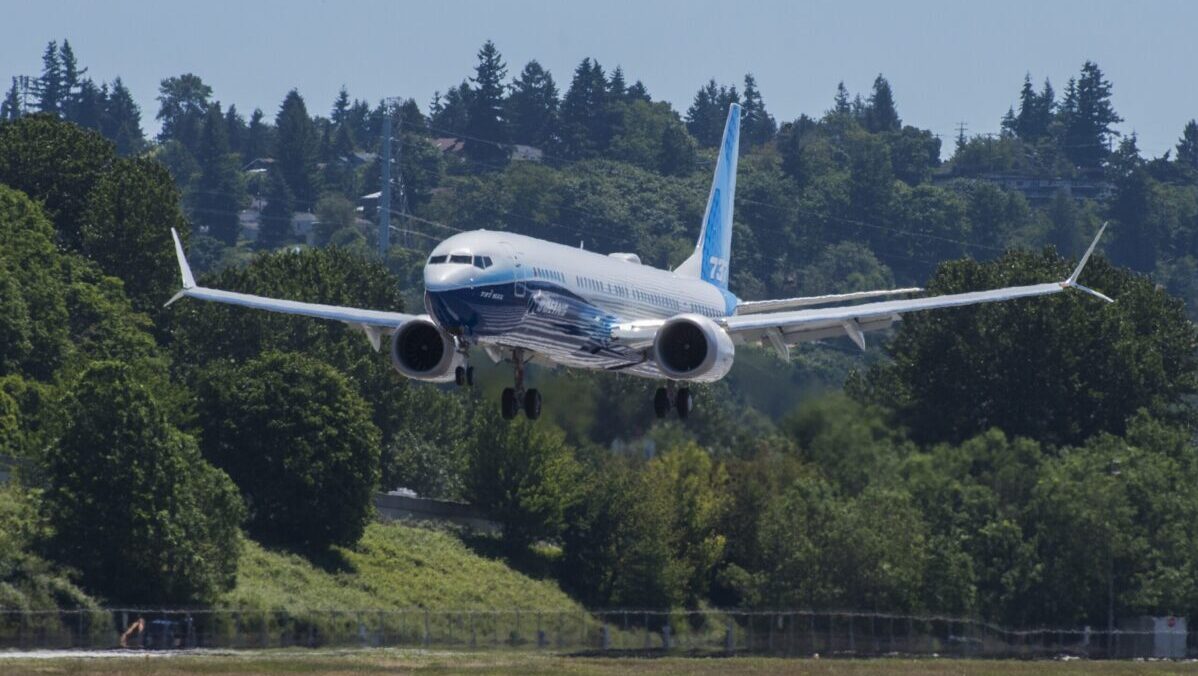
Ortberg said plans call for increasing monthly 737 MAX production from 42 to 47, and Boeing will look to add its new north line in Everett, Washington, as it moves to further increases. MAX production increases require the approval of FAA, which in 2024 imposed a production cap after the midair blowout of a door panel aboard a MAX 9 operated by Alaska Airlines.
Ortberg said he doesn’t foresee any supply chain issues with the ramp-up to 47. Going from 47 to 52 will be more of a stretch, he said, and there is work ahead to prepare for that increase in production.
The manufacturer is also making steady progress toward certification on the 737-7 and 737-10, as well as the 777-9, Ortberg said, while acknowledging that prior delays have been “challenging.” The company expects FAA to certify both MAX variants this year, he said.
The 777-9 was originally slated to launch in 2020, but has been delayed until 2027. Ortberg said the company received FAA approval for a key phase of certification testing in the fourth quarter, focused on avionics, environmental control systems and the auxiliary power unit.
He added that Boeing has identified a potential durability issue during a recent inspection of the 777X engine, made by GE.
“We’re working with GE to better understand that issue and finalize root cause and corrective action,” Ortberg said. “Importantly, as we work through this issue, we continue our certification flight testing, and we don’t expect this to impact our delivery in 2027.”
A GE spokesman said the company is inspecting engines on-wing “while we analyze the issue and define the corrective action, guided by our safety and quality systems.”