
Speeding up uncertainty quantification for aerospace applications
 By Cat Hofacker
 By Cat Hofacker
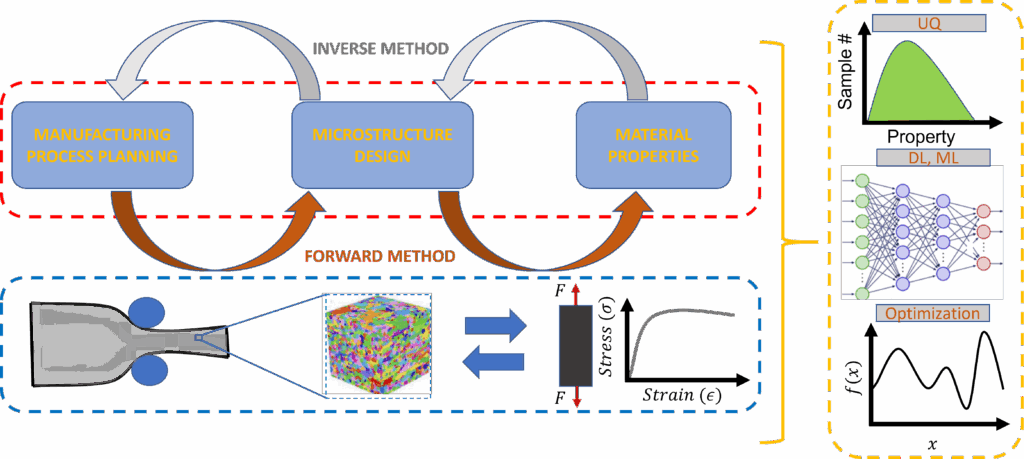
In January, Pinar Acar’s research team from the Advanced STRuctures and Optimization (ASTRO) Lab at Virginia Tech published an invited review article in the journal Advanced Engineering Materials on uncertainty quantification (UQ) of microstructures in aerospace materials. The paper surveyed state-of-the-art approaches to forward and inverse UQ problems in process-structure-property relationships and materials design and highlighted future research directions, including multiscale topology optimization, physics-informed machine learning, and UQ in additive manufacturing.
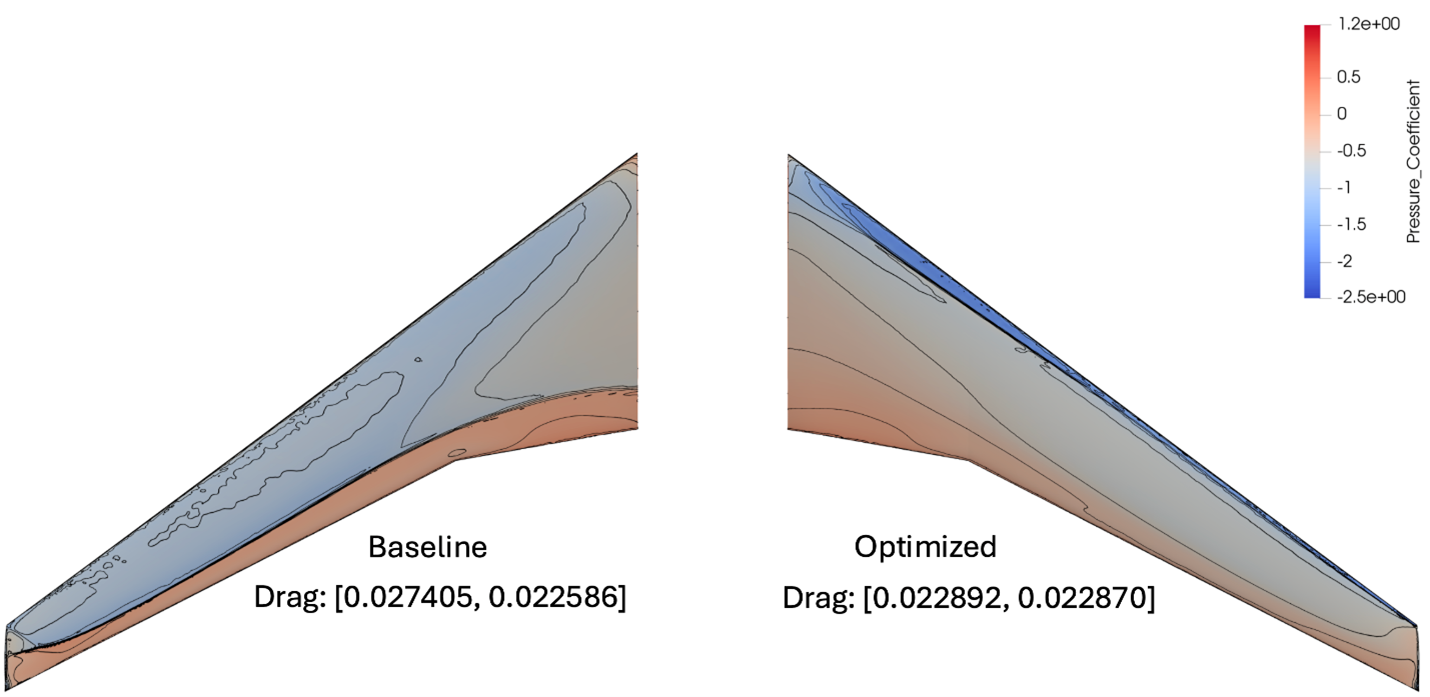
In February, the Computational Complex Engineered Systems Design Lab at Penn State led by Ashwin Renganathan made open source an implementation of its new multi-objective optimization method, entitled batch Pareto optimal Thomson sampling (qPOTS). The qPOTS method builds on Thompson sampling and Bayesian decision theory and requires substantially fewer evaluations of the objectives and constraints compared to the state of the art in multi-criteria decision-making toward the design of complex engineered systems. As of early December, the qPOTs software has been downloaded more than 6,000 times and was successfully applied to the multiobjective aerodynamic optimization of the NASA Common Research Model (CRM).
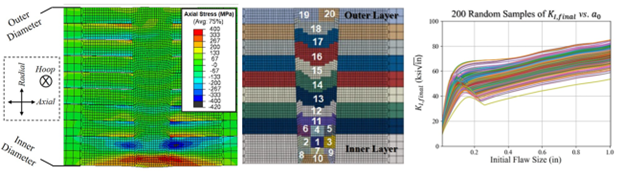
In early 2025, the Southwest Research Institute completed several probabilistic assessments of layered pressure vessels (LPVs) to predict the cumulative distribution function of the critical initial flaw size in vessel welds. SwRI supports NASA’s multiyear effort to determine the continued fitness for service of aging, non-code LPVs that are at risk of cleavage fracture within operating temperature ranges. These initial flaw size solutions have been used to develop calibration blocks for nondestructive evaluation as NASA has been inspecting its LPVs to ensure continued safe operation of these mission-critical assets.
In July, SwRI completed OMC Process-to-Performance Evaluation, Research, and Analysis (OPPERA), a multiyear program focused on developing and maturing bonded 3D textile design and analysis software tools. Under OPPERA, a process-to-performance (P2P) framework was developed and demonstrated for bonded, 3D textile pi preform joints used in aerospace applications. A verification and validation approach was employed to guide experimental characterization and model development activities and to elucidate the impact of assumptions and uncertainties. The P2P framework has been used to provide a better understanding of pi-joint failure.
In August, Jie Chen’s Stochastic Engineering Analysis and Design (SEAD) Lab at Virginia Tech demonstrated a machine learning method for high-dimensional materials design. By combining automated representation learning with UQ, the method reduced costly experiments and simulations by nearly tenfold while enabling the design of advanced materials. This breakthrough opens new possibilities for accelerating the discovery of high-performance materials across a wide range of applications.
In August, Yongming Liu’s lab at Arizona State University demonstrated Bayesian Entropy Neural Networks (BENN), a non-deterministic, physics-aware learning framework. Unlike traditional deterministic deep learning models, BENN integrates the maximum entropy principle with Bayesian neural networks to enforce constraints on values, derivatives and predictive variances while simultaneously quantifying uncertainty. This allows the model to sensibly handle conflicting information and produce accurate and uncertainty-aware predictions, which is an essential capability for safety-critical aerospace applications with incomplete data and variable operating conditions.
In September, researchers at Sandia National Laboratories completed a yearlong effort integrating projection-based reduced-order models (ROMs) in Pressio with multifidelity UQ approaches in Dakota. This effort included demonstrations on UQ for high-speed turbulent flows and the development of new multifidelity approaches that account for ROM training costs in the resource allocation phase. The multifidelity approaches leveraged ROMs across several mesh resolutions in combination with hyper-parameter model tuning to achieve more than two orders of magnitude reduction in computational cost relative to single fidelity Monte Carlo for boundary layer field quantities computed for a high-speed flow.
Contributors: Jie Chen, Yongming Liu, Patrick Blonigan, Matthew Kirby
Opener image: Baseline and qPOTS-optimized aerodynamic design of NASA’s Common Research Model through efficient multi-objective optimization. Credit: Penn State University