
The Space Tethers Technical Committee focuses on the development and use of tether-based technology for space systems.
The space tethers community maintained steady progress, including in academic modeling, laboratory experiments and fieldable flight demonstrations. Across electrodynamic propulsion, debris remediation, and new tether designs, the year saw fundamental advances and the completion of mission milestones.
In Europe, the E.T.PACK-F project — short for Electrodynamic Tether Technology for Passive Consumable-less Deorbit Kit-Fly — reached an important milestone in September with the start of acceptance testing of its 12-unit, 20-kilogram flight system. Coordinated by Universidad Carlos III de Madrid with partners — including the University of Padova, TU Dresden, and industry members SENER Aeroespacial and PERSEI Space — the project is preparing for an upcoming launch on a Vega-C rocket under the European Space Agency’s Flight Ticket Initiative. This in-orbit demo will validate if a consumable-free electrodynamic tether deorbit kit is capable of passively reentering satellites without propellant.
October marked one year since the establishment of a parallel European Innovation Council–funded program, E.T.COMPACT — short for Compact and Propellant-less Electrodynamic Tether System Based on In-Space Solar Energy. This program aims to advance a bare-photovoltaic tether mobility module, which is a long conductive tape embedded with thin-film solar cells to drive tether currents without drawing from a host spacecraft’s bus. The concept builds on recent academic work showing that a solar-panel-covered tether could provide the International Space Station with enough reboost thrust to counter orbital decay while reducing propellant requirements.
2025 also brought momentum for tether-based debris removal. In July, researchers at Tohoku University in Japan, with Japan Aerospace Exploration Agency collaboration, reported on the results of testing “shape keeper” devices to improve the survivability of hollow cylindrical tethers in hypervelocity collision experiments. By maintaining cross-sectional geometry with lightweight bumpers, the tethers showed improved resistance to micrometeoroid and debris strikes compared with traditional solid tapes.
In September, the Shizuoka University-built STARS-Me2 satellite was deployed from ISS. The satellite, operated by students, will extend a convex tether to control the orbital descent of the 1U-sized cubesat by atmospheric drag. Also in September, students at San Jose State University in California introduced UNAGI, an electrodynamic tether system for a controlled landing on Jupiter’s volcanically active moon, Io.
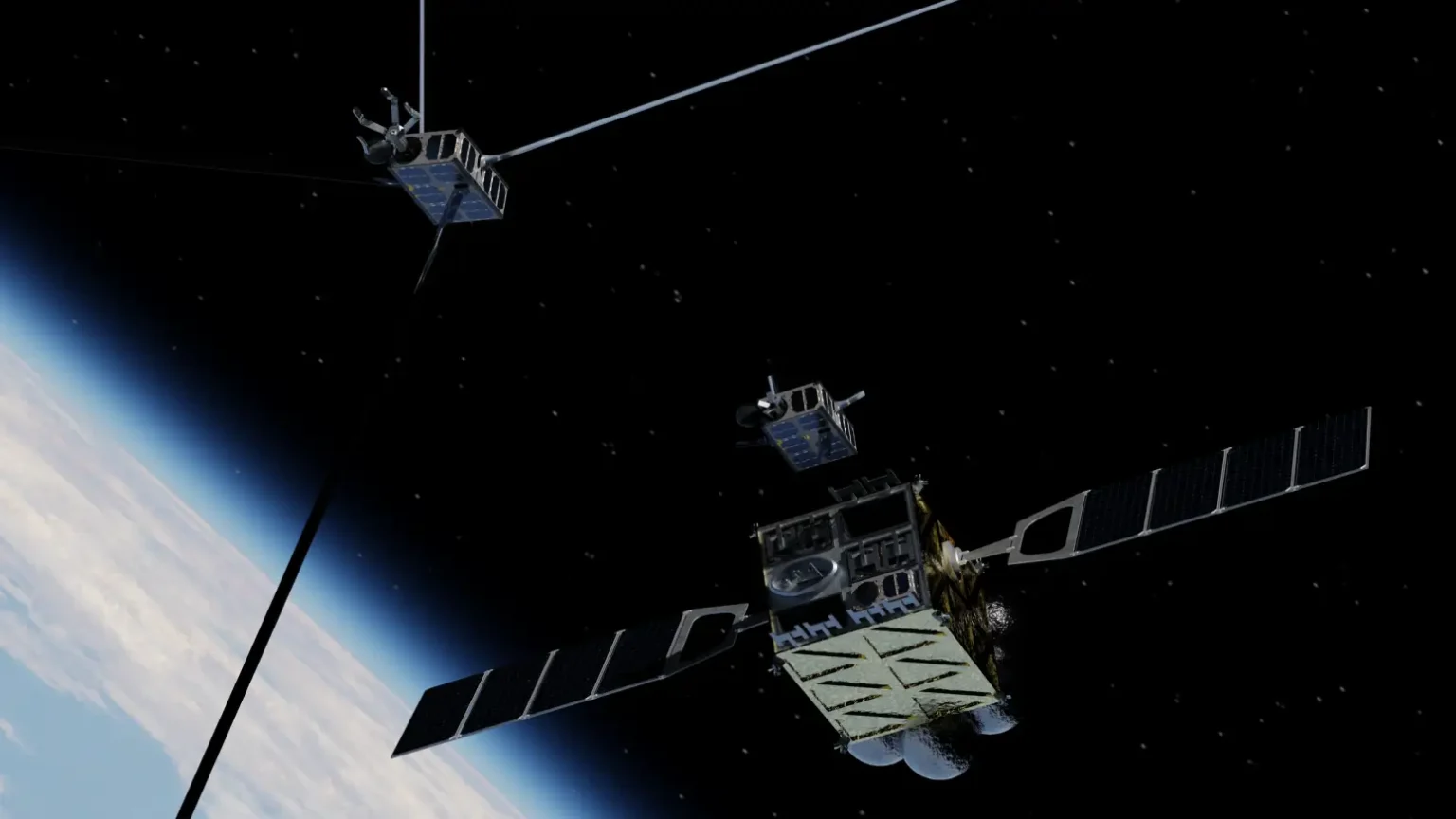
In the U.S., Orbotic Systems was awarded a NASA Phase II Small Business Innovation Research grant in July to mature its Removal of Irregular Debris using Double Assisted Nets with Controlled Enhancement (RIDDANCE) active debris removal technology. The net-and-tether system will autonomously capture, stabilize, and passively deorbit small-to-medium orbital debris via a D3 Deorbit Drag Device.
Research at the University at Buffalo in New York, reported in a series of publications over the summer, advanced autonomous control strategies for tethered debris capture. Reinforcement-learning-based controllers demonstrated improved net-capture success rates under uncertainty. Hybrid approaches integrating graph neural networks with particle swarm optimization offered fuel savings in robotic tethered capture scenarios.
Additionally, in August, a collaborative effort between the University at Buffalo and NASA’s Jet Propulsion Laboratory proposed RESTORE, the REusable Spacecraft Teams for on-Orbit debris Removal. This mission concept envisions a formation of spacecraft equipped with nets to capture and deorbit small debris via coordinated “slingshot ejection” maneuvers. Dynamics simulations confirmed the feasibility and safety of the concept for removing small- to medium-sized debris using current technology.
Looking ahead to 2026, the space tether community eagerly awaits flight data from upcoming missions like E.T.PACK-F, which could help validate models of current generation, survivability, and control under real orbital conditions. New research on collision risk and dynamic control is refining the system-level understanding needed for traffic management and integration into operational missions.
Opener image: Orbotic Systems is developing active debris removal technology including the D3 Deorbit Drag Device and a net-and-tether system. Credit: Orbotic Systems