
New capabilities unlocked for advanced laser diagnostics
 By Cat Hofacker
 By Cat Hofacker
In March, researchers at Texas A&M University demonstrated a new and improved approach to laser-induced fluorescence of nitric oxide, a diagnostic technique used for studying high-speed, high-temperature flows for aerospace applications in hypersonics and propulsion. Both the conventional approach and the new method are based on the selective excitation of two different electronic energy transitions of the nitric oxide molecule, which allows for ultra-high-speed planar laser-induced fluorescence measurements and visualization of critical air flows. However, the new method offers significantly more power to be delivered to the measurement region compared to conventional methods of using optical parametric oscillators or dye lasers. The advancement is done by using the fifth harmonic frequency of an Nd:YAG laser, with a wavelength of 213 nanometers, to target nitric oxide.
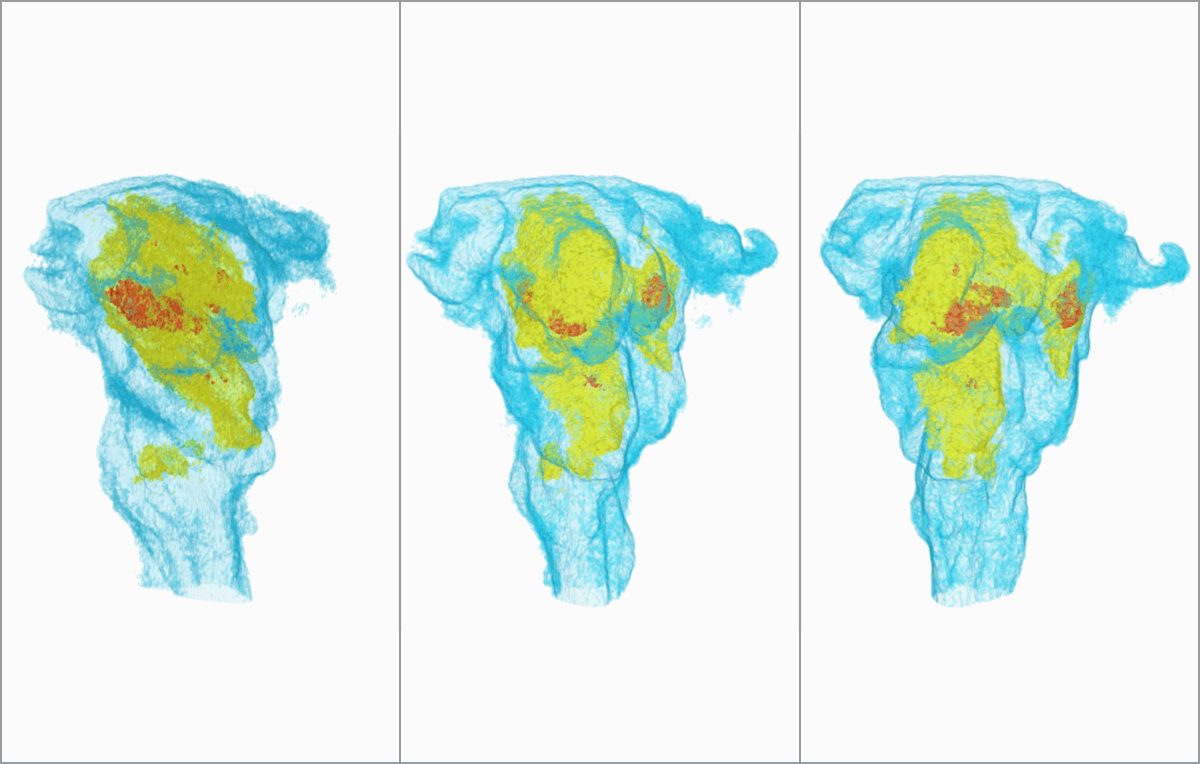
In the March demonstration of megahertz-rate NO PLIF using the fifth harmonic from a pulse-burst laser, the team reported an order of magnitude improvement in available laser pulse energy in comparison to previously tested conventional methods. The new arrangement featured a significant simplification of the experimental setup and operation. Additionally, combining the new nitric oxide PLIF method with a piezo-driven fast-scanning mirror allowed for 3D laser-induced fluorescence visualization of the flowfield of an oxy-acetylene flame plume and reconstruction of its morphology, including small structures and intricate vorticity features.
In August, MetroLaser of California was awarded a contract by NASA to build a high-speed digital holography (DH) instrument that can perform diagnosis of plume-surface interaction (PSI) events in which entrainment of dust and regolith by the plume of a lander can pose significant hazards to planetary landing missions, such as those to the moon and Mars. The instrumentation is to be deployed in NASA’s terrestrial test facilities to interrogate and obtain 3D ejecta particle trajectories, velocities, and size distributions — information that is critical toward uncovering key physics of the PSI problem.
Based on this, MetroLaser was further tasked with building an onboard prototype DH instrument that upon maturation could be deployed aboard a lander to perform measurements of ingested ejecta materials, information that is critical to the safety and integrity of the spacecraft during landing.
Also in August, MetroLaser was awarded a NASA contract to develop a nonintrusive measurement system for characterizing soot particles as they are injected into an altitude chamber for studies on how aircraft contrails are formed. Soot particles, through the nucleation of ice particles that make up contrails, contribute even more to short-term climate forcing than the carbon dioxide produced by combustion. Thus, it is important to understand how particle size and concentration affect contrail formation.
The instrument under development is based on laser-induced incandescence in a standoff configuration and will enable noncontact measurements of primary soot particle size and soot mass concentration of the particles in their natural state, thus avoiding some of the sampling errors that limit commonly used particle analysis techniques. The ability to measure primary particle size during contrail formation is expected to provide critical data supporting research on the effects of aircraft emissions on the environment.
Contributors: Boris Leonov, Jacob George
Opener image: A 3D reconstruction of an oxy-acetylene flame plume based on the fifth harmonic nitric oxide Planar Laser-Induced Fluorescence (PLIF) scan across the flowfield, conducted by Texas A&M University researchers in March 2025. Credit: Christopher Grunbok, Boris Leonov