
Artemis II counts down toward launch and Juice flies on
 By Cat Hofacker
 By Cat Hofacker
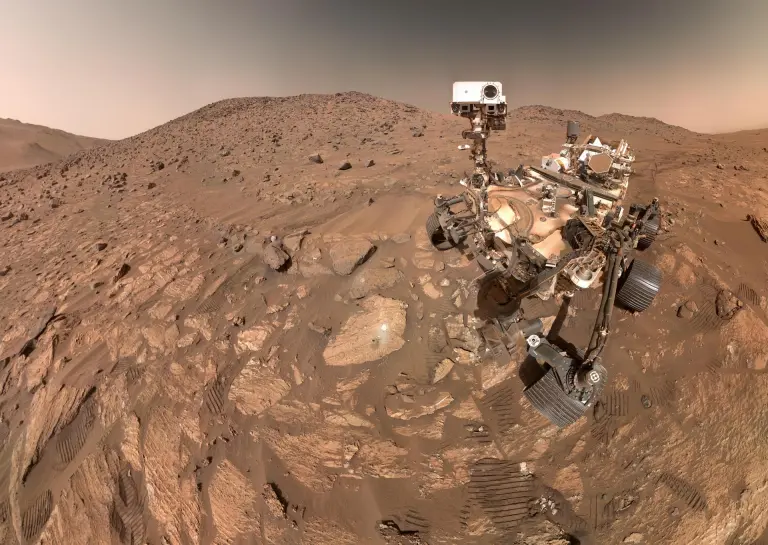
According to research published in September in Nature, analysis of rock samples collected by NASA’s Perseverance rover from the Cheyava Falls rock formation within Mars’ Jezero Crater show the strongest and geologically youngest evidence of microbial life on Mars. The samples revealed a combination of chemical compounds composed of two iron-rich minerals typically found on Earth in and around decaying organic matter. Further research of conditions documented by the surrounding geology supports the biological fingerprint theory over other anecdotal causes for these apparent biological markers.
The sample data on this rock were first collected by Perseverance’s PIXL (Planetary Instrument for X-ray Lithochemistry) and SHERLOC (Scanning Habitable Environments with Raman and Luminescence for Organics and Chemicals) instruments in July 2024.
“Getting such a significant finding as a potential biosignature on Mars into a peer-reviewed publication is a crucial step in the scientific process because it ensures the rigor, validity, and significance of our results,” said Katie Stack Morgan, Perseverance’s project scientist from NASA’s Jet Propulsion Laboratory, in a press release.
The scientists caution that although they cannot yet eliminate abiotic explanations for Perseverance’s discoveries, the findings make biological life on Mars the more plausible scenario.

NASA completed several key milestones toward completion of the Space Launch System (SLS) rocket assembly as it prepares for the launch of the Artemis II crewed lunar flyby as soon as February 2026. Notably, in August and September, technicians integrated the Orion spacecraft stage adapter with the rest of the SLS rocket stack at NASA’s Kennedy Space Center in Florida. The stage adapter connects the SLS upper stage to Orion, isolating the spacecraft and its crew from hazardous gases. The adapter also holds deployment mechanisms for four technology experiment cubesats developed by international partners. By November, the Orion spacecraft, including its launch abort escape system, was integrated with SLS at NASA’s Kennedy Space Center and critical integration systems had been confirmed.
In September, NASA’s Parker Solar Probe performed its 25th close approach to the sun, coming within 6.2 million kilometers of the surface. Its telemetry transmissions days later indicated normal system operations. This close-in pass matches similar perigee passes in December 2024, March and June. During these 10-day passes, Parker’s four science instruments collected measurements from within the corona, including of solar wind and solar flares, in the sun’s active phase of its 11-year activity cycle. These measurements add to scientific understanding of high-energy space weather that poses risks to space missions, air travel, and Earth-based power systems.
In August, the European Space Agency’s Jupiter Icy Moons Explorer (Juice) spacecraft performed a gravity-assist flyby of Venus to accelerate toward its destination. In July, the team discovered and remedied a communications software glitch that had left Juice’s communications systems in low-power mode and its ground stations unable to receive telemetry in preparation for this critical transit event. A hard-won recovery from ground control overrode the timing bug, returning the spacecraft to normal communications. Telemetry showed systems perfectly nominal ahead of the scheduled Jupiter rendezvous in 2031.
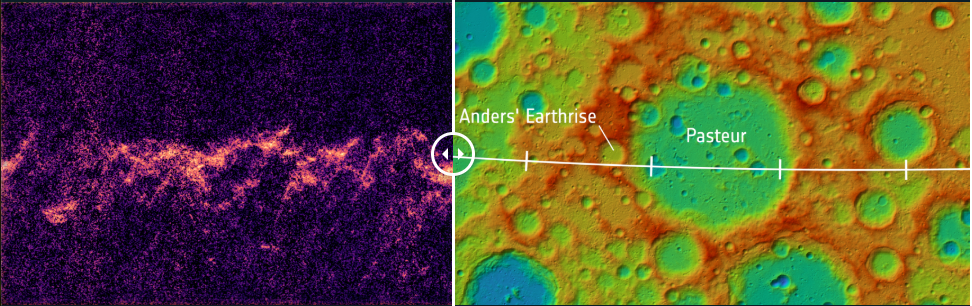
In 2024, Juice tested its Radar for Icy Moon Exploration (RIME) instrument in a lunar pass; in July, ESA released RIME’s “radargram” correlated to elevation profiles from NASA’s lunar altimetry of the moon’s key features, notably the lunar crater Pasteur-T from which NASA astronaut Bill Anders took the iconic 1968 Earthrise photograph.
The NASA-ISRO Synthetic Aperture Radar mission launched in July carrying L- and S-band synthetic aperture radar developed by NASA and the Indian Space Research Organization — a first for a satellite. The satellite is intended for surface phenomenology monitoring and disaster anticipation and response. In November, NISAR started releasing fused radar test imagery.
Opener image: NASA’s Perseverance rover in 2024 collected this “Sapphire Canyon” sample from the Cheyava Falls rock within Mars’ Jezero Crater. Scientists believe the “leopard spots” may indicate chemical reactions that supported past microbial life. Credit: NASA/JPL-Caltech/MSSS