Paper: Sonic booms could reveal where debris has fallen after uncontrolled reentries
 By Paul Marks
 By Paul Marks
Sonic booms generated as a hypersonic spacecraft breaks up on its searing, incandescent reentry through Earth’s atmosphere can be sensed by ground-based seismic networks and used to pinpoint the location of potentially hazardous debris, according to a research paper published today in the journal Science.
Because such debris may include radioactive components, toxic chemicals or volatile fuels, spacecraft operators need to find and recover any detritus that is not entirely burned up. But to date, it’s been notoriously tricky to predict precisely when a derelict spacecraft in a decaying orbit — such as a spent rocket body, dead satellite or abandoned crew capsule — will begin its uncontrolled reentry, and therefore where any debris may fall.
“Even within a day of reentry, the uncertainty windows commonly span several hours. This translates into orbital tracks covering large swaths of the planet, making advanced planning for response and recovery efforts challenging,” write planetary scientists Benjamin Fernando of Johns Hopkins University in Maryland and Constantinos Charalambous of Imperial College in London, in their paper, “Reentry And Disintegration Dynamics of Space Debris Tracked using Seismic Data.”
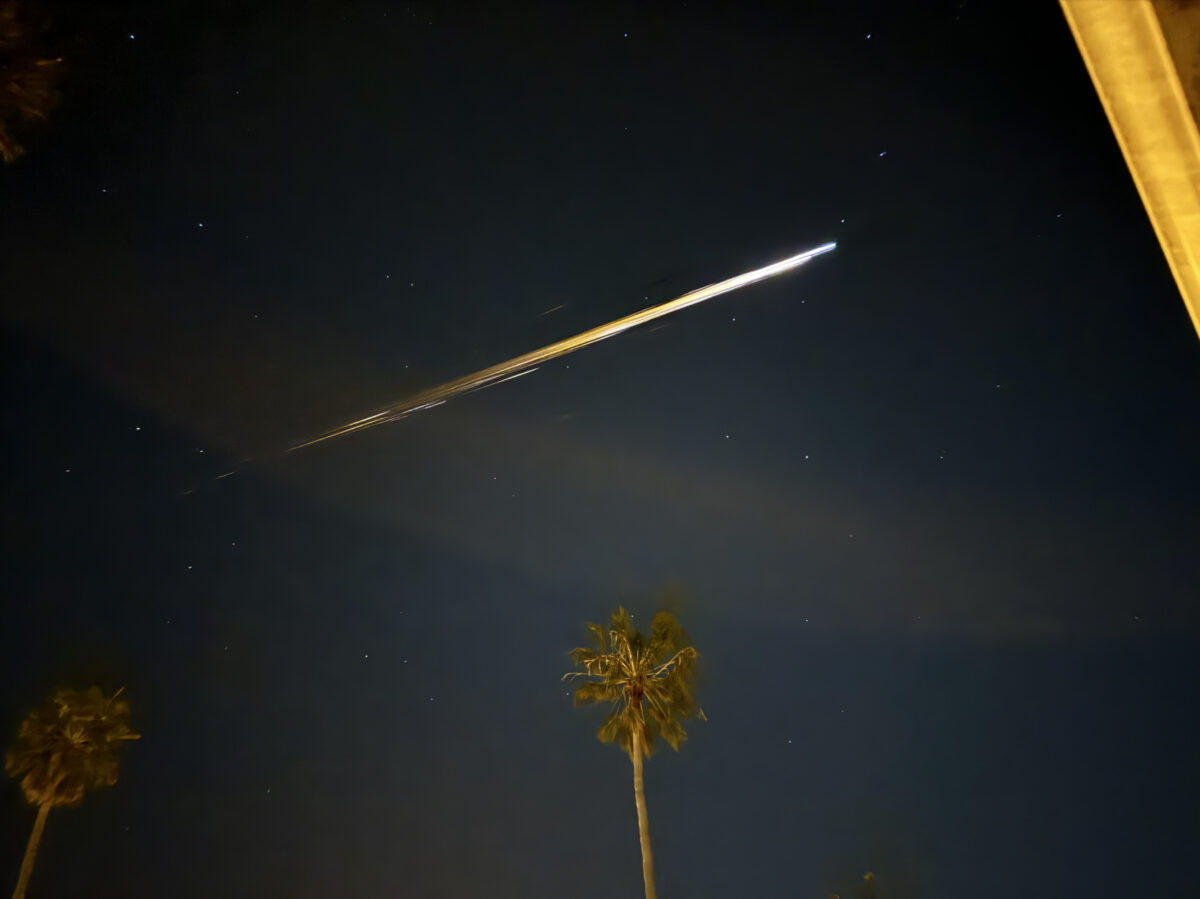
What’s needed, the pair says, is a better way of calculating where and when an uncontrolled reentry began and then tracking it. Inspiration arrived in the form of an unoccupied module from China’s Shenzhou-15 flight, which generated fireballs and sonic booms over California and Nevada during its breakup and reentry in April 2024. This made Fernando and Charalambous wonder if those sonic booms held clues to the fate of any debris.
That spacecraft was of particular interest, too, because the reentry prediction differed greatly from its actual trajectory. The United States Space Track service had estimated Shenzhou-15 would plunge through the atmosphere over the northern Atlantic Ocean at 09:06 UTC on April 2. But at 08:40 UTC (01:40 a.m. local time) witnesses began reporting a bright, noisy fragmenting fireball over the greater Los Angeles area — some 25 minutes earlier and 8,600 kilometers away from the predicted area.
Could an analysis of the sound data received by the earthquake sensors at seismic stations reveal where any surviving debris was headed? To find out, Fernando and Charalambous acquired publicly available, open-source data from 124 stations on the Southern California Seismic Network and from one on the Nevada Seismic Network.
They found the sensors had indeed picked up the shockwaves from the sonic booms generated by the spacecraft breaking up. They were able to calculate and plot the arrival times of those shockwaves across the region, enabling them to estimate the doomed spacecraft’s speed, altitude and ground track.
Based on the sonic boom patterns, Fernando told me in a video interview, Shenzhou-15 fragmented into tinier and tinier pieces. To his knowledge, no debris has so far been found, but had any pieces survived, the ground track analysis would have given recovery teams accurate clues as to where to look.
“It’s a little bit of a laborious process at the moment, because we need to examine the seismic data manually,” he said. “But it would be good to get to the stage where we don’t need to do that anymore and it’s all automated, in near real-time.”
In particular, the researchers hope more accurate debris recovery can help megaconstellation operators refine their satellite designs to ensure these spacecraft entirely burn up during reentry.
“We have an ever increasing number of reentries, and once they’re breaking up within the atmosphere, it becomes very difficult to figure out where they’ve broken up and where fragments might have landed,” Fernando said. “So the advantage that we can offer here is, rather than just seeing what happened in orbit, and approximating a solution in the atmosphere, we can actually track it as it’s breaking up and its disintegration as it passes through the air.”
Asked via email for his opinion of the ideas the paper surfaces, space debris simulation expert Hugh Lewis, a professor of astronautics at the University of Birmingham in the U.K., said he was impressed by the research.
“This is a fascinating study,” he wrote. “We tend to rely on tracking radars to predict re-entry locations, which are not always accurate. Understanding more precisely where a spacecraft re-enters and breaks up in the atmosphere might lead to better predictions of future re-entries and the risks they might pose to people on the surface or in aircraft.”