Autonomous aircraft ops may be limited by number of human operators, NASA research indicates


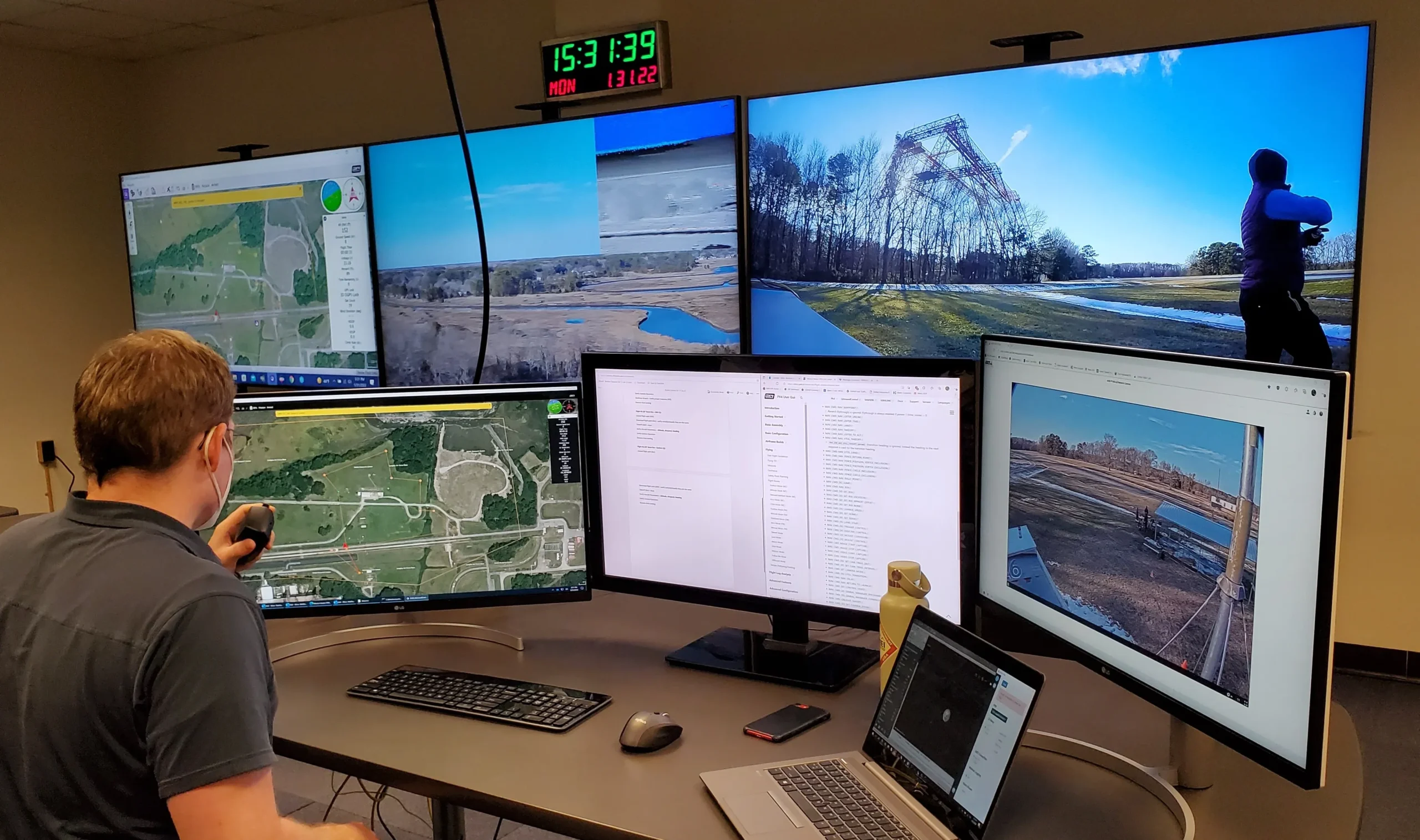
Plans for operating autonomous aircraft with no onboard pilot usually include some kind of remote monitor, a position that the industry increasingly describes as a “vehicle supervisor.”
Watching radar, GPS and visual or radio telemetry from afar in a ground control station, these supervisors would notionally monitor multiple aircraft, which proponents estimate would save money and allow greater distribution of drones or passenger aircraft. Such multi-vehicle supervisors already exist in the military world, tracking multiple tactical drones at one time.
However, there are likely limits to how many aircraft human supervisors can monitor at a time, according to research by NASA’s Langley Research Center in Virginia working with the Florida Institute of Technology. The researchers presented their findings last week at AIAA’s SciTech Forum in Orlando.
“When static mockups were scaled up to 10 vehicles, operators expressed concerns with the magnitude of information presented, stating that monitoring 10 vehicles would significantly diminish attention across the Ground Control Station,” the paper said. “In fact, based on the data we collected, we believe that scaling from 4 to 10 vehicles would fundamentally change the task. As such, a new interface design would likely be required.”
Exactly how many aircraft one person can monitor safely, especially in the event of emergencies or problems that demand attention, “has been an ongoing question” in the industry for years, Michael Politowicz, a NASA Langley aerospace research engineer and one of the co-authors, told me in an interview after the forum.
“That turned out to be a much harder question to answer than we realized. As we started to look across the entire AAM ecosystem, we realized that looking at one type of operation doesn’t necessarily equate to another,” Politowicz said. He was referring to the broad range of applications for aircraft categorized under advanced air mobility. Consider drones, which are being utilized for pipeline inspection, security and military surveillance, and delivery of cargo and consumer goods.
The paper is an incremental report under NASA’s ongoing MPATH initiative, short for Measuring Performance for Autonomy Teaming with Humans. Politowicz and his co-authors cited other research and conducted their own at Langley’s UAS Operations Center. They flew five drones simultaneously at the facility’s drone testing grounds, completing simple departures, looping flight patterns, and arrivals at a simulated vertiport complex. For those flights, human supervisors monitored only one aircraft at a time.
Then, the researchers ran simulations of supervisors monitoring multiple aircraft at once, Politowicz said. Operators were asked to provide ongoing feedback about the simulation, including how the graphic display on screens should be presented.
“We received consistent feedback that operators would not be able to monitor multiple vehicles at once and would need to rely more heavily on automation for routine aspects of the mission to free up resources to deal with off-nominal or emergency situations that arise,” the paper said.
In other words, operators were capable of focusing on only one issue at a time. “As a result, critical information should be easy to access to support quick response when any urgent situation occurs,” the paper said.
Virginia Stouffer, president of Virginia consultancy Transformational Technologies, said she was impressed by the paper and SciTech presentation, which she attended. She applauded the researchers for stating that automation has limits due to safety needs.
“The authors indicated firmly that more than four aircraft would be problematic,” she told me. “This was one of the hidden gems of the presentation: the first indication of what the human-to-vehicle ratio should be in practical terms for the remote supervision control that is key to increasing flights and controlling pilot costs.”
While the Langley tests may serve as a useful data point for the industry, Politowicz acknowledged the results may not necessarily apply to all types of drone operations.
“We don’t view this issue as having only one solution,” he said. “Ultimately, it comes down to, ‘What are you asking the operator to do?’ From the small drones up to the air taxis, what the operators are being asked to do is pretty fundamental to how many aircraft can be monitored by one person.”