
Technology demonstrations and deployable parts research lead 2025 milestones
 By Cat Hofacker
 By Cat Hofacker
2025 saw a flurry of deployable structures delivered across the space industry, including antennas, solar arrays and technology demonstrations.
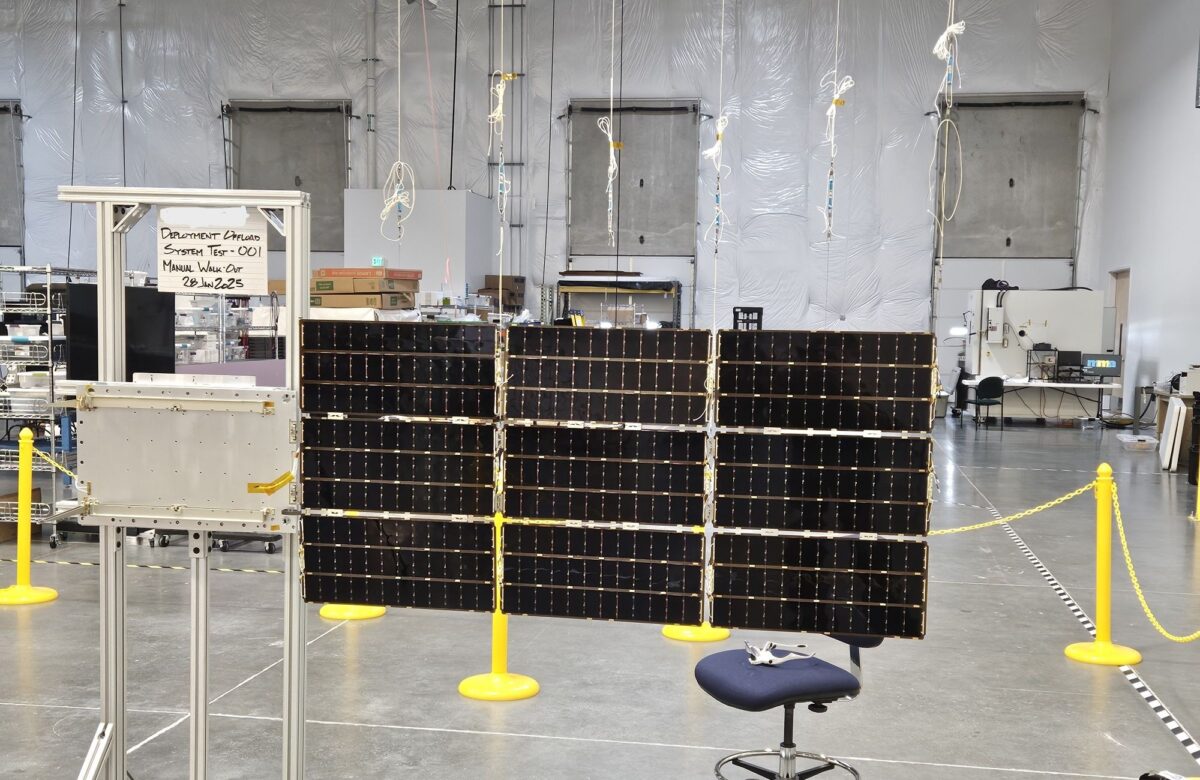
Cubesats have a standardized form factor that places strict volume limits on the spacecraft. These restrictions mean that power and communications systems will sometimes call for deployable elements with very efficient packaging. In August, MMA Space delivered two deployable systems — an ultra high frequency (UHF)/very low frequency (VLF) crossed dipole antenna, and a deployable solar array wing — to the U.S. Department of Defense for use on a 24-unit cubesat. The dipole antenna rolls into a compact package for launch and will deploy to a 5-meter tip-to-tip span. The nine-panel deployable solar array is expected to supply 330 watts of power at the end of life.
In June, Capella Space’s Capella-17 “No Cloudy Days” synthetic aperture radar spacecraft launched with a Tendeg deployable reflector onboard. The reflector deployed in July, and the mission has returned radar images from areas including Lima, Peru, and Reykjavik, Iceland, where frequent cloud cover interferes with visible light photography. Capella-17 marked Tendeg’s 25th successful on-orbit deployment.
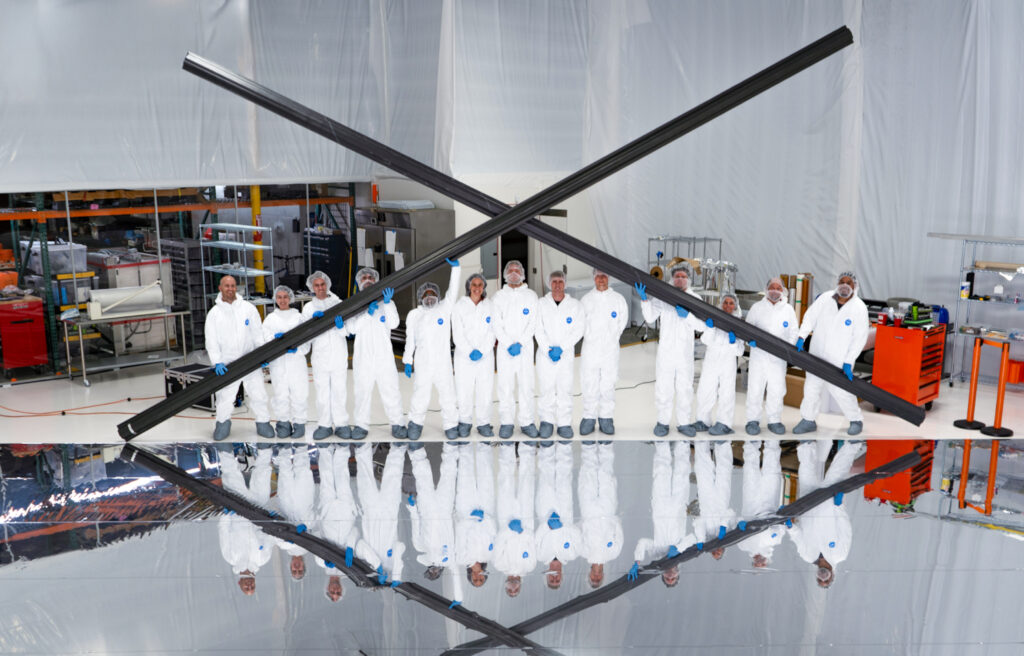
The 2024 article featured Caltech’s Space Solar Power Demonstrator mission, a demonstration of a large deployable array for beaming power to remote locations on Earth. California startup Reflect Orbital is developing a similar technology, and in June was awarded a Phase II Small Business Innovation Research grant by the U.S. Air Force. While the Space Solar Power Demonstrator envisioned beaming power to Earth at microwave frequencies, Reflect Orbital designs and manufactures large deployable reflectors for directing supplemental sunlight to Earth. Large, lightweight rollable composite booms would be used to deploy and support these orbital structures.
DARPA’s NOM4D — short for Novel Orbital and Moon Manufacturing, Materials, and Mass-efficient Design — program envisions in-space manufacturing of precision structures. In February, DARPA announced that Caltech and the University of Illinois Urbana-Champaign were selected to develop in-space demonstrations of their respective manufacturing systems. In-space manufacturing makes it possible to use lightweight structural designs that would not survive the high loads experienced during a rocket launch.
This reduced structural requirement can save mass and volume in the launch vehicle and has the potential for high mass savings on the moon and Mars, where in situ resources can be added to materials from Earth. Caltech’s demonstration will assemble a 1.4-meter circular truss from thin composite tubes and mesh, and the University of Illinois demonstration will launch soft, uncured carbon-fiber composite parts that are polymerized into stiff structural parts in space.
As of February, the University of Florida and NASA’s Marshall Space Flight Center were continuing to study the use of lasers for bending metal into precise patterns as part of NOM4D Phase 3. Earlier rounds NOM4D funded a wide range of in-space assembly concepts and the use of both launched materials and lunar regolith for building space structures.
Opener image: MMA Space’s cubesat solar array that was delivered to the U.S. Defense Department in August. The array measures 71 by 154 centimeters when deployed and 27 x 55 x 4 cm when stowed. Credit: MMA Space