Supercomputing and AI-equipped satellites continue to advance aerospace technologies
 By Cat Hofacker
 By Cat Hofacker
In March, the European Space Agency inaugurated its new Space High-Performance Computing supercomputing facility in Frascati, Italy, developed in partnership with Hewlett Packard Enterprise. The system delivers 5 petaflops of performance powered by 108 Nvidia H100 GPUs, more than 34,000 central processing unit (CPU) cores, and 3.6 petabytes of solid-state drive storage. More than half of its power demand is provided by solar panels, with waste heat recycled for facility use, reflecting Europe’s commitment to sustainable computing.
Space HPC accelerates modeling, simulation and data-intensive workflows critical to spacecraft design and aerospace operations.
At the unveiling, ESA demonstrated a 1,000-time runtime reduction for the EUHFORIA space weather model, cutting execution from 10 hours to one minute. “With this new facility, ESA is providing a flexible supercomputing infrastructure in support of R&D, testing and rapid benchmarking for ESA programmes, industrial players, and researchers,” Director General Josef Aschbacher said in the press release.
In May, the China Aerospace Science and Technology Corp. (CASC) took its first step toward creating the world’s first space-based supercomputer constellation with the launch of 12 satellites under its Star Compute initiative. The satellites were delivered to orbit aboard a Long March 2-D rocket that lifted off from the Jiuquan Satellite Launch Center. Each spacecraft is equipped with an onboard AI processor with an 8 billion parameters model and a processing capability of 744 tera operations per second. Collectively, the initial cluster achieves 5 peta-operations per second, with plans to expand the network to up to 2,800 satellites.
The constellation incorporates laser-based intersatellite links with up to 100 Gbps bandwidth, 30 TB of shared storage, and specialized payloads including an X-ray polarization detector. As orbital supercomputing capabilities mature, these technologies will support real-time Earth observation and disaster response, digital twin modeling, space science, and beyond.
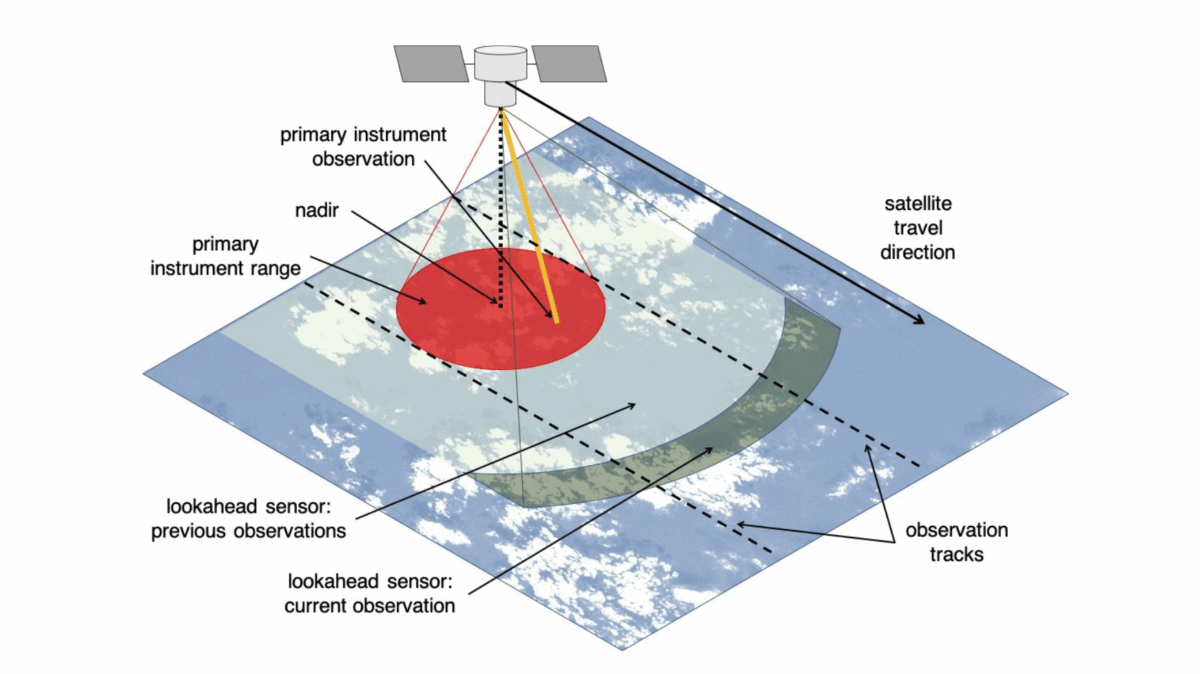
In July, NASA demonstrated how artificial intelligence can improve space-based science through a technology called Dynamic Targeting. Tested aboard the CogniSAT-6 satellite, Dynamic Targeting enables spacecraft to autonomously decide where and when to make observations in orbit, all within 90 seconds and without human intervention. Using an onboard AI processor, the system can analyze imagery from a lookahead sensor, distinguishing between clouds and clear sky and then directing instruments to capture the more useful cloud-free data.
This innovation marks a shift toward edge computing on spacecraft, providing the capability to interpret sensor inputs and make real-time decisions without human help. Instead of just acquiring data, the satellite can recognize potential science targets — such as wildfires, volcanic eruptions, and rare storms — and aims its sensors accordingly. This first test centered on avoiding clouds, which degrade up to two-thirds of Earth observations.
In September, NASA engineers developed and tested a solution to address vibration issues on the Space Launch System rocket. During the 2022 Artemis I test flight, SLS experienced higher-than-expected vibrations near the solid rocket booster attachment points. To solve this problem, engineers proposed adding four strakes to the rocket’s core stage. Using Unsteady Pressure Sensitive Paint technology in NASA’s Unitary Plan Wind Tunnel at Ames Research Center and the NASA Supercomputing facility Cabeus, the team analyzed the effectiveness of the strakes in reducing vibrations.
The computational fluid dynamics simulations confirmed that the strakes would effectively smooth airflow and reduce component vibrations. Boeing installed these strakes on the rocket at NASA’s Kennedy Space Center in October, ahead of the Artemis II crewed flight test planned for early 2026.
Opener image: The Jet Propulsion Laboratory’s Dynamic Targeting concept relies on a “lookahead sensor” to detect objects in the path of the satellite, while onboard algorithms identify which objects to avoid and targets that require closer observation. Credit: NASA/JPL-Caltech