Record launches, qualification milestones and facility expansions for solid rocket motors
 By Cat Hofacker
 By Cat Hofacker
It was an active year of launches, tests and industry growth that reaffirmed the critical role of solid rocket motors in the defense and commercial sectors.
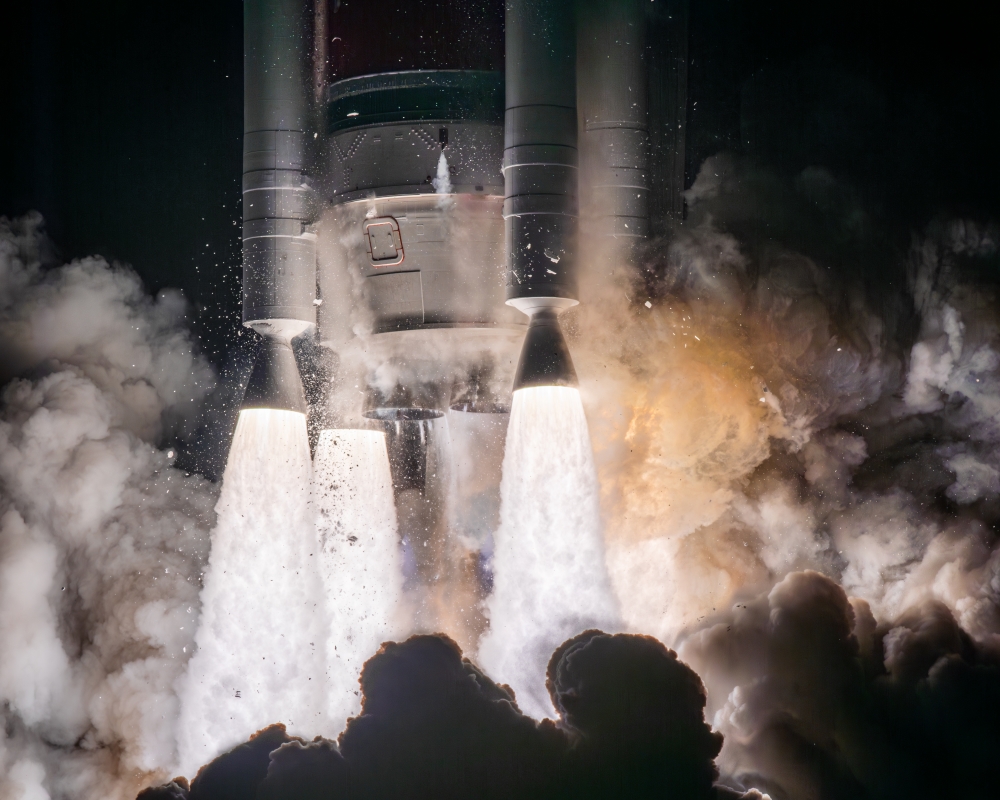
In June, Northrop Grumman static fired two Graphite Epoxy Motor-63XL (GEM-63XL) strap-on boosters. Each provided 449,000 pounds (2,000 kilonewtons) of thrust, validating the longest monolithic single-case booster design and recent design changes. In August, four of these boosters flew on a United Launch Alliance Vulcan Centaur that deployed the USSF-106 payloads while delivering nearly 2 million pounds (8,900 kN) of thrust.
ULA’s Atlas V design continued its legacy with launches in April and June that each sent 54 Amazon Project Kuiper satellites to low-Earth orbit. These rockets incorporated a total of five GEM-63 and nine retro boosters. In April, a Minotaur IV launch from Vandenberg deployed classified National Reconnaissance Office payloads, the first launch in over a decade with repurposed Peacekeeper stages.
From Europe and Asia, Avio in April and July launched six satellites aboard two Vega-C rockets. Two Ariane 6 launches were also conducted from Kourou, French Guiana. March’s VA263 orbited France’s CSO-3 satellite, in which two P120C boosters each supplied over 80% liftoff thrust. August’s flight carried EUMETSAT’s Metop-SGA1 — this was Arianespace’s 355th launch.
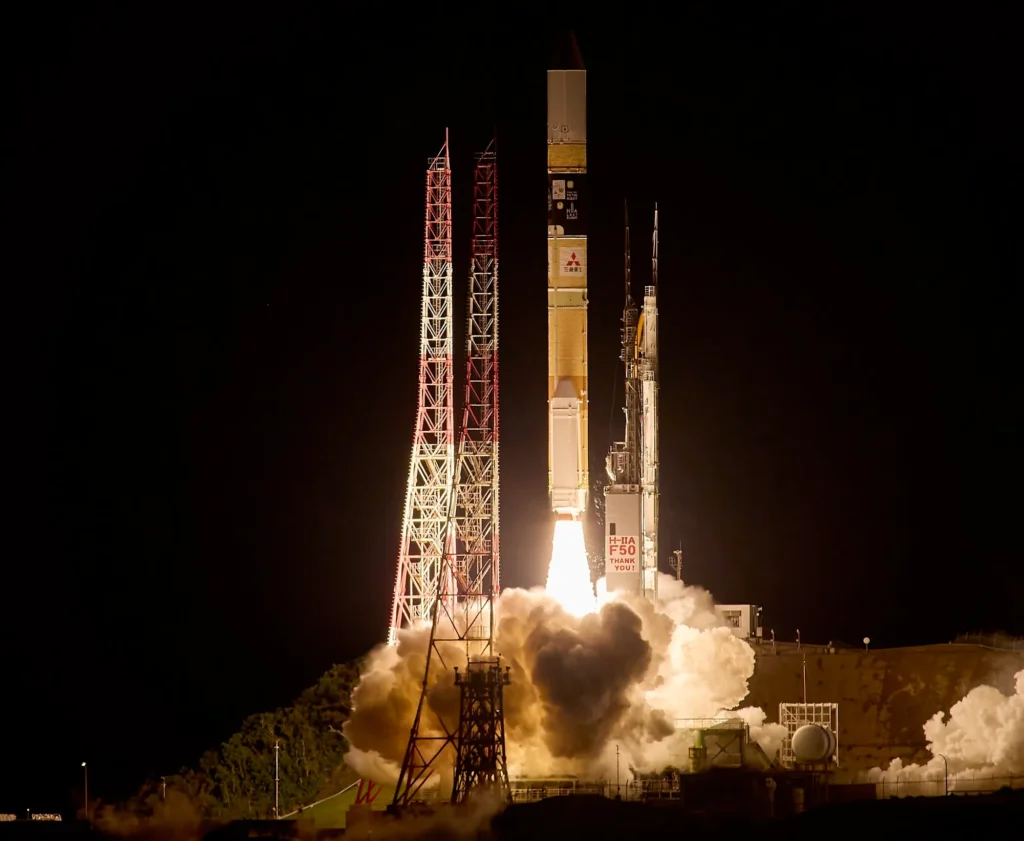
In June, Japan retired its H-2A after 24 years of service. For the final launch, a climate satellite was orbited from Tanegashima with two SRB-A3 boosters. In January, China’s Galactic Energy launched five weather satellites via Ceres-1 four-stage SRM from the Gobi Desert. In July, an Indian Geosynchronous Satellite Launch Vehicle orbited the NASA-ISRO Synthetic Aperture Radar (NISAR) satellite using four L40 boosters.
In space exploration, Northrop Grumman in June tested the first Space Launch System Block 2 Booster Obsolescence and Life Extension (BOLE) motor, DM-1, in Utah. Despite a nozzle issue, the 140-second burn consumed 1.4 million pounds (635,000 kg) of propellant, generating four million pounds (17,800 kN) of thrust and providing data for future Artemis payloads. In July, Northrop Grumman’s Elkton site validated a propellant change for a second stage SRM for boosting the NASA Mars ascent vehicle.
Ground and flight tests also continued. In March, Northrop Grumman and the U.S. Air Force qualified the LGM-35A Sentinel intercontinental ballistic missile first stage and, in July, the second stage at Arnold Engineering Development Center, validating digital models where Sentinels will replace Minuteman IIIs. In March, L3Harris Technologies debuted the eSR-19 advanced large SRM for a Medium Range Ballistic Missile (MRBM) target. In a U.S. missile defense test, the MRBM was air launched with a hypersonic target vehicle on the front-end. Anduril announced in March it had conducted two 21-inch (53 cm) SRM tests for the Navy’s Standard Missile Program.
Tactically, Lockheed Martin’s Precision Strike Missile (PrSM) completed production flights in February, April and March, meeting extended range milestones. Meanwhile, RTX conducted live fires with Patriot missiles in February, followed by a June launch with Ursa Major of a hypersonic launch glide body using an SRM equipped with highly-loaded grain technology.
In major awards, Lockheed Martin secured two Trident II D5 contracts as well as deals for PrSM, Joint Air-to-Ground Missile/Hellfire and PAC-3 Missile Segment Enhancement. RTX announced awards for Standard Missile-6 Block IA, Evolved Sea Sparrow Missile, AIM-9X Block II and Rolling Airframe Missile production. In partnerships, Anduril announced future SRM design collaborations with Germany’s Rheinmetall.
Due to increasing demand for SRMs, the industry responded nationally and internationally to expand U.S. manufacturing capability. Anduril, Avio, L3Harris, Nordic Ammunition Co., Northrop Grumman, Ursa Major and X-Bow announced new or expanded facility developments.
These achievements highlight the solid rocket community’s focus areas, from monolithic cases to digital engineering, all aimed at providing affordable space access and defense systems amid global competition.
Opener image: A United Launch Alliance’s Vulcan Centaur rocket lifted off with four Northrop Grumman-built GEM 63XL solid rocket boosters in August 2025 for a U.S. Space Force mission. Credit: ULA