Golden Dome headlines the year’s developments in missile defense
 By Cat Hofacker
 By Cat Hofacker
Shortly after being sworn in as president of the United States in January, Donald Trump signed Executive Order 14186, “The Iron Dome for America,” directing the creation of a missile defense shield for the defense of the American homeland, noting modern threats.
The EO outlined a number of expectations for this Golden Dome, which the Department of Defense in general and the Missile Defense Agency (MDA) in particular are trying to address. “The threat of attack by ballistic, hypersonic, and cruise missiles, and other advanced aerial attacks, remains the most catastrophic threat facing the United States,” reads the EO.
Trump directed the Pentagon to submit a “reference architecture” that adhered to a number of requirements, including: plans for defending the U.S. “against ballistic, hypersonic, advanced cruise missiles, and other next-generation aerial attacks from peer, near-peer, and rogue adversaries;” “Accelerati[ng] the deployment of the Hypersonic and Ballistic Tracking Space Sensor layer;” “Development and deployment of proliferated space-based interceptors capable of boost-phase intercept;” and “Development and deployment of capabilities to defeat missile attacks prior to launch and in the boost phase[.]”
In July, the Senate confirmed four-star Space Force Gen. Michael Guetlein as program manager of Golden Dome. As of mid-December, the proposed architecture had not been released.

Further reinforcement of the Golden Dome priorities came from the Office of Management and Budget, which in September released a memorandum for the heads of executive departments and agencies, listing fiscal year 2027 administration research and development budget priorities and cross cutting actions: “Agencies should invest in critical capability needs that will support the President’s bold vision for homeland missile defense as outlined in the Golden Dome for America initiative. These include the [science & technology] underpinning sensing and sensemaking, trusted autonomy, space maneuverability, directed energy, advanced materials, and affordable scalability. Agencies should also closely evaluate how their talent communities and unique resources can align towards risk reduction or capability enhancement activities for Golden Dome and explore opportunities for the dual-use applications of the exquisite capabilities that the Golden Dome will afford.”
The Missile Defense Agency (MDA) in September released a 10-year, multiple-award, indefinite-delivery, indefinite-quantity contract solicitation for the Scalable Homeland Innovative Enterprise Layered Defense, dubbed SHIELD. The stated anticipated maximum value was $151 billion, and proposals were due Oct. 16. Development work will occur under multiple task order contracts, which will be provided for competitive bid to those companies that win SHIELD IDIQ awards.
Sounding the need for additional missile defense capability, the U.S. Army in September awarded Lockheed Martin a $9.8 billion contract for 1,970 Patriot Advanced Capability–3 Missile Segment Enhancement interceptors and associated hardware. This is the largest contract in Lockheed Martin Missiles and Fire Control history.
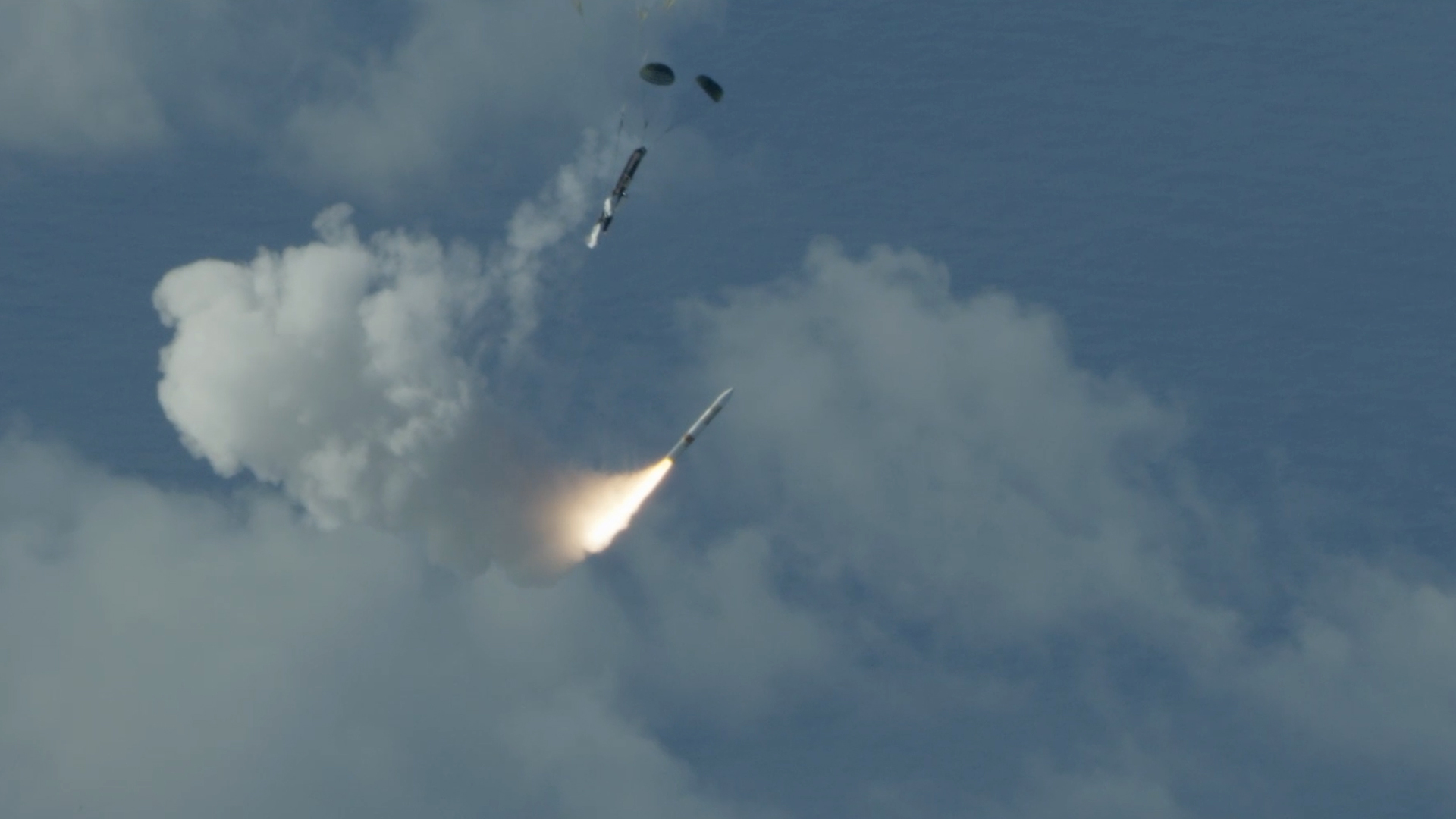
In March, MDA and the U.S. Navy conducted Flight Test Other-40 (FTX-40), or Stellar Banshee, to demonstrate the ability to track a hypersonic vehicle. The vehicle was drop launched from the back of a C-17 and tracked by Aegis systems and the Hypersonic and Ballistic Tracking Space Sensor demonstration satellites. The test demonstrated integration of space assets and naval assets in a missile defense scenario. FTX-40 also served as a risk-reduction flight for the new MDA-developed hypersonic test target.
In August, MDA and the Israel Missile Defense Organization completed a series of developmental flight tests of the David’s Sling Weapon System against simulated future threats. This system, which has intercepted multiple missiles fired at Israel in recent years, is part of Israel’s layered air and missile defense architecture that also includes the Arrow anti-ballistic missiles, Iron Dome and the planned Iron Beam.
Opener image: The U.S. Missile Defense Agency and Navy in March 2025 completed Flight Test Other-40, in which a hypersonic target vehicle was air launched from a C-17 off the coast of Hawaii. Credit: Missile Defense Agency