Advanced air mobility continues to mature
 By Cat Hofacker
 By Cat Hofacker
Driven by global markets and competition, leading advanced air mobility (AAM) companies continued their progress toward entry into service and revenue generation, although notable exits and consolidations also occurred. Public entities advanced regulations and guidance to support integrating AAM operations into the airspace and broader transportation ecosystem.
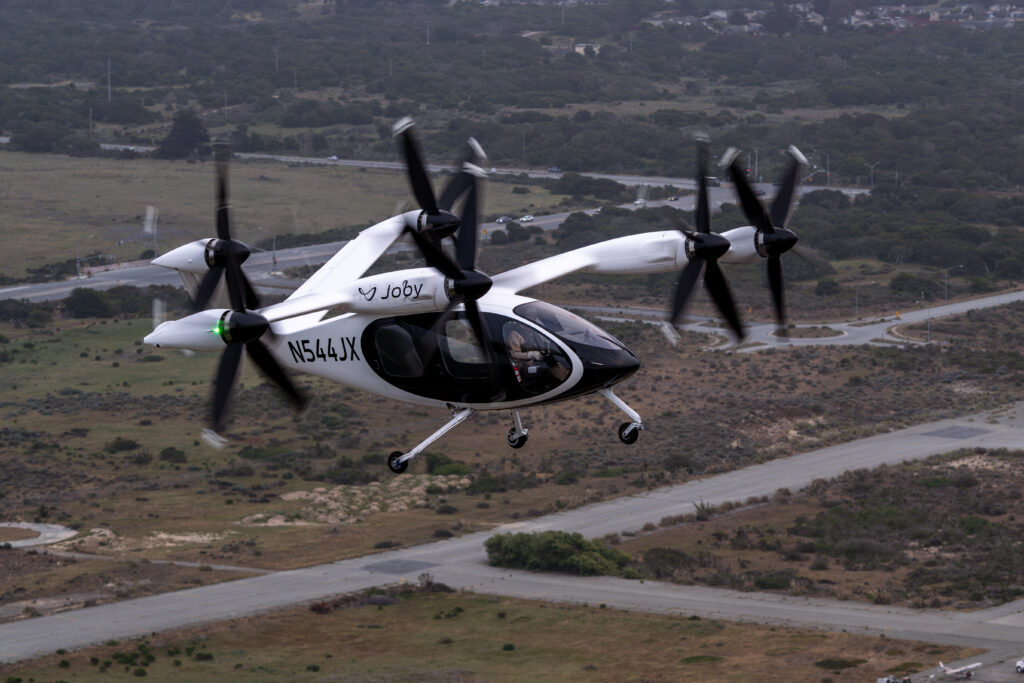
Developers of passenger-carrying AAM aircraft continued toward certification and operations. In California, Joby Aviation and Archer Aviation advanced from remotely piloted testing of their electric vertical takeoff and landing aircraft (eVTOLs) to testing with onboard pilots. In April, Joby performed its first piloted flight with full transitions between powered-lift and wingborne flight. Archer began onboard piloted flights in June, focusing initially on conventional takeoff and landing operations. Between January and September, Bristol-based Vertical Aerospace in the U.K. advanced through hover, low-speed maneuvering, and wingborne piloted flight testing with its second VX4 prototype. In September, Vertical Aerospace initiated a fourth phase to eventually perform full transition flight.
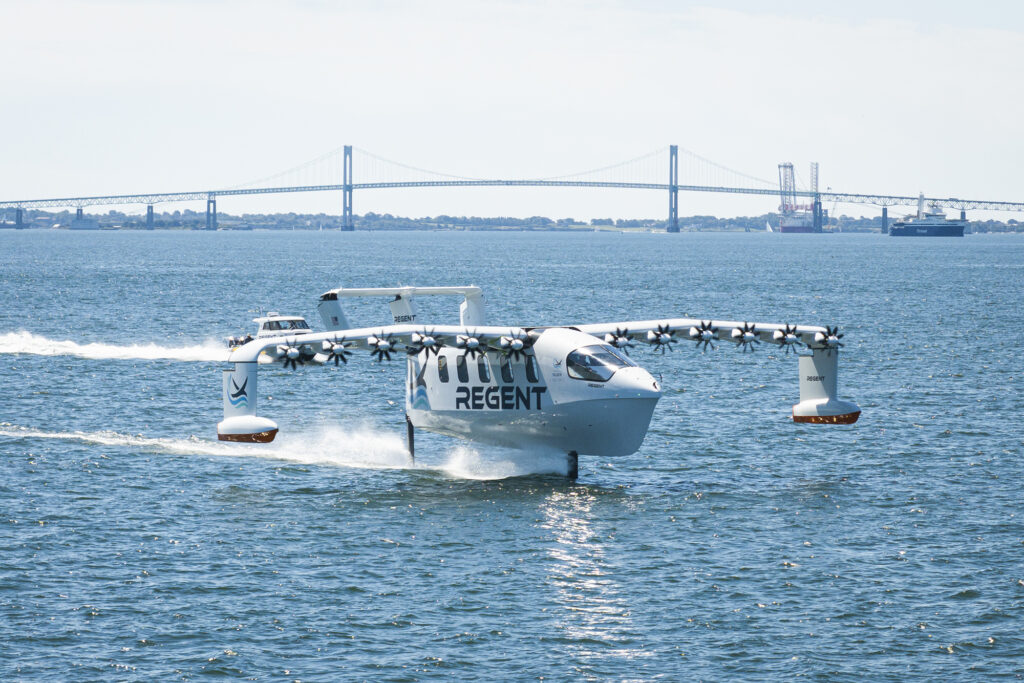
Throughout the year, companies with mature prototypes or type-certified aircraft, including China-based EHang and AutoFlight, conducted flight demonstrations worldwide. Several occurred in the United Arab Emirates, which is attracting companies through infrastructure investment. In June, Vermont-based BETA Technologies performed the first all-electric flight into New York’s John F. Kennedy International Airport. The piloted ALIA CX-300 prototype carried four passengers. Other demonstrations included two in June: the testing of Rhode Island-based REGENT’s full-scale Seaglider wing-in-ground-effect vessel, which foils on a hydrofoil as a transition mode between hull-based and wingborne operations, and Joby’s reported nine-hour flight of a demonstrator powered by hydrogen fuel cells.
Continuing a 2024 trend, 2025 saw further industry consolidation and partnering. In January, Airbus paused development of its CityAirbus eVTOL. In September, Supernal — the California-based subsidiary of Hyundai Motors — paused eVTOL development despite having performed tethered hover testing with a technology demonstrator in March. In February, German-based Lilium, which emerged from insolvency in December 2024, reentered insolvency, and Washington state-based Eviation paused development of its Alice electric airplane.
Other companies consolidated or formed strategic partnerships. German startup Volocopter, which filed for insolvency in December 2024, was purchased by Chinese firm Wengfang. Skyports, a London-based vertiport management company, entered into agreements worldwide, including in Dubai, New York City, and London, making it an early leader in vertiport management for initial operations. In June, Boeing subsidiary Wisk announced that Skygrid, a Texas-based service provider specializing in autonomous flight and airspace management, would become its subsidiary.
Regulators continued progress toward enabling AAM operations. In April, the aviation agencies of Australia, Canada, New Zealand, United Kingdom and the U.S. released a Roadmap for Advanced Air Mobility Aircraft Type Certification. In July, FAA released guidance for certifying powered-lift aircraft and its final Modernization of Special Airworthiness Certification (MOSAIC) rule. MOSAIC broadens the definition of light-sport aircraft to include allowing eVTOLs to be certified in this category, which supports increased AAM utilization in operations not involving commercial passenger and cargo transportation. In August, FAA released draft rules to enable remotely piloted aircraft to fly beyond visual line of sight (BVLOS). The draft proposes Part 108 for low-altitude, BVLOS operations and Part 146 for certifying automated data service providers, which opens the door for third-party service providers to support a myriad of future operations.
Also in August, the National Association of State Aviation Officials’ AAM Multistate Collaborative, a coalition of over 30 states, released four topic papers discussing the role of states in AAM. In September, the U.S. Department of Transportation released the eVTOL and AAM Integration Pilot Program solicitation, seeking teams of public and private entities to accelerate AAM adoption.
Overall, AAM continued its steady maturation.
Opener image: Archer Aviation was among the companies that conducted demonstration flights of an electric vertical takeoff and landing aircraft in the United Arab Emirates in 2025. Credit: Archer Aviation