
SpaceWorks satellite docking device completes ground test
 By Keith Button
 By Keith Button
SpaceWorks, one of the companies aiming to create the standard docking mechanism for satellites and orbiting spacecraft, passed a development milestone earlier this month.
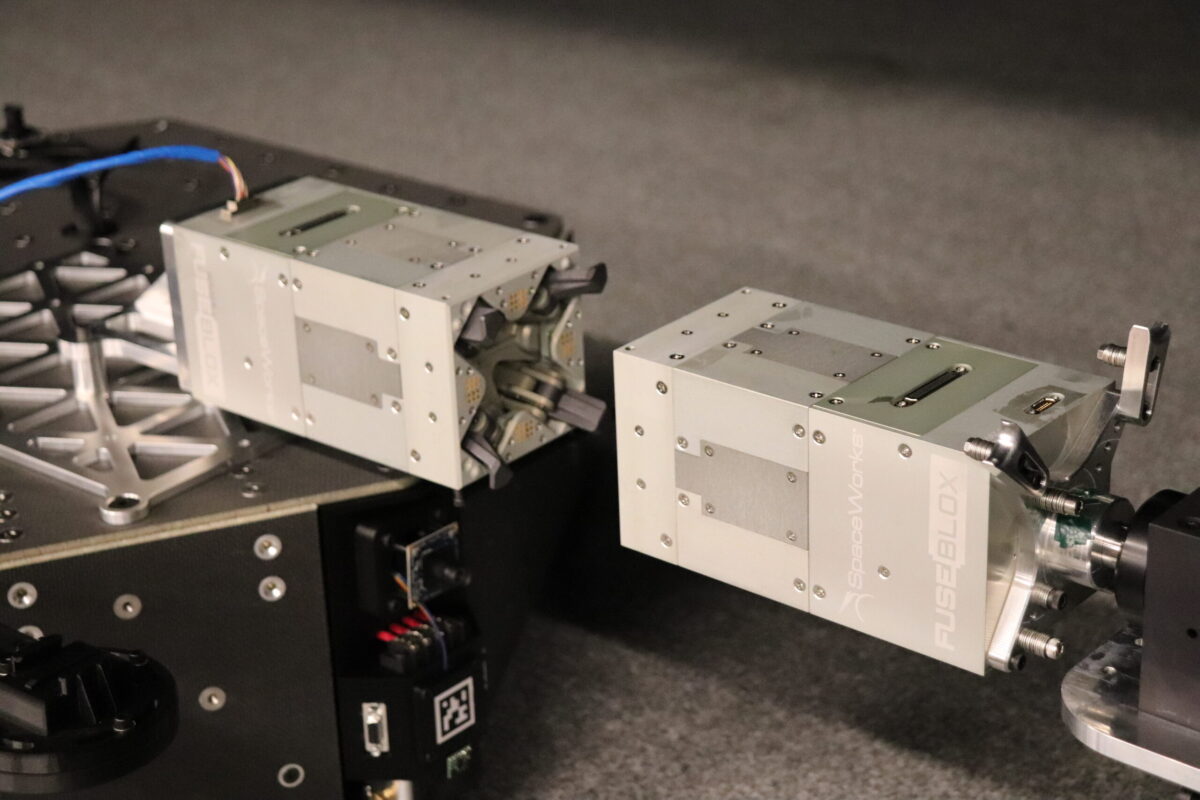
The Atlanta company’s FuseBlox docking device was publicly ground tested by a commercial customer for the first time, said Kevin Okseniuk, product lead for FuseBlox. Rogue Space Systems of New Hampshire simulated how a spacecraft could dock with a cargo container in space and then transmit data and power through SpaceWorks’ docking connection, Okseniuk said. (A previous commercial customer test cannot be publicized under the terms of a nondisclosure agreement.)
The public demonstration allows SpaceWorks to make its case for making FuseBlox a standard, he said: “We want it to be on every satellite.”
Settling on a single docking standard would benefit the space industry because the alternative — having every spacecraft lug around an extra adapter to fit a variety of docking devices — would be too costly, Okseniuk said. “That’s launch mass that you have to pay for.”
He added: “My hypothesis over the next two to four years is you’ll see a race to become the standard, and you’ll see a lot of different interfaces, including FuseBlox, trying to compete for at least a part of that standard.”
That said, a particular design might not emerge as the winner, he said. Rather, the chosen standard may ultimately be an amalgamation of the competing standards.
“I think it is healthy for interfaces to compete over these next few years to try to become part of that standard,” Okseniuk said.
Each FuseBlox is a 3-kilogram-long rectangular block, about half the size of a 12-pack of soda, designed to connect end-to-end with a second FuseBlox by extending four “claws,” each shaped like the head of a railroad spike. These claws grab inside the second FuseBlox and pull the two blocks together. The device is androgynous, meaning that either can be the grabber or the grabbee.
FuseBlox also contains connectors for data and power feeds. SpaceWorks is developing add-on options for transferring rocket propellant and other fuels, as well as cryogenic fluids like liquid oxygen. In August, the company demonstrated this capability with a bench test, flowing water through two connected devices.
NASA is interested in the cryogenic liquid transfer concept. So far, the space agency has awarded $1 million in Small Business Innovation Research Ignite grant funding to SpaceWorks to develop that technology, which the company plans to demonstrate next year. Plans call for two connected FuseBlox to transfer liquid nitrogen at Marshall Flight Space Center by October 2026, Okseniuk said. If those go as expected, SpaceWorks could be approved for additional NASA grants to build a version that could be tested on a satellite in orbit. FuseBlox hasn’t flown yet.
Other companies creating their own docking technologies include Northrop Grumman, which has developed a satellite docking and refueling mechanism called a Passive Refueling Module. Similarly, Orbit Fab of Colorado has its Rapidly Attachable Fluid Transfer Interface and GRIP docking and refueling devices. Lockheed Martin in 2022 created a Mission Augmentation Port interface standard as a guide for other companies to build docking and power and data connections for satellites, along with its own Augmentation System Port Interface docking device.
Today, cargo and crew spacecraft traveling to the International Space Station are equipped with the International Docking System Standard, created by NASA and the space agencies of Canada, Europe, Japan and Russia. Those devices have a 0.8 meter-wide passage.
Okseniuk is the lead author of a SpaceWorks paper about the development and potential of FuseBlox that is due to be presented next month at AIAA’s SciTech Forum. In addition to refueling satellites, standard docking devices would make it easier for capturing wayward satellites, sending cargo to and from orbiting manufacturing sites, and connecting satellites to transfer data or manage thermal loads, such as with predicted orbiting data centers for artificial intelligence computing.
“I’ll be really interested to see how that plays out with the data center space, with interfaces like FuseBlox,” he said. “It might not be FuseBlox that wins out, but interfaces like this could help enable the growth of those industries, aggregating things in the space.”