Opinion: How to solve Hubble’s gyroscope problem and give the telescope new life

By Roshi Nilchiani, David Barnhart and Rashika Sugganahalli
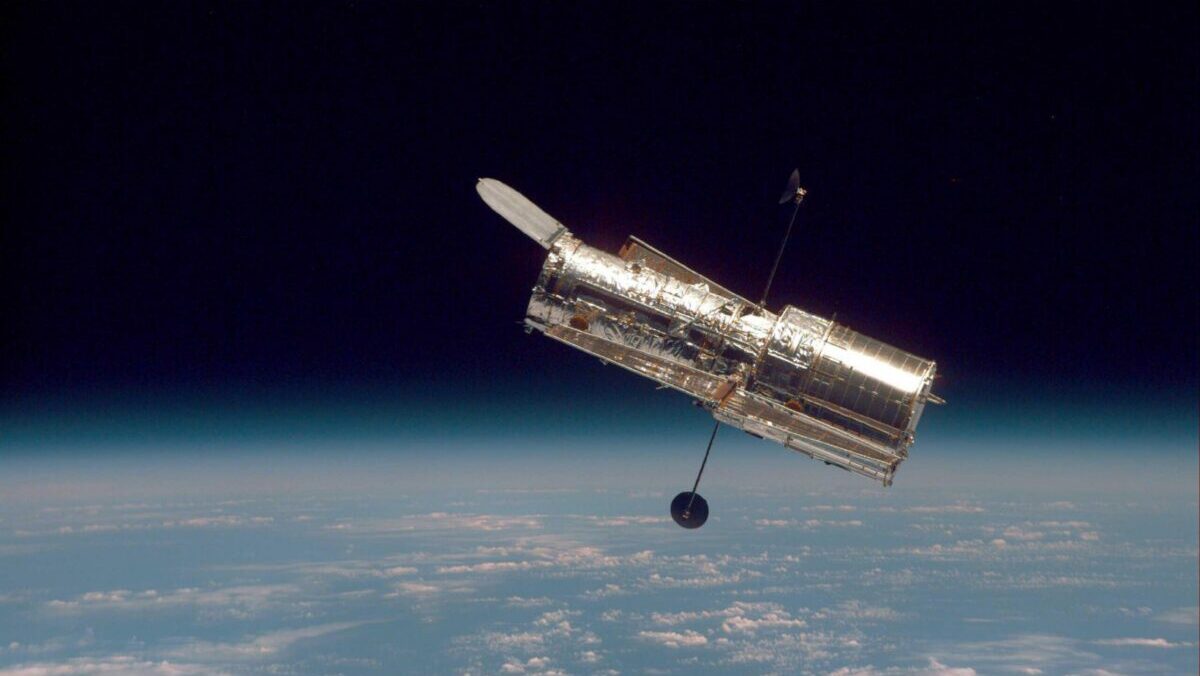
NASA’s Hubble Space Telescope (HST) has been arguably one of its most valuable missions, returning a plethora of scientific discoveries that have reshaped our understanding of the universe. Since its 1990 launch, Hubble has enabled over 22,000 peer-reviewed publications, captured detailed images of over 1.7 million celestial objects, and contributed to the discovery of phenomena such as the accelerating expansion of the universe, the first directly imaged exoplanet atmospheres, and the identification of thousands of new star clusters and nebulae in distant galaxies.
Much of this wouldn’t have been possible if HST had not been designed to be serviceable by the space shuttle, allowing astronauts to perform upgrades, restore or replace failed components and update obsolete systems. For example, shortly after launch, Hubble’s primary mirror exhibited a spherical aberration that required corrective optics to be installed. Over the years, various instruments and gyroscopes have also been replaced or upgraded, demonstrating the flexibility of the design to maintain and enhance the telescope’s capabilities.
These gyroscopes are small spinning devices that tell the telescope how fast and in what direction it is turning, so it can point steadily at distant targets. When these gyros fail, Hubble struggles to sense its own motion, making it slower and harder to aim precisely for the sharp images scientists need. Their functionality has been a persistent issue. Of the six replacements installed in 2009, only the three enhanced models were operational as of 2018. By mid-2024, NASA began transitioning Hubble to operate routinely in “one gyro mode,” with one additional gyro held in reserve and other sensors such as star trackers, sun sensors and magnetometers taking on more of the pointing workload.
NASA estimates that at least one enhanced gyro will remain operational through the 2030s, although officials acknowledge that performance degradation and loss of efficiency is bound to happen. The major weakness lies in Hubble’s ability to sense its own motion. As gyros drop offline, controllers fall back on one-gyro mode, leaning more heavily on star trackers and magnetometers. The workaround keeps the observatory alive, but it slows Hubble’s response to new pointing commands, which can limit scheduling flexibility for observations.
Our research team has created an economical and relatively simple solution to save Hubble and extend its operational life by at least two decades, although reaching the 2030s and beyond also depends on addressing orbital decay with a future reboost of the telescope’s altitude. Our concept is straightforward: Deploy four to six nanosatellites, each equipped with state-of-the-art gyroscopes as its primary payload, evenly spaced along a flexible tether that forms a ring with a slightly larger diameter than Hubble’s cylindrical body. The idea grew out of a discussion during Hubble’s 35th anniversary celebrations, when three researchers, passionate about cost-effective, low complexity solutions, began exploring non-intrusive ways to extend the life of a legacy observatory — especially as NASA’s deorbit studies and private reboost proposals highlighted both the risks and opportunities of intervening in Hubble’s future.
Once launched and inserted into low-Earth orbit, this nanosatellite array would autonomously rendezvous with Hubble, align with its outer structure and then gradually tighten its tether, fastening the nanosat ring securely around the telescope without any direct mechanical intrusion into the telescope’s structure.
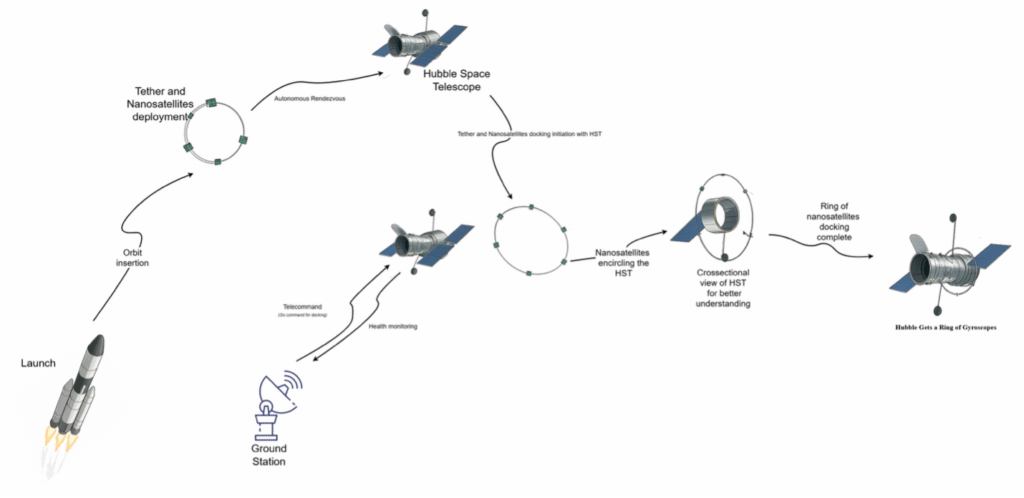
Each nanosatellite would be about the size of a shoebox and carry a compact gyroscope unit to provide precise angular rate data. Their role is not to steer Hubble but to restore its ability to sense motion with the accuracy required for science. Each nanosatellite would be capable of collective autonomous decision-making to execute docking and proximity operations, allowing them to position themselves relative to Hubble without relying on direct communications during approach.
Integration of the ring would be dependent upon the optimum configuration of launch, traverse to Hubble and then deployment. Following separation from a launch vehicle, the nanosats would be able to communicate with one another, and a few designated units would serve as relays during the final approach, providing ground controllers with the authority to issue a “go” or “no-go” before the rendezvous and connection with Hubble. The deployment of the tether system would be done prior to or just after contact. After attachment, sensor data would be routed into Hubble’s established telemetry pathways, avoiding the need for large antennas or separate ground links on the nanosats themselves, thus limiting overall power requirements.
The tether holding the formation is designed to expand over Hubble’s widest cross-section and then contract. Soft, compliant pads rest against preselected structural surfaces, such as instrument module flanges, ensuring secure grip without mechanical penetration. Gecko pads (as demonstrated on the Gecko Gripper from Stanford and the REACCH system from the University of Southern California) provide the unique unidirectional grip points to the HST structure. The approach and contact sequence would be deliberate and layered: autonomous rendezvous and hold at a safe distance, validation of system health, soft-capture with minimal contact force, controlled tightening to conform the ring to Hubble’s shape, and final latching. Each stage is monitored with redundant checks and can be safely aborted if constraints are violated.
Once secured, the array functions as an external sensing shell. By fusing measurements from multiple nanosats, the system generates a robust, redundant attitude-rate estimate. This information is integrated with Hubble’s own control architecture, supplementing the degraded internal sensors. In practice, this restores Hubble’s ability to provide high-fidelity rate information on demand between targets and to hold its pointing long enough for demanding science exposures, without requiring new actuators or any modification of the heritage spacecraft.
We estimate this external gyroscopic augmentation system mission would cost less than $10 million, less than the $30 million contract NASA awarded to reboost its Swift Observatory. For comparison, NASA estimated the final shuttle servicing mission to Hubble at about $900 million “cradle to grave.” And perhaps most compellingly, our solution is reversible. Release commands are built in, allowing the tether to disengage and leave Hubble as it was. Failed nanosats can be isolated, and, in the future, an upgraded ring can replace the old one, turning what is otherwise a countdown to deorbit into a pathway for sustained evolution.
Our team is discussing this concept with a number of agencies and potential partners that could affect this or a similar type of augmentation. The technology for rendezvous with then attaching and interfacing with legacy systems has already been demonstrated. While future systems will have built-in post-launch interface connectors, this concept shows that small space systems aggregated in the right way can turn legacy high-value space assets into long-term sustainable science platforms for years to come.
Roshi Nilchiani is a professor at Stevens Institute of Technology and an MIT AeroAstro alumna with a passion for complex systems, edge cases, and space systems.
David Barnhart is a research professor in the Department of Astronautical Engineering at University of Southern California and director/co-founder of USC’s Space Engineering Research Center.
Rashika Sugganahalli Natesh Babu is a Ph.D. researcher in systems engineering at Stevens Institute of Technology focusing on spacecraft complexity and obsolescence, and a member of AIAA’s 2025 ASCENDANTS cohort.