NASA’s Artemis II moon mission will put these technologies to the test


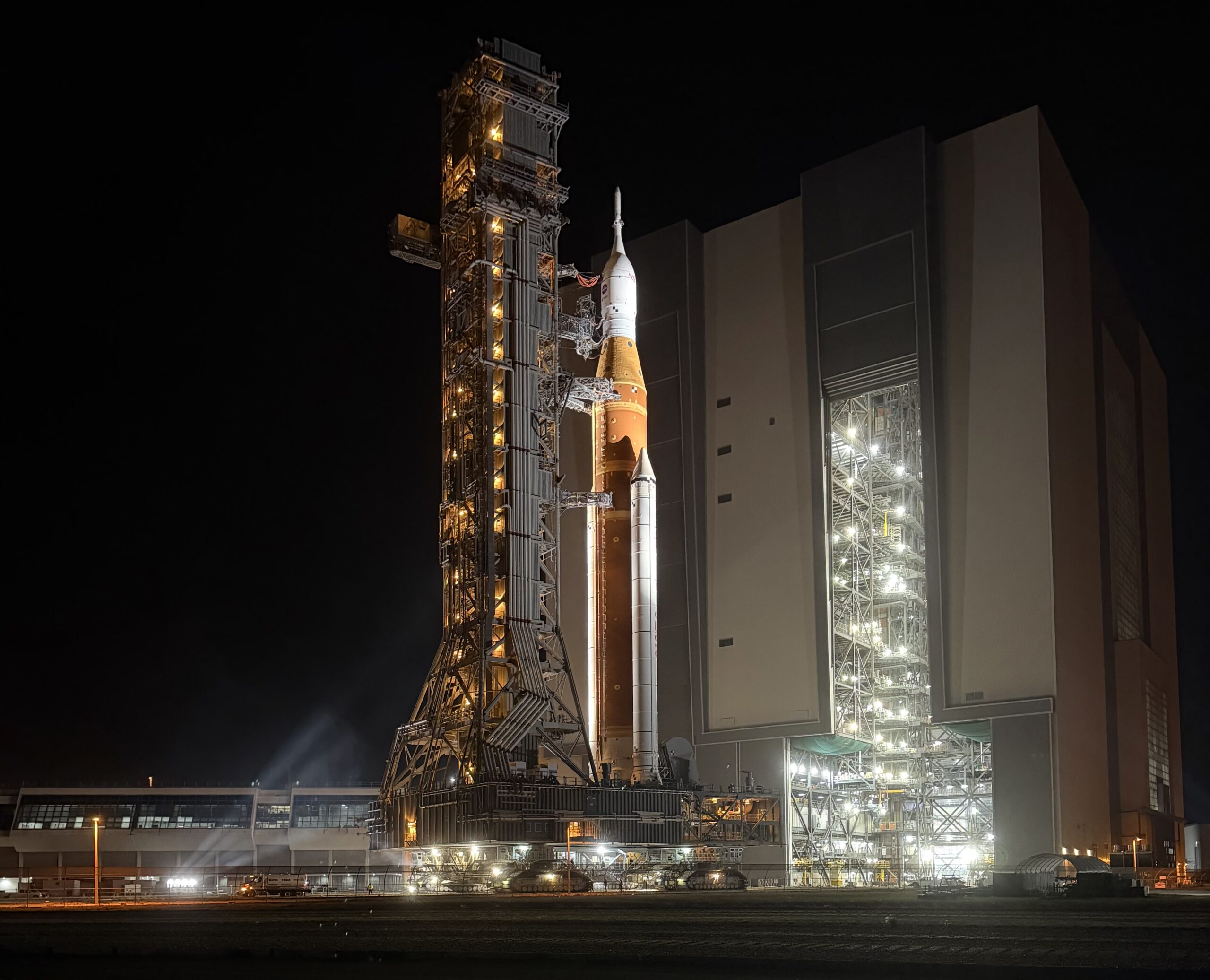
For its first crewed spaceflight beyond low-Earth orbit since 1972, NASA plans to evaluate a range of technologies and techniques — from life support systems to manual spacecraft control — critical to the Artemis IV landing and other future lunar expeditions.
“This is an exciting time to fly humans around the moon for the first time in over 50 years, send them further than any humans since Apollo 13, and continue paving the road of human exploration to the moon and beyond,” NASA’s Norm Knight, director of the Flight Operations Directorate, said during a March 12 press conference following the flight readiness review for Artemis II.
The 10-day mission is scheduled to commence April 1. The agency ruled out opportunities in February and March so it could troubleshoot the hydrogen leaks and helium flow interruptions the SLS experienced during prelaunch tests, the first of which emerged during an early February wet dress rehearsal on the launch pad. Teams were able to address the leaks on the pad, but had to roll the rocket back to the Vehicle Assembly Building at NASA’s Kennedy Space Center to resolve the helium issues. The rocket returned to the pad on Friday.
On launch day, SLS will loft an Orion capsule carrying NASA astronauts Reid Wiseman, Victor Glover and Christina Koch, and Canadian astronaut Jeremy Hansen to orbit. From there, the crew is to loop around the moon, traveling farther from Earth than any human has ever ventured.
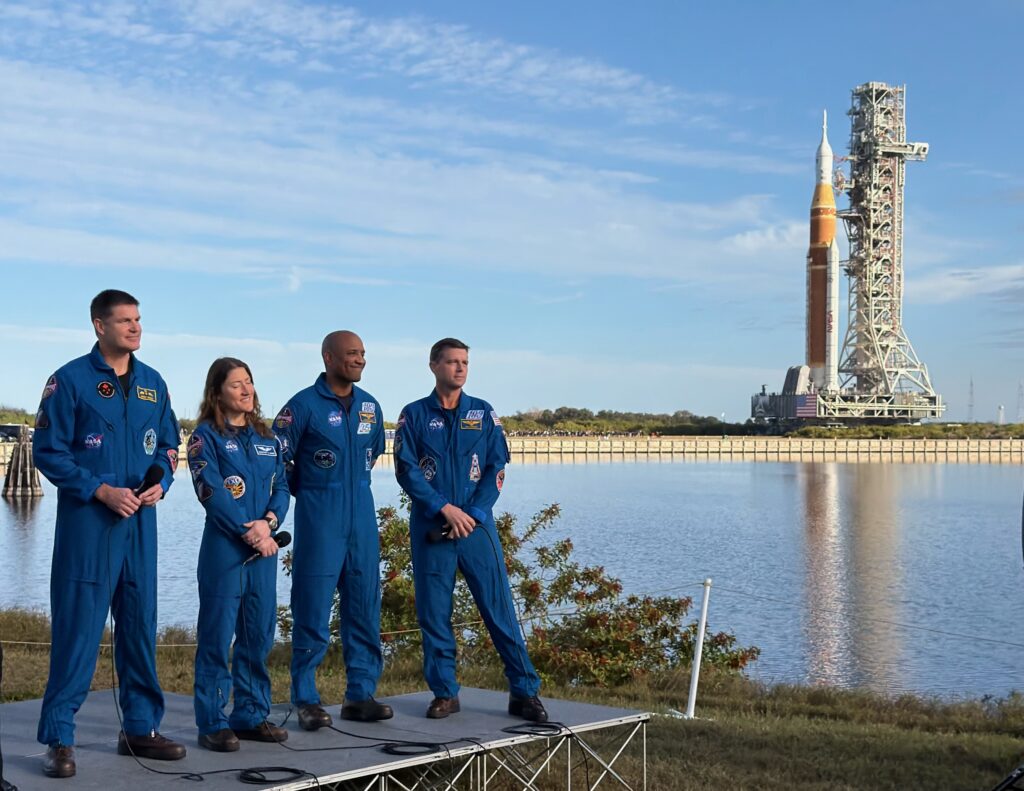
The mission plan includes dozens of objectives, but for the crew, success boils down to whether their flight paves the way for the return of U.S. astronauts to the lunar surface, Hansen said during a press conference last year. That inaugural landing was to occur on Artemis III, but NASA in late February converted that mission to a crewed docking test in low-Earth orbit. Plans call for conducting Artemis III in 2027 to prepare for a 2028 landing with Artemis IV.
The goal is “getting back to the surface for our astronauts. And so, when we do all this training, all this preparation, we are buying down all this risk. And we’re always thinking about, what are we handing off to the next crew?” Hansen said.
Artemis II will be Orion’s second journey to deep space, but the first in this precise configuration. The unoccupied capsule that flew around the moon in 2022 for the Artemis I demonstration had thermal control and other cabin environmental systems, but not the full life support suite required when astronauts climb aboard.
These life-sustaining technologies include a new air purification system to supply oxygen while removing carbon dioxide and humidity generated by astronaut breathing — NASA’s Environmental Control and Life Support System. Other upgrades from the Apollo and space shuttle days include a Laser Air Monitor System to gauge air quality and autonomous life support capability, should astronauts become disabled.
Similar features were built into SpaceX’s Dragon and Boeing’s Starliner capsules, but Orion, built by Lockheed Martin, is the first NASA deep spacecraft with such capabilities.
Unlike the Apollo capsules and other previous spacecraft, Orion’s carbon removal will be derived from reusable filters. These scrubbers, formally known as the Carbon Dioxide and Humidity Control filters, make use of an ammonia-derived solvent to remove the carbon and humidity.
There are three such renewable CHC units on board. One or two will be in use at any time, while a third will be exposed to the vacuum of space. That exposure will vent the carbon and humidity, rendering the scrubber ready for use again, Paul Boehm, NASA’s Orion crew support and thermal systems functional area manager, said in an email.
“The CO2 removal system is a regenerable system based on the previous shuttle system but has been significantly redesigned to reduce mass and volume for the system itself and for the consumables,” Boehm said.
On the space shuttle orbiters, for instance, expendable chemicals were used to remove carbon dioxide. “For perspective, these chemicals took up the volume of nearly 143 basketballs. Orion’s system will take up the space of only 16 basketballs and weigh 100 pounds less,” Boehm said.
A few hours into the mission, Wiseman and Glover are slated to take Orion’s controls and manually fly the spacecraft in a “proximity operations” demonstration. The capsule is to first separate from the SLS upper stage, then the astronauts will test Orion’s handling, dual pilot stick controls and thrusters while near the spent stage.
“We’re going to fly it by hand, and we’re going to make sure that the flying qualities of the Orion spacecraft are suitable for the more complex missions,” Glover said during a September press conference. Artemis III will test this maneuver more extensively, having Orion dock with one or both of the commercial landers in development — a SpaceX Starship and Blue Origin Blue Moon — in low-Earth orbit, as a practice run for Artemis IV. For that mission, Orion must dock with the lander in lunar orbit so the astronauts can transfer into that vehicle for their descent to the surface.
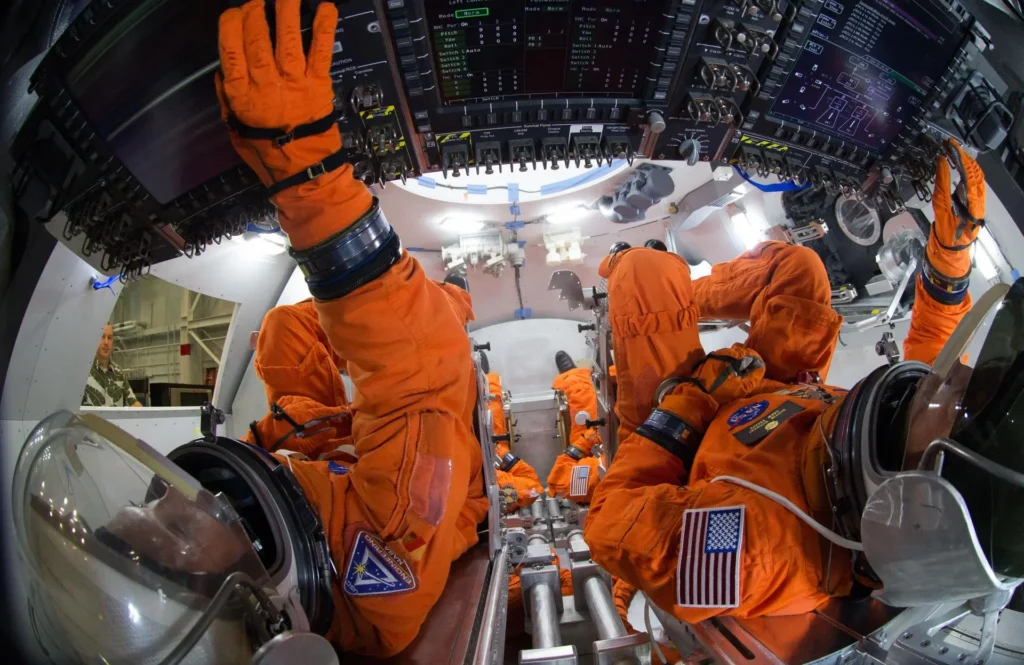
The astronauts will use two different hand controllers — rotational and translational — to steer Orion. The shuttles had similar controllers, but NASA said Orion’s are almost entirely integrated with software, and the crew can tap into advanced lidar and cameras.
Also, Orion’s flight deck display is relatively streamlined, compared to that of the shuttle, noted Blaine Brown, Lockheed Martin’s director of Orion mechanical systems. The capsule has 62 buttons and switches, whereas “shuttle had 2,000.”
One of the final tests for Orion will come near the end of the mission. The heat shield on the bottom of the capsule, comprised of blocks of a silica fiber and resin mixture called AvCoat, must absorb the extremely high temperatures generated during the plunge through Earth’s atmosphere.
This reentry trajectory will differ from Artemis I’s “skip” maneuver, in which the capsule dipped into the upper atmosphere and back out in an attempt to reduce heating and acceleration before the final descent. NASA determined this maneuver caused gas and pressure to build up inside the heat shield’s outer layer, leading to the loss of more material than expected as Orion streaked through the atmosphere, encountering temperatures up to 2,760 degrees Celsius (5,000 degrees Fahrenheit) and top speeds of about 40,000 kilometers per hour.
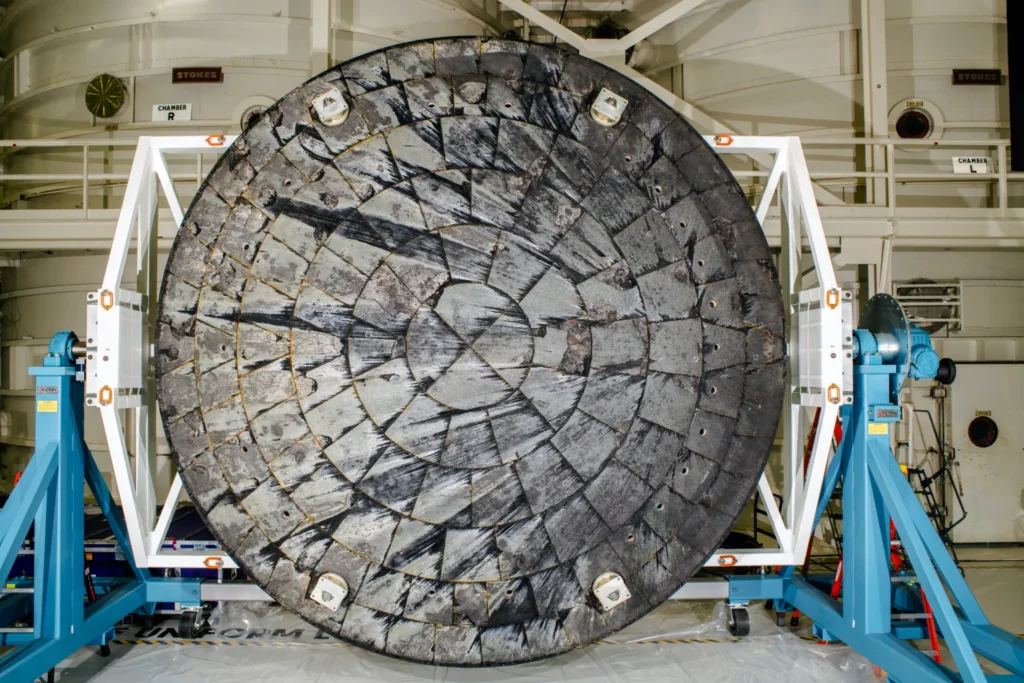
Those high temperatures were not felt within the capsule, and the shield otherwise worked as intended, NASA concluded via analysis of the onboard sensors and extensive simulations. But the agency doesn’t want the phenomenon to repeat with astronauts on board, so the Artemis II reentry will be faster and steeper, allowing a brief period of peak temperature that is expected to create ideal conditions for the heat shield ablation. Lockheed Martin is modifying the heat shield manufacturing process for future capsules, starting with the one intended for Artemis III.
The astronauts have previously expressed confidence in the heat shield updates, and those fixes were also a topic of conversation in the March readiness review. The two-day review concluded with a pause for reflection in case anyone had last-minute concerns about the mission, said John Honeycutt, chair of the Artemis II Mission Management Team.
“At the end, we spent a little bit of quiet time giving people plenty of time to come to the table and share any dissenting concerns, and there were none,” Honeycutt told reporters.