




NASA says it’s found likely signs of ancient life on Mars


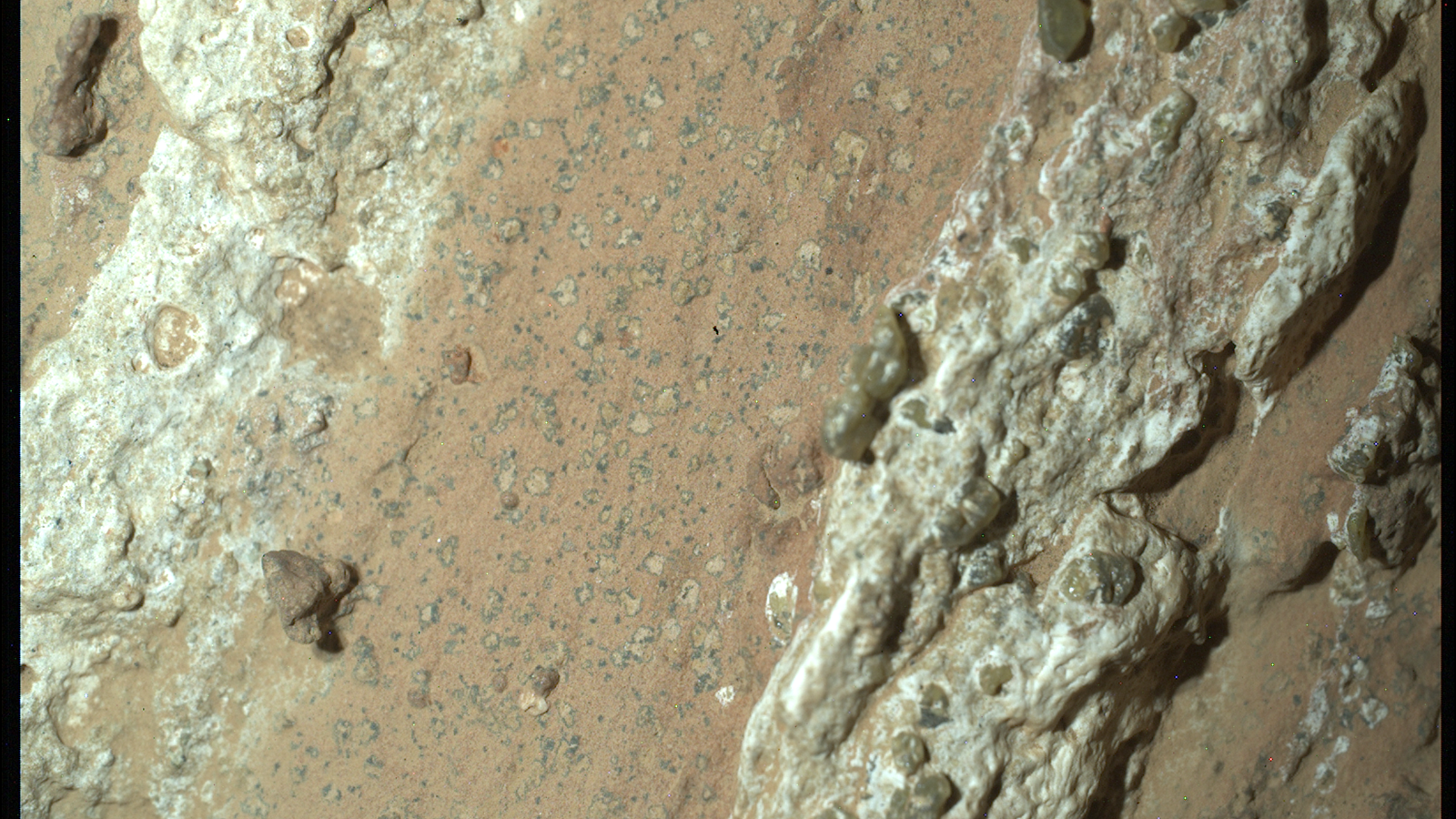
NASA scientists have detected a possible biosignature in a sample of this Martian rock, collected last year by the Perseverance rover from a riverbed in the Jezero Crater. Credit: NASA/JPL-Caltech-MSSS
NASA scientists think they have found the likeliest evidence yet of the existence of past life on Mars in the form of a speckled rock collected in July 2024 by the Perseverance rover.
The likeliest explanation so far for the markings that resemble poppy seeds and leopard spots is excretion by a microorganism, officials told reporters during a press briefing Wednesday, the same day the team published in its paper, “Redox-driven mineral and organic associations in Jezero Crater, Mars,” in the journal Nature.
In 2021, Perseverance began trundling over the 45-kilometer-wide Jezero Crater, where features of the landscape indicate that two ancient rivers emptied into a lake. The rover is collecting samples of Mars dirt and rocks, or regolith, in tubes in the hope that another mission will follow in its tracks to pick them up and return them to Earth for more analysis.
Meanwhile, Perseverance’s science team makes limited observations with the rover’s onboard instruments. When it came to the spotted rock sample, “scientists immediately knew it was interesting,” said Nicky Fox, associate administrator of NASA’s Science Mission Directorate. “We hadn’t seen anything like that before on Mars.”
After distributing images and other findings and following the paper’s peer-review process, the agency has made its conclusion. “This finding by our incredible Perseverance rover is the closest we’ve actually come to discovering ancient life on Mars,” Fox said.
Fox characterized the discovery as “a signature. It’s a sort of leftover sign.” It “could have been from ancient life … something that was there billions of years ago, nothing that’s currently there.”
The rock is about 3.5 billion years old, the officials said, roughly the timeframe of life emerging on Earth. On Earth, “this is the kind of signature that we would see that was made by something biological,” Fox said. “In this case, it’s kind of the equivalent of seeing … leftovers from a meal, and maybe that meal has been excreted by a microbe.”
The ancient river valley where Perseverance picked up the sample would have been “filled with rushing rivers carrying mud, sand and gravel from outside the crater” 3.5 billion years ago, said Katie Stack Morgan, deputy project scientist for Perseverance.
The lakes and rivers dried up, revealing rocky features the researchers targeted for exploration, including a rock formation with “layers of very fine grained, rusty red mud stone that had in them these incredible features, these things that we took to calling poppy seeds, which are the sort of dark black spots on the rock, and leopard spots, which are these kind of ring-shaped features that have dark rims around them,” said Joel A. Hurowitz, lead author of the paper. “These textural features told us that something really interesting had happened in these rocks. Some set of chemical reactions occurred at the time they were being deposited.”
An examination by the rover’s SHERLOC instrument — short for Scanning Habitable Environments with Raman & Luminescence for Organics & Chemicals — provided an important clue, Hurowitz said. Spectral readings from SHERLOC provided a “smoking-gun indicator for the presence of organic matter in this mud.”
Chemical examination with Perseverance’s PIXL instrument – Planetary Instrument for X-ray Lithochemistry – revealed the possible presence of a mineral “that is a sort of combination of mud and organic matter … that when we see features like this in sediment on Earth, these minerals are often the byproduct of microbial metabolisms that are consuming organic matter and making these minerals as a result of those interactions.”
Acting NASA Administrator Sean Duffy said the Trump administration is “looking at how we get this sample back.” The administration has proposed canceling the Mars Sample Return mission because of ballooning costs.