NASA chief: Artemis moon landing is litmus test for ‘American exceptionalism’
 By Cat Hofacker
 By Cat Hofacker
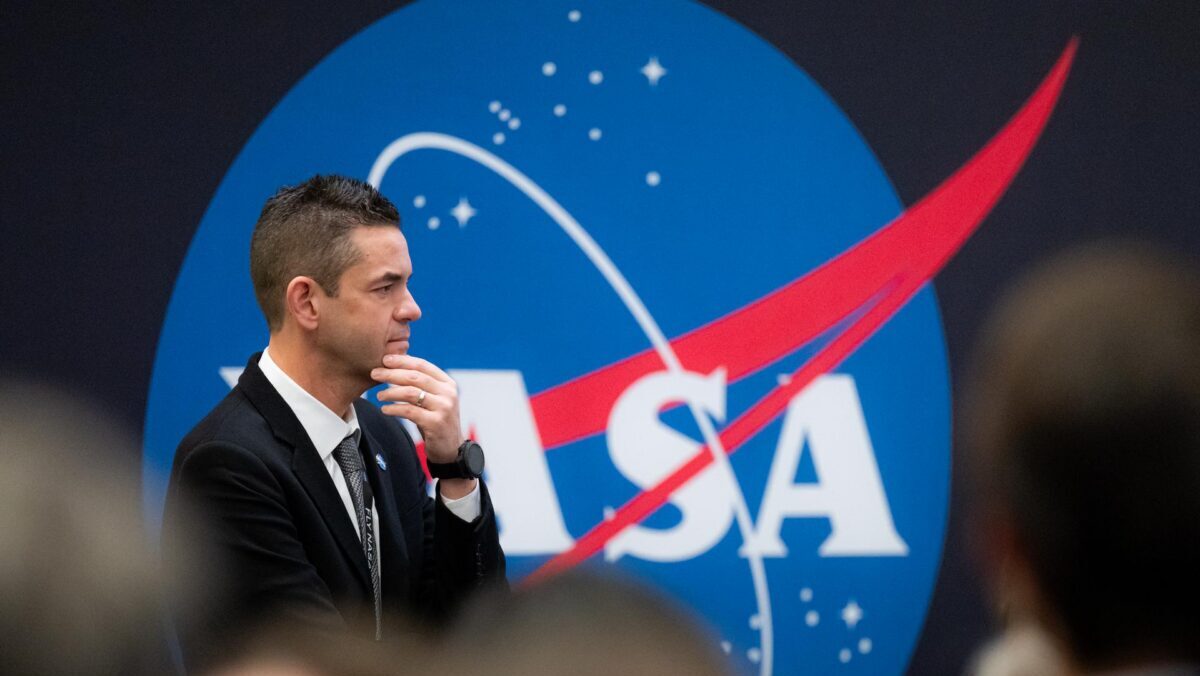
RESTON, Va. — The stakes for NASA’s Artemis lunar program are higher than just returning U.S. astronauts to the surface of the moon, according to Administrator Jared Isaacman. Failure to do so before China lands its own astronauts would “call into question American exceptionalism,” he told a crowd today at the Defense and Intelligence Space Conference here.
A U.S. failure in this area should trigger questions about “what else is broken? What else is wrong?” he said. “I would expect there’d be a lot of congressional hearings on that, because it calls almost everything we are pursuing across all these emerging and important technological domains into question.”
The White House in December delayed the target date for the Artemis III landing to 2028, four years behind the date set when the Artemis program was established during the first Trump administration, and just two years before China’s 2030 target for its own landing.
In some sense, Isaacman said, this competition has incentivized NASA to adapt and shorten its own timelines. “Competition on a geopolitical level is a good thing as well if that causes us to challenge the status quo, which is desperately needed right now, and unleash the potential that we have as a nation.”
The agency last year decided to revisit the contract for the Artemis III lander, awarded to SpaceX in 2021. U.S. lawmakers and observers have voiced concern that SpaceX’s architecture is too complicated because it requires the Starship lander to dock with multiple tanker spacecraft to fill up its fuel tanks with cryogenic methane, a technique that has never been demonstrated on-orbit. NASA in October solicited alternative lander architectures from SpaceX and Blue Origin, the contractor for a future Artemis landing, that reportedly do not require refueling.
Isaacman today emphasized the need to achieve the Artemis III landing as quickly as possible, but noted that on-orbit propellant transfer operations will play a central role in NASA’s long-term goal to establish at least one lunar surface base to achieve a “sustained presence.”
“That will be a light switch moment for humanity,” as well as “a key enabling capability for peaceful exploration of space, but certainly national security reasons,” he said.
Also central to Artemis and other “absolute needle-moving objectives,” he said, is rebuilding internal expertise within the agency, the goal of a workforce directive he issued last week. Within 30 days, NASA center directors are to prepare assessments of which roles and functions currently done by contract employees should be converted to civil servant positions.
“One thing that I thought was rather surprising is — and I don’t know how applicable this is across other government agencies — but 75% of our workforce is contracted,” Isaacman said. That makes sense for some functions, like cybersecurity, he said, but “I would think that when it comes to flight test operations, launching rockets and on-orbit operations, that would be an area of great expertise” for NASA to have in-house.