

Teachers who wish they could bring the International Space Station (ISS) out of orbit and into their classroom can have their wish come true. A group of passionate engineers and educators has done exactly that with ISS Mimic.
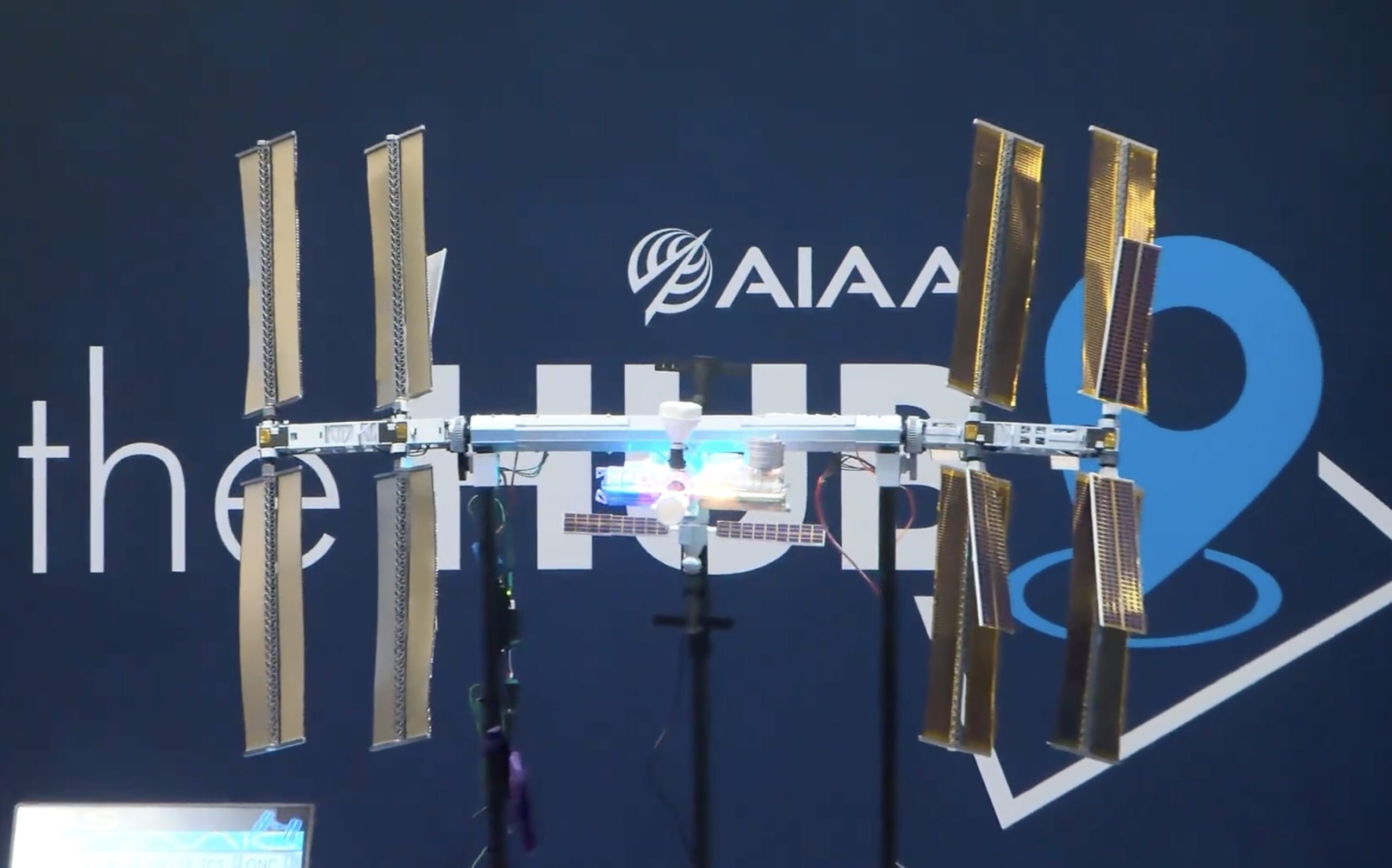
ISS Mimic is an open-source, real-time desktop model of the ISS, designed to strengthen students’ connection with human spaceflight and to embed authentic STEM learning in the classroom. Developed collaboratively by aerospace engineers and K–12 educators, ISS Mimic translates live telemetry, its orbital attitude data, into mechanical motion, providing a tangible demonstration of how the real ISS orients its solar arrays and modules as it orbits Earth.
In a fascinating and fun presentation at a HUB stage during AIAA AVIATION Forum and ASCEND in July, Aymette “Amy” Medina Jorge, Blue Origin astronaut and a middle-school teacher from Odyssey Academy in Galveston, Texas, and Bryan Murphy, associate chief engineer of the ISS and ISS Mimic PL Boeing, describe how the model, “the hardest Lego set ever,” works in tandem with the real ISS above to engage and inspire.
Murphy explained how he came up with the idea. Most students—and even some teachers—feel like space exploration is something happening to other people, he said. His solution is a fully 3D-printed model of the ISS that moves in real time, mirroring the station’s actual orientation as it orbits overhead.
Powered by off-the-shelf electronics (such as a Raspberry Pi and small DC motors), the model has a “slip ring” mechanism, which permits the continuous rotation of the solar arrays without cable entanglement—an elegant microcosm of the full-scale station’s power-transmission solution, Murphy noted. All CAD files, software code, and assembly instructions are published under an open-source license on GitHub, allowing any educator or student organization to reproduce the system. Just download the CAD files, print the parts, wire up a Raspberry Pi or Arduino, and you get a desktop‐sized station that moves along with the real one.
Early prototypes impressed engineers but proved too intricate for busy teachers. In response, the team collaborated with Jorge, the teacher-astronaut who helped refine the design into two scalable versions: the full-scale ISS Mimic and a half-scale “Meta Mimic.” She then developed bilingual instructional materials, including:
• Next Generation Science Standards (NGSS)-aligned lesson plans covering Earth and space science, engineering design, and computational thinking
• Step-by-step build guides, both written and video, tailored to visual learners
• Thematic units that progress from station architecture and CAD modeling to embedded software programming and additive-manufacturing exploration
The partnership between engineers and teachers is what makes it a success. Following a 2023 pilot in schools across Puerto Rico, Mexico, and the continental United States—underwritten by grants from the ISS National Laboratory—the initiative has expanded rapidly, Jorge said. Participating classrooms report heightened student engagement, evidenced by improved design-thinking skills, confidence in coding, and enthusiasm for aerospace careers, she added.
Building a full-scale model from scratch runs only about $1,000 in parts (motors, rails, electronics), though grants have covered that for pilot schools. And beyond the base kit, college students from Houston Community College and Cornell University are designing upgrades that could foreshadow future space-station designs. Jorge’s Blue Origin flight into space exemplifies the project’s ethos: demonstrating to students that spaceflight is attainable for “ordinary” people with STEM proficiency. [https://aerospaceamerica.aiaa.org/institute/aiaa-educator-associate-member-conducts-experiments-on-blue-origin-spaceflight/]
Thus, the presenters said, ISS Mimic represents a scalable way for integrating authentic aerospace engineering into middle- and high-school curricula. By merging live space-station telemetry with hands-on fabrication, coding, and systems analysis, the project demystifies orbital mechanics but also cultivates the skills essential for the future space workforce. Watch this presentation to explore ISS Mimic’s technical architecture, classroom deployments, and community-driven collaborative innovation in greater detail.